Shock Waves That Saved the Universe (Image Credits: Upload.wikimedia.org)
The early universe teemed with equal amounts of matter and antimatter, setting the stage for potential total annihilation. Yet today, matter prevails, forming stars, planets, and galaxies. Researchers now propose that shock waves from exploding primordial black holes provided the crucial imbalance, steering the cosmos toward a matter-dominated existence.[1]
Shock Waves That Saved the Universe
Imagine the universe mere fractions of a second after the Big Bang, a seething quark-gluon plasma where particles collided relentlessly. Primordial black holes, relics of density fluctuations, dotted this hot soup. Their sudden explosions unleashed powerful shock waves that disrupted the symmetry between matter and antimatter.
Alexandra Klipfel, a physicist who presented the idea at the American Physical Society’s Global Physics Summit in Denver on March 18, 2026, described the process vividly. “And that heats up a small sphere of our plasma, very, very hot. It’s a really sharp wall, with different conditions inside and outside the shock.”[1] These blasts occurred within the first tenth of a billionth of a second, injecting immense energy into the surrounding plasma.
The shock fronts created stark contrasts: interiors hotter than 162 GeV, where the Higgs mechanism remained inactive and particles lacked mass, bordered cooler exteriors where masses emerged. Particles crossing this boundary experienced rapid changes, amplified by CP-violating interactions in the early universe physics.
Primordial Black Holes: Tiny Titans of the Cosmos
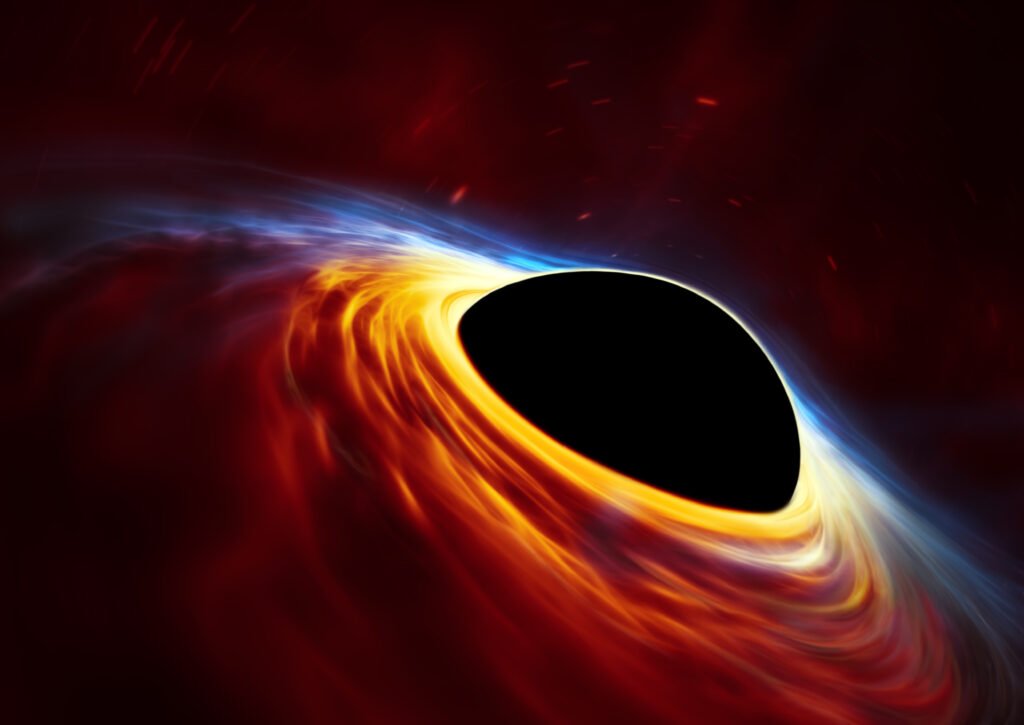
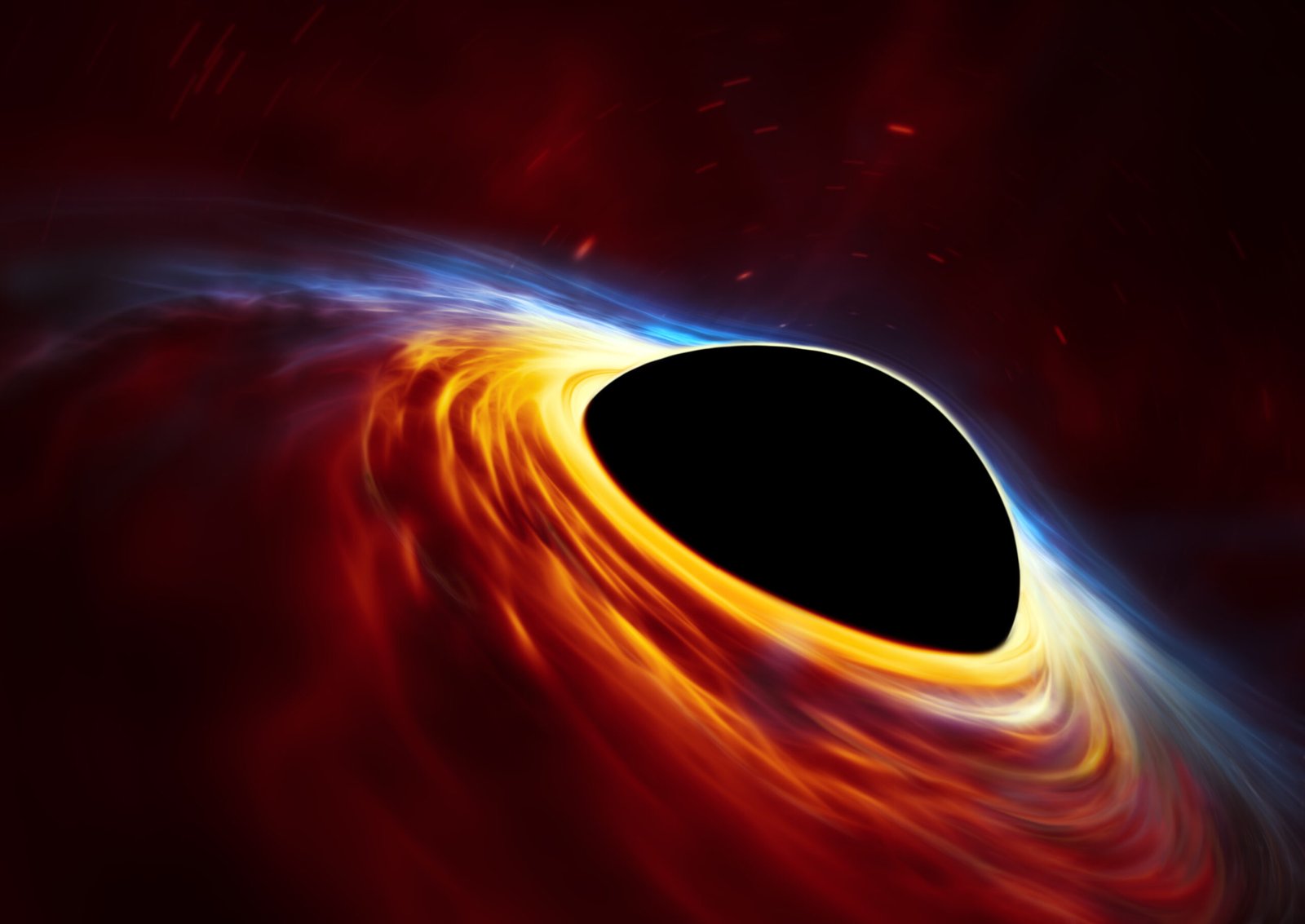
Unlike stellar black holes born from collapsing stars, primordial black holes formed from tiny overdensities in the universe’s first moments. These minuscule objects weighed around a thousand kilograms each. They evaporated through Hawking radiation, steadily losing mass by emitting high-energy particles.
As evaporation accelerated, the black holes reached a tipping point and exploded. Detailed models show these events produced ultrarelativistic shock waves followed by rarefaction waves, forming expanding shells of superheated fluid.[2] The explosions aligned perfectly with the post-electroweak phase transition era, when temperatures hovered around 162 GeV.
- Masses ranged from 10^5 to 10^8 grams, with lifetimes of about 10^{-10} to 10^{-11} seconds.
- Initial energy density fractions as low as 10^{-11} sufficed to influence the plasma significantly.
- Evaporation powered by Hawking radiation, culminating in runaway phase and total disintegration.
- Comoving number densities evolved to match observed baryon asymmetry without overproducing entropy.
- Shocks propagated to radii allowing efficient baryon generation before sphaleron processes could erase it.
The Mechanism Behind Matter’s Edge
At the shock interface, chiral charge built up through CP-violating effects, converting into baryon number. A proposed dimension-5 operator at the TeV scale, involving quarks, Higgs, and a singlet scalar, facilitated this asymmetry. The thin shell of the shock, moving near the speed of sound, locked in the excess before equilibrium restored symmetry.
Calculations reveal the local baryon yield matched observations when scaled by the observed ratio of about 8.65 × 10^{-11}. Multitudes of these explosions integrated over time produced the total baryon-to-entropy ratio we see today. Sphaleron washout proved negligible due to the brief propagation timescales.
The model requires no fine-tuning beyond standard extensions to the Standard Model. It accommodates primordial black hole distributions from Gaussian perturbations, with parameters like α=2.78 and β=2.78 yielding optimal results.
Challenges and Observational Clues
Detecting these long-gone black holes poses difficulties. Theoretical physicist Lucien Heurtier of King’s College London noted, “It’s very difficult to detect their existence in cosmology because they are gone. They have been gone for a while.”[1]
Recent papers underpin the theory: one on shock dynamics (arXiv:2603.15746) and the baryogenesis mechanism (arXiv:2603.29024).[1] Future gamma-ray observations might indirectly support primordial black holes through Hawking radiation signatures, though explosions predate Big Bang nucleosynthesis.
Transient matter domination from these black holes remains consistent with cosmic microwave background data. The framework also hints at connections to dark matter candidates if similar populations persisted.
Key Takeaways
- Exploding PBHs generated shock waves restoring electroweak symmetry locally, sourcing baryon asymmetry via CP violation.
- Observed η_B = 8.65 × 10^{-11} emerges naturally with TeV-scale physics and PBH fractions around 10^{-11}.
- Mechanism operates post-EWPT, pre-BBN, evading washout and overproduction issues.
This theory transforms our view of the infant universe, revealing how fleeting explosions sculpted its fate. Without them, annihilation would have left a barren expanse of radiation. What implications might this hold for beyond-Standard-Model physics? Share your thoughts in the comments.