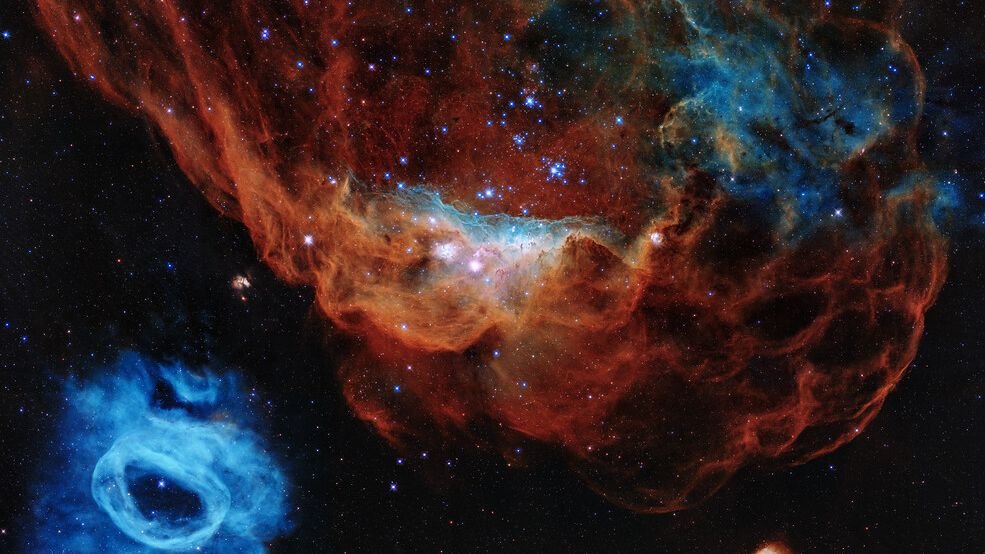
New AI algorithms are 95% better at showing how the universe changes over time – Image for illustrative purposes only (Image credits: Flickr)
Astrophysicists have developed a novel set of AI algorithms that dramatically improve the precision of modeling how the universe evolves over time. Known as GAME, or Genetic Algorithms with Marginalised Ensembles, this technique addresses longstanding challenges in reconstructing subtle changes in cosmic expansion rates.[1]
Traditional methods often faltered when pinpointing rates of change, but GAME’s ensemble approach delivers a 95% leap in accuracy for these critical derivatives, opening doors to clearer insights into the cosmos’s behavior.[1]
Overcoming the Fog of Traditional Genetic Algorithms
Genetic algorithms have long served as powerful tools in astrophysics, mimicking natural evolution to find optimal fits for complex cosmic data. Researchers fed these algorithms vast datasets on galaxy distributions and expansion histories, but the results proved frustratingly imprecise for derivatives – the rates at which cosmic quantities shift.[1]
These methods excelled at overall curve fitting yet produced wobbly outputs when scientists needed sharp details on acceleration or deceleration. Uncertainties clouded the picture, much like viewing distant stars through foggy lenses, limiting the ability to test competing models of dark energy and matter.[1]
GAME’s Ensemble Power: Multiple Minds, One Clear Vision
The GAME framework introduces a squad of algorithms working in parallel, each exploring different paths to the same solution. Ensemble averaging then combines their outputs into a weighted consensus, prioritizing those that best match the data while favoring smoother functions.[1]
This marginalization technique accounts for correlations across solutions, reducing fragility in derivative calculations. Paul Sutter, a research professor at SUNY Stony Brook University and the Flatiron Institute, detailed the method in a recent preprint, highlighting its potential to act as a “council of cosmic detectives.”[1]
By running multiple iterations simultaneously, GAME avoids getting trapped in suboptimal local fits, yielding robust reconstructions of non-observable quantities like expansion histories.
Quantifiable Leaps: From 20% to 95% Accuracy Gains
Tests on synthetic functions revealed GAME’s edge clearly. Overall reconstruction accuracy improved by 20%, a solid gain, but the real breakthrough came with derivatives, where precision surged 95% over standard genetic approaches.[1]
Early applications to real data, such as cosmic chronometers – galaxies serving as natural clocks – produced Hubble constant estimates consistent with the standard cosmological model. These chronometers measure expansion rates independently, offering a benchmark for the algorithm’s reliability.[1]
| Aspect | Traditional Genetic Algorithms | GAME Algorithms |
|---|---|---|
| Overall Accuracy | Baseline | 20% improvement |
| Derivative Precision | Often wobbly and uncertain | 95% better |
| Approach | Single evolutionary path | Ensemble averaging with weighting |
This table underscores the shift from fragile single-model fits to ensemble-driven clarity, equipping scientists with tools for finer-grained analysis.[1]
Unlocking Future Cosmic Mysteries
As observatories like the Dark Energy Spectroscopic Instrument generate floods of galaxy maps and spectroscopic data, GAME stands ready to process it all. The algorithm enables model-independent tests, helping discern whether dark energy behaves as predicted or harbors surprises.[1]
Beyond expansion rates, its versatility promises applications in galaxy formation simulations and large-scale structure analysis. Researchers anticipate integrating GAME with upcoming datasets to probe tensions in current models, such as discrepancies in Hubble measurements.[1]
The full details appear in the preprint “Genetic Algorithms with Marginalised Ensembles,” submitted earlier this year.[1]
With GAME, astrophysicists move closer to a crisper portrait of the universe’s dynamic history, one precise derivative at a time. This advancement not only refines today’s models but equips the field to tackle tomorrow’s data deluge head-on.