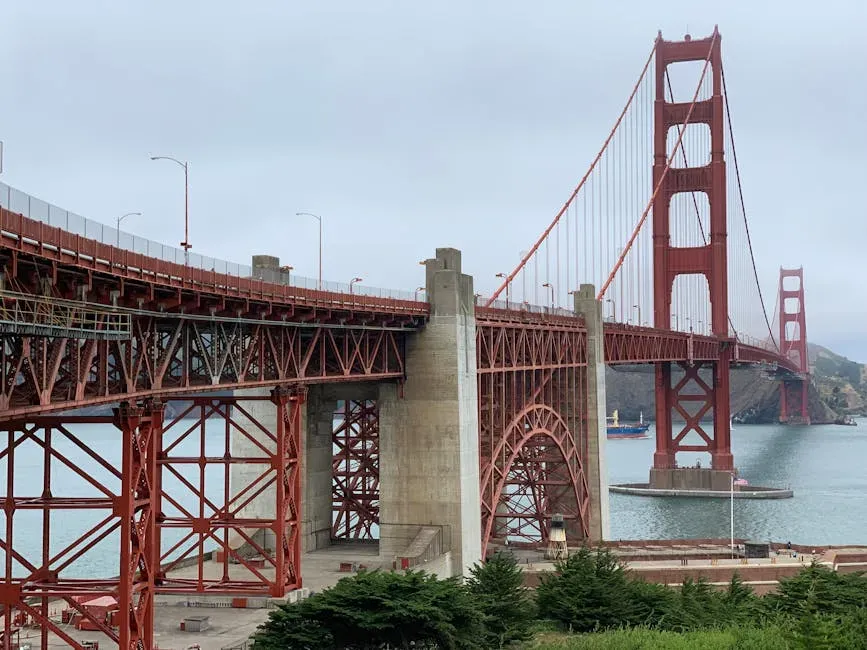
If you live anywhere near the Golden Gate Bridge, you probably remember the first time you heard it: that eerie, otherworldly hum drifting across the bay like the soundtrack to a sci‑fi movie. It was unsettling, beautiful, and frankly a little unnerving to hear a world‑famous landmark suddenly start to sing. For a structure that has stood since 1937, surviving earthquakes, storms, and endless traffic, a brand‑new voice felt like a plot twist nobody saw coming.
What makes this story fascinating is that the sound is not a glitch or a sign of imminent disaster, but a side effect of deliberate engineering meant to protect the bridge from extreme winds. In other words, the Golden Gate started “talking” precisely because humans tried to make it safer. Engineers have been treating this as a serious puzzle: What exactly is the bridge doing, why now, and how do you quiet something this big without breaking what you just fixed? The answers are surprisingly subtle, scientific, and a little bit poetic.
The Day the Golden Gate Started to Sing

On a windy day in early June 2020, people across San Francisco and Marin suddenly started hearing a long, steady tone sweeping in from the direction of the bridge. Some compared it to a ghostly organ, others to an air‑raid siren stuck on one drawn‑out note. The sound could carry for miles under the right conditions, riding on the same wind that was causing it in the first place. It was not a short, mysterious blip; during strong wind events, the hum could last for hours.
What made it so unsettling was that long‑time residents had never heard anything like it before. The Golden Gate Bridge had always creaked, rattled, and thrummed like any massive steel structure, but this was different: clean, tonal, almost musical. The timing was suspicious too. The hum appeared right after a major retrofit on the bridge’s west‑side railings and wind fairings, work that was done to help the bridge stand up to stronger, more turbulent winds. Locals quickly connected the dots: something about that upgrade had turned the Golden Gate into a gigantic unintended instrument.
How a Wind Retrofit Accidentally Gave the Bridge a Voice

The project that changed everything was not cosmetic; it was about survival. Engineers had been working for years on a wind retrofit to make sure the Golden Gate could safely handle more powerful storms and higher average wind speeds in the future. A key part of that plan involved replacing older railings on the west sidewalk with thinner, more aerodynamic stainless‑steel slats. The goal was clear: let more wind slip through, reduce the load on the structure, and prevent destructive oscillations in extreme conditions.
This is where the irony kicks in. By making the railings more streamlined for big, dangerous wind events, the design also made them more sensitive to a different kind of interaction with the airflow. In wind‑tunnel tests, the possibility of a hum was noted, but the real‑world intensity turned out to be stronger and more noticeable than anticipated once the full bridge and full Bay Area wind field got involved. In simple terms, the new railing did its main job – protecting the bridge from dangerous wind forces – but it also created a perfect setup for sound, much like tightening a reed in a woodwind instrument and suddenly discovering it can play much louder than you expected.
The Science of a Singing Bridge: Aeolian Tones and Giant Reeds

So what is actually happening when the Golden Gate Bridge “sings”? At its core, this is a textbook example of something called Aeolian tones – sounds produced when wind flows past a sharp edge or through a regular pattern, like slats or wires. Think about the low whistle you hear when wind squeezes through a slightly open window, or the way a set of wires on a fence can hum on a gusty day. Scale that up to thousands of identical, closely spaced metal slats, and you begin to get the idea.
As fast wind moves through the new railing, it sheds little vortices – tiny swirling eddies of air – at a rate that lines up with certain natural frequencies of the slat edges. When that shedding becomes regular, the pressure fluctuations add up and produce a steady tone. Under some conditions, the bridge generates a lower, more distant hum; under others, a higher, more piercing sound that nearby residents find harder to ignore. From a physics perspective, the Golden Gate has effectively become the world’s biggest metal reed instrument, with the Bay Area wind playing it whenever it hits the right speed and direction.
Inside the Investigation: Cameras, Wind Tunnels, and Full‑Scale Models
Once the sound started attracting attention, the response was not just hand‑waving explanations. The bridge district brought in specialized teams in bridge aerodynamics and acoustics and began a systematic investigation. Engineers used “sound cameras” on the sidewalks during high‑wind days to map exactly where on the structure the noise was coming from. Those measurements confirmed that the source was not the main cables, not the roadway, but specifically the new west‑side railings, with their slender vertical slats acting as noise generators.
To really understand the problem – and test potential fixes without risking the real bridge – they built full‑scale segments of the railing and put them in a wind tunnel. There, they could dial in wind speed and direction and watch how the airflow separated, which frequencies were excited, and how different tweaks changed the sound. The tests showed that there were at least two distinct tones associated with different wind angles and speeds, both tied to the precise geometry of the slats and their edges. This was not random rumbling; it was a repeatable, measurable aerodynamic phenomenon that could be turned on and off in a controlled lab setting.
What Engineers Can (and Can’t) Change Without Risking the Bridge
From the outside, the obvious solution might seem simple: just bolt something on, cover the edges, or make the slats thicker until the noise goes away. In reality, every proposed fix has to pass a brutal test: it must not undo the very aerodynamic benefits the retrofit was designed to provide. The Golden Gate is not just a postcard; it is a highly stressed suspension bridge in an exposed, windy location, and anything that increases drag or alters its wind response could be a serious safety problem in future storms.
That constraint forced engineers to think in terms of subtle tuning instead of big, blunt changes. Options studied included tiny U‑shaped clips over the slat edges, textured coatings to break up smooth airflow, tapes or inserts that slightly disrupt the regular vortex shedding, and added damping in certain elements to soak up vibrations before they organize into a tone. None of these are dramatic from a distance; you would barely notice them on a casual walk. But at the scale of airflow, even millimeter‑level tweaks can be the difference between a howling note and almost complete silence.
Is the Sound Dangerous – or Just Annoying and Unforgettable?

Whenever people hear a huge structure making a strange new noise, the first fear is obvious: is this a warning sign that something is about to fail? In the case of the Golden Gate’s hum, the consensus among engineers has been that the sound is a by‑product of surface‑level vibrations in the railings, not a symptom of deep structural distress. The frequencies involved are relatively high compared to the big, slow motions that engineers worry about with catastrophic resonance in long bridges. In other words, it is loud to human ears but not the kind of vibration that threatens the integrity of the main cables or towers.
That does not mean it is harmless in every sense. Noise pollution is real – for people and for wildlife – and a steady tonal sound that can be heard over neighborhoods is understandably frustrating. Some residents find it fascinating or even comforting, but many more find it grating, especially at night or during prolonged wind events. The challenge, then, is balancing engineering reality with community expectations: the bridge is functioning safely and as designed in terms of wind performance, yet its new audible personality feels intrusive. That tension is why, even if the bridge is not in danger, officials have treated the hum as a problem worth spending real time and money to mitigate.
Why This “Mystery Hum” Says a Lot About Modern Infrastructure

What I find most interesting about this whole saga is how it exposes the trade‑offs baked into modern infrastructure. We want iconic structures like the Golden Gate to last through stronger storms, shifting climate patterns, and heavier usage, but we also want every upgrade to be invisible and consequence‑free. The reality is that when you push the limits of aerodynamics and materials on something this large, sometimes you end up uncovering new side effects – like a bridge that suddenly acquires a voice after eight decades of relative silence.
There is also something humbling here for engineers: extensive modeling, historic experience, and sophisticated wind‑tunnel tests did identify the possibility of sound, but the real‑world experience still surprised people with its intensity and reach. That gap is not a failure so much as a reminder that complex systems living in the messy, turbulent atmosphere will always do a few things we did not fully predict. To me, the right response is not panic but curiosity and honesty – acknowledging the limits of our models and then improving them, even if it means admitting that the bridge taught us something we did not know.
Conclusion: A Giant Red Lesson in Listening to Our Bridges

In my view, the Golden Gate’s strange new song is less a horror story and more a strange, slightly inconvenient gift. It forced everyone – engineers, officials, and the public – to pay closer attention to how a familiar structure behaves in a changing world. Yes, the hum is annoying for many people, and yes, it should be quieted as much as practical. But it also represents a real‑time lesson in aerodynamics, design trade‑offs, and the messy overlap between physics and everyday life that no classroom lecture could match. This is what happens when you upgrade a legendary bridge for harsher winds: sometimes it talks back.
If anything, I think the story argues for more transparency and more curiosity around infrastructure. When a bridge starts to sing or a building sways more than expected, we should not jump straight to fear or denial; we should ask what the behavior is telling us and how we can refine our designs without pretending surprises will never happen again. The Golden Gate Bridge’s new voice may eventually be muffled by careful tweaks and quiet hardware, but the lesson should linger: even our most iconic structures are still experiments in the real atmosphere. The real question is whether we’re willing to listen when steel and wind start having a conversation – would you have guessed a bridge could become an accidental musical instrument just because of a few centimeters of metal?