Articles for tag: Astrobiology, cosmic radiation, Deep Space, Supernova

a bright blue and red star surrounded by stars

A Supernova From Deep Space May Have Altered Evolution on Earth

Suhail Ahmed

The idea sounds like science fiction: a distant star explodes, and millions of years later, life in Earth’s oceans and on land subtly changes course because of it. Yet over the last decade, a convergence of astrophysics, geology, and biology has turned that wild notion into a serious scientific discussion. Radioactive fingerprints in deep‑sea rocks, ...

blue sky with stars during night time

Huge Meteor Impact 3 Billion Years Ago May Have Spurred Evolution

Suhail Ahmed

  Picture Earth three billion years ago: no forests, no animals, no blue sky as we know it – just a restless ocean world under a dimmer Sun. Into that fragile, microbial planet, a rock from space the size of a small city may have slammed down with unimaginable force, boiling oceans, shaking continents, and ...

an artist's rendering of a red planet in space

Titan vs. Earth: A Tale of Two Atmospheres

Suhail Ahmed

Two worlds share one cosmic stage: one blue and breathing, the other copper and cryptic. Earth’s sky feels familiar – wet, windy, oxygen-rich – while Titan’s is a slow-motion laboratory where sunlight drips through haze and methane stands in for water. The mystery isn’t just how different these atmospheres are, but why they arrived at ...

an aerial view of a colorfully colored landscape

Signs of Ancient Life? Thick Clay Layers on Mars Could Hold the Answer

Suhail Ahmed

Imagine standing on the rust-colored desert of Mars. The dust swirls around your boots as your gaze falls upon a rugged cliffside layer upon layer of hardened clay, each stratum whispering secrets from billions of years ago. Could these silent bands of rock hold evidence that life once stirred on the Red Planet? Recent findings ...

a planet in space

How Will We Know We’re Not Alone?

Suhail Ahmed

  Somewhere beyond the planets we know, past the frozen rubble of Pluto’s realm, something is tugging at our solar system’s edge. Astronomers see its fingerprints in the strange orbits of distant icy worlds, like chairs in a room nudged out of place by an unseen guest. They suspect a new kind of neighbor: a ...

The Universe's Most Extreme Environments and How Life Survives Them

The Universe’s Most Extreme Environments and How Life Survives Them

Jan Otte

You know that feeling when someone tells you life can only exist in just the right conditions? Yeah, turns out that’s not quite the whole story. Life has this incredible talent for showing up in places where, honestly, it has no business being. We’re talking about environments that would vaporize, freeze, or crush most living ...

BENNU’S JOURNEY-Early Earth

Life on Earth-like Planets: Could It Emerge Faster Than We Thought?

April Joy Jovita

A new study suggests that life may emerge rapidly on Earth-like planets once conditions become favorable. By analyzing Earth’s early history and applying Bayesian probability models, researchers propose that abiogenesis—the process by which life arises from non-living matter—could occur much faster than previously assumed. Rapid Abiogenesis on Earth Earth formed approximately 4.5 billion years ago, ...

a close up of a planet with a black background

5 Celestial Bodies That Could Harbor Alien Life (And Why)

Suhail Ahmed

  For the first time in human history, we’re seriously mapping where in our own cosmic backyard life might be hiding – and the shortlist is both thrilling and unnerving. Astronomers and planetary scientists are no longer asking whether alien life is possible, but where the odds are best, and what kind of strange ecosystems ...

Exploring the Cosmos: Potential Life Indicators Found on Exoplanet K2-18b

Jan Otte

New James Webb Telescope data reveals tantalizing hints of biological activity on a distant water world but scientists urge cautious optimism. A Whisper From 120 Light-Years Away The James Webb Space Telescope (JWST) has detected what may be the most promising evidence yet for extraterrestrial life: “This isn’t just another blip it’s a siren call ...

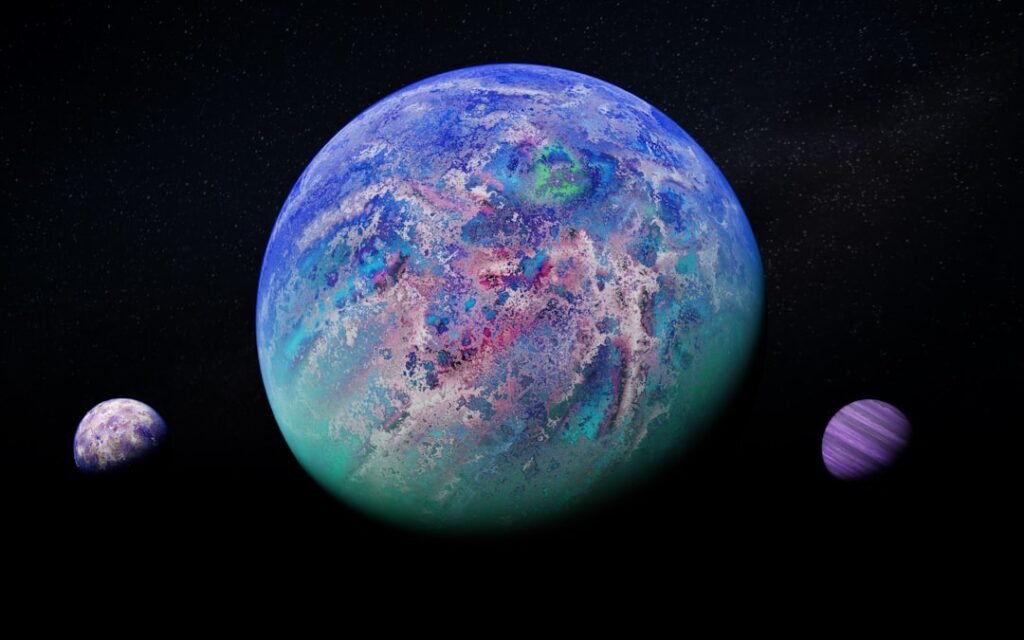
A hycean planet is a hypothetical type of planet, described as a hot, water-covered planet with a hydrogen atmosphere. The presence of extraterrestrial liquid water makes Hycean planets promising candidates for planetary habitability. According to researchers, density data imply that both rocky Super-Earths and Sub-Neptunes can fit this type, and it is thus expected that they will be common exoplanets. Currently there are no confirmed hycean planets, but the Kepler mission detected many candidates. Hycean planets could be considerably larger than what habitable planets were previously thought to be, with radii reaching 2.6 R⊕ (2.3 R⊕) and masses of 10 M⊕ (5 M⊕). Moreover, the habitable zone of such planets could be considerably larger than that of Earth-like planets. The planetary equilibrium temperature can reach 500 K (227 °C; 440 °F) at late M-dwarfs. There could also exist tidally locked 'Dark Hycean' planets (habitable only on the side of permanent night) or 'Cold Hycean' planets (with negligible irradiation). Hycean worlds could be soon investigated for biosignatures by terrestrial telescopes and space telescopes like the James Webb Space Telescope. The term "Hycean planet" was coined in 2021 by a team of exoplanet researchers at the University of Cambridge, as a portmanteau of "hydrogen" and "ocean", used to describe planets that are thought to have large oceans and hydrogen-rich atmospheres. Hycean planets are thought to be common around red dwarf stars, and are considered to be a promising place to search for life beyond Earth. Although the presence of water may help them be habitable planets, their habitability may be limited by a possible runaway greenhouse effect. Hydrogen reacts differently to starlight's wavelengths than do heavier gases like nitrogen and oxygen. If the planet orbits the star at one Astronomical unit (AU), the temperature would be so high that the oceans would boil and water would become vapor. Current calculations locate the habitable zone where water would remain liquid at 1.6 AU, if the atmospheric pressure is similar to Earth's, or at 3.85 AU if it is the more likely tenfold to twentyfold pressure. All current Hycean planet candidates are located within the area where oceans would boil, and are thus unlikely to have actual oceans of liquid water. Hycean planets have hydrogen-rich atmospheres. The atmospheres on Hycean planets are thought to be made up of hydrogen, helium, and water vapor. They are thought to be covered in oceans. The oceans on Hycean planets are thought to be much deeper than the oceans on Earth. They are thought to be common around red dwarf stars. Red dwarf stars are the most common type of star in the Milky Way galaxy. They are considered to be a promising place to search for life beyond Earth. Hycean planets have the ingredients necessary for life, including liquid water, energy, and organic molecules. The discovery of Hycean planets may represent a new frontier in the search for life beyond Earth. These planets are thought to be very different from Earth, but they could still be home to forms of life. Astronomers plan to use telescopes like the James Webb Space Telescope to search for Hycean planets and to learn more about their potential for human habitability. One such candidate planet is K2-18b, which orbits a faint star with a period of about 33 days. It could have liquid water, contains a considerable high amount of hydrogen gas in its atmosphere, and is far enough from its star. It clearly resides in its star’s habitable zone. It is discovered to contain water in its atmosphere. Such candidate planets can be studied for biomarkers. Image created by Pablo Carlos Budassi in 2023 (pablocarlosbudassi.com)

Do Deep Exoplanet Oceans Hide Clues to Life? Exploring Hycean Habitable Zones

Jan Otte

The quest for life beyond Earth has centered for decades on rocky, Earth-like planets, but a new class of enigmatic worlds called Hycean planets may upend this way of thinking about habitability. These ocean-laden exoplanets, cloaked in dense hydrogen atmospheres, could have great hidden seas thousands of miles below their surfaces, and tidal forces and geothermal heat ...