A Cosmic Giant Stirs After Eons (Image Credits: Flickr)
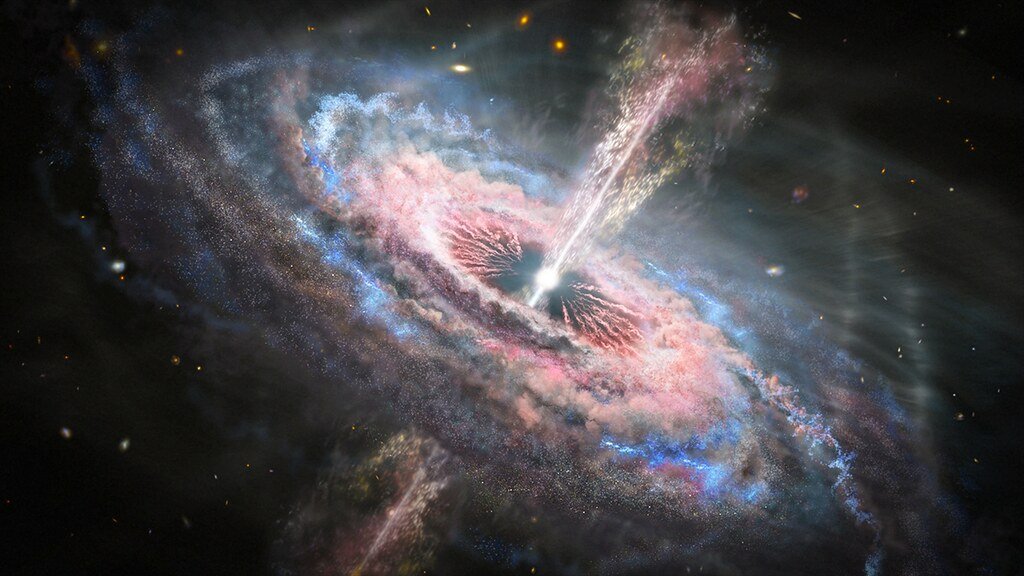
Astronomers recently observed a supermassive black hole in galaxy J1007+3540 roar back into activity following almost 100 million years of silence. Fresh radio images captured powerful jets of magnetized plasma surging from the black hole’s core, where they clashed with the crushing pressure of a surrounding galaxy cluster. This colossal outburst reshaped vast structures across nearly one million light-years, providing a vivid snapshot of intermittent black hole behavior.[1][2]
A Cosmic Giant Stirs After Eons
Radio telescopes unveiled one of the most striking examples of a black hole reigniting its engine. The supermassive black hole at J1007+3540’s heart produced a compact, bright inner jet, signaling its recent awakening. Older remnants from previous eruptions lingered nearby, forming faded plasma cocoons and a faint tail of diffuse emission millions of years old.[1]
Lead researcher Shobha Kumari of Midnapore City College in India described the scene vividly. “It’s like watching a cosmic volcano erupt again after ages of calm – except this one is big enough to carve out structures stretching nearly one million light-years across space,” she stated. This layering of young jets amid exhausted older lobes marked clear evidence of episodic activity.[1]
Trapped in a High-Pressure Galaxy Cluster
J1007+3540 resides within a massive galaxy cluster brimming with scorching hot gas. This environment generated immense external pressure, far exceeding that in typical radio galaxies. As the new jets propelled outward, the cluster’s gas bent, compressed, and distorted them into chaotic forms.[1]
A compressed northern lobe emerged, complete with a curved backflow of plasma shoved sideways by the pressure. The uGMRT observations confirmed an ultra-steep radio spectrum in this region, indicating ancient particles that had lost energy through interactions. Such dynamics highlighted the ongoing battle between black hole outbursts and their surroundings.
- Hot cluster gas creates pressure 10 times higher than average.
- Jets form curved trails and compressed clouds.
- Diffuse tails extend for millions of years, dragged through intergalactic space.
- Plasma ages rapidly, altering radio emissions.
- Multiple cycles reshape the galaxy’s morphology over time.
Advanced Telescopes Uncover Hidden History
Researchers relied on the Low Frequency Array (LOFAR) in the Netherlands and India’s Upgraded Giant Metrewave Radio Telescope (uGMRT). LOFAR’s sensitive interferometry mapped the broad structures, while uGMRT zoomed into finer details like the compressed lobe. These instruments revealed the black hole’s full episodic history, from fresh jets to ghostly old lobes.[1][2]
The findings appeared in Monthly Notices of the Royal Astronomical Society. Sabyasachi Pal, a collaborator from Midnapore City College, noted, “J1007+3540 is one of the clearest and most spectacular examples of episodic AGN with jet-cluster interaction.” Additional experts praised the system’s scale, which allowed detailed dissection of these rare events.[1]
Insights into Black Hole Life Cycles
This discovery illuminated how supermassive black holes flicker on and off over cosmic timescales. Most galaxies harbor such black holes, but few launch the vast plasma jets seen here. Episodic active galactic nuclei like J1007+3540 demonstrated that fuel supply – gas and dust – dictates these bursts, often from mergers or inflows.[2]
The jets influenced star formation in the cluster, either igniting or quenching it through feedback. Observations of these interactions refined models of galaxy evolution. Future studies planned higher-resolution views to track the jets’ propagation.
Key Takeaways
- J1007+3540 showcases multiple eruption cycles, with new jets amid 100-million-year-old remnants.
- Galaxy cluster pressure dramatically distorts plasma structures spanning one million light-years.
- Reveals episodic black hole behavior, aiding understanding of AGN feedback on cosmic scales.
This reborn black hole reminded scientists that cosmic power operates in unpredictable bursts, not steady flows. Continuous monitoring could reveal more about these intermittent giants. What do you think about this cosmic spectacle? Tell us in the comments.