
You have probably heard the phrase spooky action at a distance tossed around as if it were science fiction. Yet in today’s labs, with lasers, superconducting chips, and satellite links, you can watch this “spookiness” show up in real measurements. Quantum entanglement is no longer a philosophical curiosity; it is something you can test, quantify, and even build devices around.
When you look closely at what entanglement really does, you start to see why Einstein was uneasy and why modern physicists pushed so hard to break it. Instead of breaking, it passed every test. If you are willing to let go of a few comforting ideas about how the world should behave, you can see how entanglement proves that nature really does allow a kind of instant connection across distance – subtle, constrained, but undeniably real.
How Quantum Entanglement Actually Works (In Plain Language)
To make sense of entanglement, start with a single quantum particle, like an electron or a photon. Instead of having a definite property before you look, it sits in a blend of possibilities, a superposition, as if it were secretly trying out many values at once. When you measure it, you do not gently reveal what was already there; you help decide which option becomes real for you.
Now imagine creating two particles together in a way that links their properties through the laws of quantum mechanics. Once they are entangled, you can think of them as parts of one shared state, even if you later fly them to opposite sides of the planet. Each particle on its own looks random when you measure it, but when you compare their results, you see a pattern so strong that you cannot explain it by saying they each carried pre-agreed instructions from the start.
Why Einstein Thought Spooky Action Made No Sense
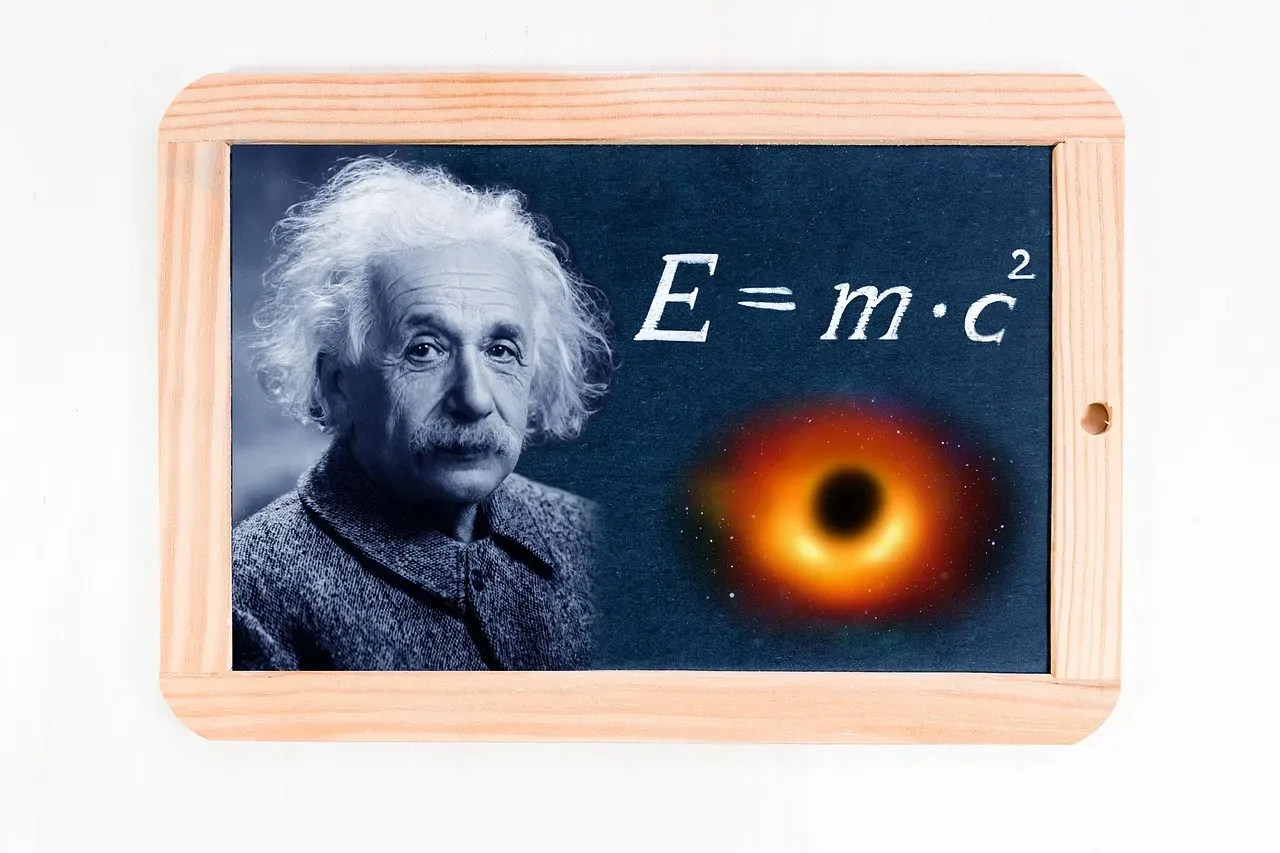
If you feel some resistance to this idea, you are in good company, because Einstein felt the same way. He assumed that when you measure one particle here and instantly know something about its partner far away, you must be revealing a property that was already fixed in both from the beginning. In that picture, there is no instant influence, only hidden details you had not yet uncovered.
Einstein’s deep belief was that distant things should not affect each other faster than light can travel, and that physical properties should exist whether or not you look. From that viewpoint, quantum theory looked incomplete rather than wrong; it seemed to be a clever statistical trick covering up some deeper, more sensible story. Entanglement, to him, was a sign that the current theory had left something crucial out, not a feature to celebrate.
Bell’s Theorem: The Mathematical Trap You Can’t Wiggle Out Of

You might try to rescue Einstein’s intuition by imagining hidden variables, little secret tags each particle carries that decide how it will respond to any possible measurement. This feels reasonable: your measurement here just reveals the tag on your particle, and the distant one reveals its own tag, with no spooky influence required. Both outcomes match up because the tags were coordinated when the pair was created.
Bell’s theorem shows you that this kind of reasonable story cannot match the predictions of quantum mechanics. It lays out an inequality, a sort of mathematical speed limit on how strong the correlations between distant results can be if only local hidden tags are at work. Quantum entanglement predicts correlations that break this limit, and that gives you a clear, testable line between a world with only local causes and a world where something genuinely nonlocal is happening.
Bell Test Experiments: Where Theory Meets the Lab Bench
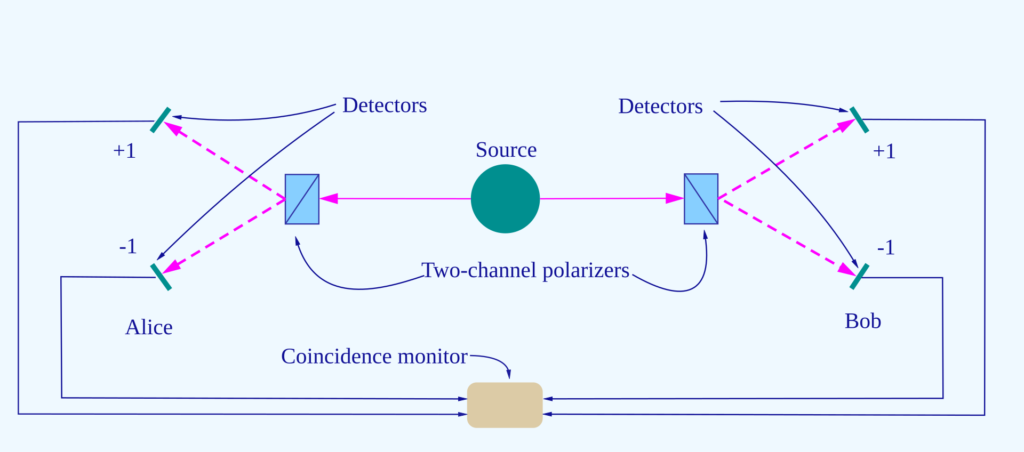
Once you have a theorem, you can head to the lab and see what the universe chooses. In Bell test experiments, you create pairs of entangled particles and send them to two separate measurement stations, often with space-like separation so that no light-speed signal could travel between them in time. At each station, you randomly choose which property to measure, so the particles cannot predict your choice in advance.
When you tally the results over many runs, you find correlations that repeatedly overshoot the limits that any local hidden-variable model allows. Researchers have tightened these tests for decades, closing loopholes like detector inefficiency, communication delays, and even memory effects. Each time you expect that perhaps some sneaky classical explanation will survive, you end up with data that line up with quantum predictions and show that the spooky part is not going away.
What “Nonlocal” Really Means (And What It Doesn’t)

Hearing that entanglement is nonlocal, you might jump to the idea of faster-than-light messaging, as if you could tap a key on one particle and send a Morse code signal to its distant partner. Quantum physics firmly shuts that door: although measurement outcomes are correlated, each side only sees random results locally. You cannot control which result you get, so you cannot encode a usable message into those outcomes.
What nonlocality really tells you is that the joint outcomes of distant measurements cannot be explained by any story where causes are limited to their local neighborhoods and pre-set variables. When you look at the combined statistics, they behave as if the two sides share a single, indivisible description, no matter how far apart they are. You still respect the limit on information transfer set by the speed of light, but you give up the comfort of believing that all physical influence stays neatly within local boundaries.
From Spooky Curiosity to Real Technologies You Can Touch
Once you accept that entanglement is real, you start to see how it can become a resource rather than just a philosophical headache. In quantum key distribution, for instance, you and a partner share entangled particles and use the correlations in your measurements to generate a shared secret key. If anyone tries to eavesdrop, they disturb the quantum link in a way that shows up in your statistics, warning you to discard the compromised data.
In quantum computing, entanglement lets you tie together many qubits so that they explore multiple computational paths at once with coordinated structure. You can picture it as upgrading from a collection of isolated light switches to a complex dimmer network where every setting depends on all the others. Quantum networks aim to use entanglement to link distant nodes, opening the door to new kinds of secure communication and distributed processing that go beyond anything your classical internet can pull off.
What This Means for Your Picture of Reality

Accepting entanglement forces you to rethink what it means for something to have a property in the first place. Instead of imagining particles as tiny billiard balls carrying fixed traits, you start to treat them as parts of a shared quantum state that only reveals definite outcomes when you interact with it. In that view, reality is not a static inventory waiting to be checked off; it is an ongoing process that solidifies differently depending on the questions you ask.
You also have to loosen your grip on the idea that the universe is stitched together purely by local cause and effect. The experimental violations of Bell inequalities tell you that any deeper theory consistent with observations must still allow some form of nonlocal structure, even if it hides behind unfamiliar math or alternative interpretations. You do not need to abandon common sense entirely, but you do have to extend it into a territory where intuition built from everyday objects no longer fully applies.
Living With Spooky Action: A New Normal for Physics
By now, you can see that spooky action at a distance is not a fringe claim; it is the best-supported description you have of how entangled systems behave. Modern experiments keep confirming that when you separate entangled particles, their joint behavior continues to defy any purely local explanation. Instead of treating that as a bug, today’s physics treats it as a fundamental feature built into the way the quantum world works.
As you get used to this, the shock gradually shifts into curiosity and even gratitude. Entanglement gives you new tools to build technologies, new puzzles to explore, and a humbling reminder that nature does not owe you simplicity. You might not like the word spooky, but you are living in a universe where distant pieces of reality can act as one, and that strange fact is now part of your everyday, working picture of the world.
In the end, quantum entanglement does more than vindicate a catchy phrase about spooky action at a distance; it rewrites your expectations about how far influence and connection can reach. You cannot use it to shout across the galaxy, but you can use it to show that the universe knits itself together in ways that go beyond any local, clockwork model. When you look up at the night sky now, does it feel a little different to know that some of its most fundamental connections ignore distance in the way you once thought was impossible?