

You know that moment: you are half asleep, the house is quiet, and suddenly there is a thud, creak, or faint scrape. Your heart jumps, your breathing changes, and suddenly every tiny sound in the room feels right next to your face. It is easy to blame your ears or your imagination, but modern neuroscience is pretty clear on this: what really changed was not the world around you, but the way your brain is cranking up its internal volume knob.
Far from being a sign of weakness or paranoia, this hyper-alert state is a deeply wired survival feature. Your brain is running a 24/7 risk assessment, and night-time is a high-risk slot in its operating schedule. When something unexpected breaks the quiet, your inner alarm system does not just notice it; it actively boosts your sensitivity, tightens your focus, and makes every rustle feel closer, louder, and more threatening than it actually is. Once you understand what is going on under the hood, those scary night noises start to look less like danger and more like your brain doing exactly what it evolved to do.
The Brain’s Night Watch: Why Your Alarm System Is Always On Call
Here is the surprising truth: even when you are asleep, your brain never fully clocks out. Parts of your cortex go offline, but deeper systems that track safety and threat stay alert, especially in unfamiliar or vulnerable settings. That is why you can sleep through the hum of a fan but snap awake at the sound of a door latch or a glass clink in the kitchen.
Evolutionarily, the cost of missing a real threat at night was huge, so your brain is biased toward being jumpy in the dark. It quietly monitors the soundscape, and when something violates the expected pattern of quiet, it shifts into a higher gear almost instantly. That vague sense of unease you feel after a strange noise is not irrational drama; it is your internal security detail moving from casual patrol to full alert.
How Your Brain Turns Up the Volume: The Neural Gain Trick
When neuroscientists talk about the brain “turning up the volume,” they often mean changes in neural gain. Neural gain is like the master sensitivity control on your brain’s circuits: when gain goes up, neurons respond more strongly to the same input. At night, or in anxious states, your brain can raise this gain in sensory systems so that faint or distant sounds feel more intense and intrusive.
This is not your ears suddenly becoming superhuman; the raw sound coming in is the same. What changes is how much weight your brain gives to that input, how much it amplifies the signal versus the background. Think of it like turning up the contrast on a photo: nothing in the picture moved, but the edges feel sharper, the darks deeper, the highlights brighter. In your brain, elevated gain means small creaks become sharp cracks, and distant traffic can suddenly feel like it is right outside your bedroom door.
The Amygdala: Your Internal Smoke Alarm for Threats
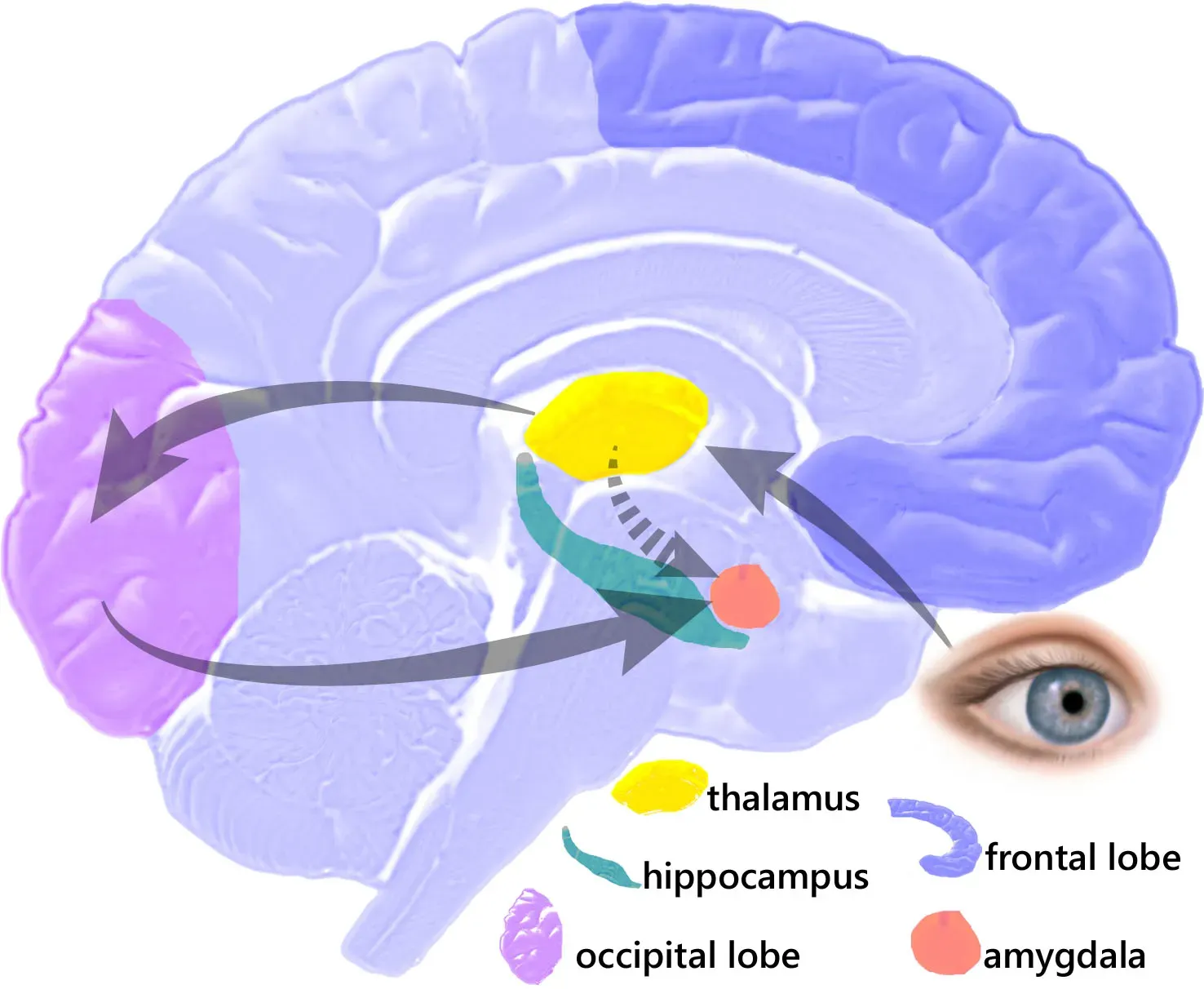
Sitting deep in your brain is the amygdala, a small almond-shaped structure that acts like an emotional smoke detector. It is especially tuned to anything that might signal threat, uncertainty, or risk. An unexpected noise at night is basically its favorite kind of problem: ambiguous, potentially dangerous, and arriving when your guard is down.
When the amygdala flags a sound as suspicious, it does not just make you feel uneasy. It sends urgent signals to other brain regions and to your body, triggering a cascade of changes: boosted attention, faster heart rate, shallower breathing, and a narrowed focus on the environment. It also biases your perception so you are more likely to interpret anything you hear as closer or more menacing than it really is. In other words, the amygdala is not neutral – it is built to err on the side of “this could be bad.”
Fight, Flight, or Freeze: How Your Body Joins In

Once the alarm is raised, your sympathetic nervous system jumps into action. Hormones like adrenaline surge, your muscles tense, and your senses sharpen. This is the classic fight‑or‑flight response, but there is also a quieter “freeze” mode, where you lie still, barely breathe, and listen like your life depends on it. That motionless listening is not cowardice; it is strategy.
In this state, your brain is effectively putting all available bandwidth into monitoring sound and subtle movement cues. The side effect is that everything feels turned up and moved closer. A fridge compressor cycling on might suddenly feel like footsteps. A tree branch brushing the window might feel like a hand. Your body has been primed to act, but in many modern contexts – like lying in bed in an apartment – you have nowhere to direct that energy, which makes the sensations even more intense and uncomfortable.
There is also a memory angle: your brain constantly cross‑references similar past events, stories you have heard, or movies you have watched. A door creak is not just a sound; it is instantly compared to every creepy hallway scene you have ever experienced, and that mental library heavily biases what you feel in the moment. If your last experience of a strange noise ended harmlessly, your system may calm down faster next time. If it coincided with a real break‑in or a deeply scary moment, your brain will lean even harder toward over‑protective overreaction.
Why Night Makes Everything Scarier: Context, Darkness, and Uncertainty

During the day, you have rich visual information, background noise, and familiar routines that help you interpret what you hear. At night, you lose most of that context, especially visual cues. When you cannot easily look and confirm that everything is fine, your brain fills in the blanks with worst‑case scenarios. It is not doing this to torture you; it is trying to keep you alive in an information‑poor environment.
Darkness and silence also change what your brain expects. A sudden sound in a noisy café barely registers, because your brain anticipates randomness. The same sound in a quiet bedroom hits like a red alert. Your system had settled into “all clear” mode, and now something has violated that expectation, which makes it feel bigger and more salient. The less you know about the source of a sound, the more your brain tilts toward caution, and that cautious tilt is exactly what makes everything seem closer and more dangerous.
Anxiety, Stress, and Sleep Debt: When the Alarm System Becomes Too Sensitive

Here is where things get personal: the more stressed, anxious, or sleep‑deprived you are, the more reactive your brain’s alarm system becomes. Chronic stress can keep your threat circuits in a semi‑activated state, so it takes less and less to push you into full alarm. If you have ever noticed you are jumpier during a tough week, or more rattled by sounds after nights of poor sleep, that is not in your head – it is in your nervous system.
Over time, this can turn into a feedback loop. You are stressed, so you sleep lightly. You sleep lightly, so you wake more easily to small noises. You wake more, worry more, and your brain learns that “night = danger,” which makes it even more vigilant. The volume knob never really turns back down. Breaking this cycle often takes deliberate work: managing daytime stress, creating a safer‑feeling sleep environment, and sometimes getting professional help if your nightly alarm response is spilling into daytime anxiety or panic.
Practical Ways to Calm the System Without Ignoring Real Danger

Here is the tricky part: you do not want to shut off your alarm system entirely. Sometimes a weird noise really does mean something is wrong. The goal is not to become numb, but to move from constant red alert to a more balanced, flexible response. One simple tactic is to add predictable, harmless nighttime sounds – like a fan or white noise – that your brain can learn as safe. This reduces the sharp contrast when an unexpected sound appears and can keep your gain settings from shooting straight into max mode.
Another underrated tool is how you talk to yourself in those moments. Instead of immediately spinning a horror story, you can mentally label what is happening: your amygdala fired, your nervous system is in high gear, and your brain is temporarily amplifying sounds. That small bit of understanding can create just enough distance to slow the spiral. Pair that with grounding habits – like slow breathing, relaxing your jaw and hands, or briefly checking the environment in a calm, methodical way – and you teach your brain that not every creak needs a full emergency response.
So, Is Your Brain Overreacting – or Doing Its Job Too Well?

Personally, I think we underestimate how brutally efficient this system is. It feels unfair when your heart slams against your ribs over what turns out to be the cat nudging a box, but from your brain’s perspective, that is a win: the worst‑case scenario did not happen, and you were ready if it had. Our modern lives ask our nervous systems to operate in ways they were never fully built for – living stacked above strangers in apartments, sleeping with phones by our heads, binging true‑crime stories before bed – and then we are surprised when the alarm goes off more than we like.
So the next time you jolt awake at a strange noise, it might help to see it less as a failure of courage and more as proof that your internal guard is still on duty. Yes, you can and should work on dialing back unnecessary overreactions, especially if they are wrecking your sleep or mental health. But in a world where real risks do exist, I would rather have a brain that occasionally makes the shadows seem too close than one that shrugs at everything. When that thud in the night comes, will you curse your racing heart, or quietly thank your nervous system for caring enough to wake you up?