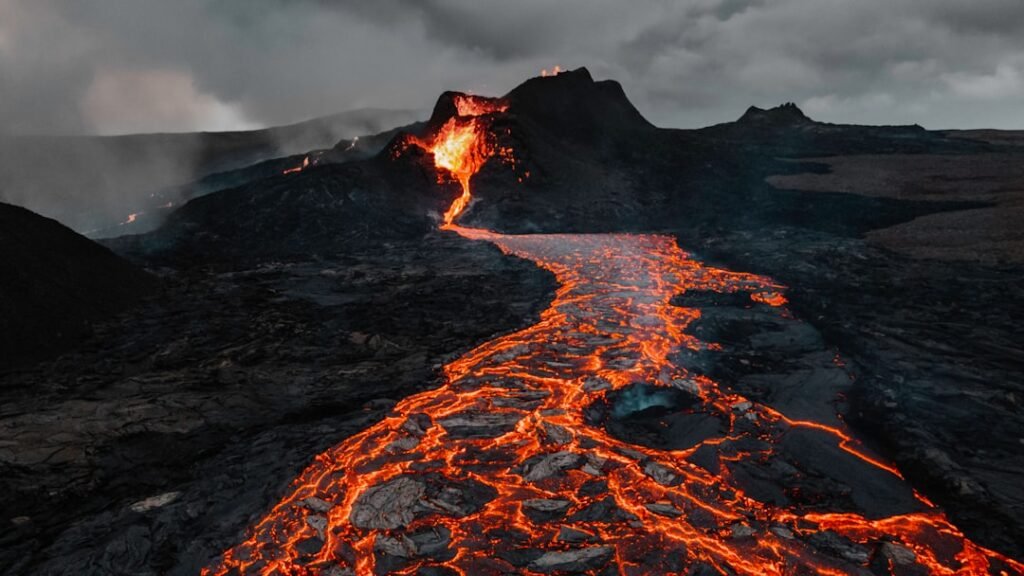

Etna’s Lava Defies Standard Categories (Image Credits: Unsplash)
Sicily, Italy – Researchers have pinpointed a distinctive magma process beneath Mount Etna that sets it apart from familiar volcanic archetypes. The Sicilian giant, standing 11,165 feet (3,403 meters) tall, produces lavas with an unusual chemical signature that has puzzled experts for years. A new analysis explains this anomaly through interactions between a mantle melt layer and a deformed tectonic boundary.
Etna’s Lava Defies Standard Categories
Volcanologists traditionally grouped active volcanoes into three main classes. Mid-ocean ridge volcanoes form where oceanic plates diverge, allowing mantle magma to create fresh crust. Intraplate volcanoes, such as those in Hawaii or Yellowstone, stem from stationary mantle hotspots piercing stable plates. Subduction zone volcanoes arise inland from trenches, where descending oceanic slabs release water that triggers melting.
Mount Etna occupies a hybrid position. It lies directly atop the boundary where the African Plate edges under the Eurasian Plate, rather than farther inland. Its lavas carry traces of alkali elements like potassium and sodium, akin to hotspot varieties, yet no plume lurks below. Early eruptions yielded modest silica-rich flows, followed by voluminous alkali-rich ones – a reversal of typical patterns where silica-rich magmas dominate large reservoirs.
Magma Rises from a Hidden Mantle Reservoir
The breakthrough traces Etna’s magmatism to a low-velocity zone, a partially molten layer crowning the upper mantle. Seismic waves travel slower through this “melty” region due to scattered melt pockets. Such zones exist globally, but magma seldom breaches the surface elsewhere.
Etna’s initial melts ascended through the silica-laden continental crust of the African Plate. Reactions en route enriched them with silica, producing the volcano’s earliest lavas around 500,000 years ago. Later, a straighter pathway funneled purer alkali-rich magma from the low-velocity zone, sustaining larger outflows. This dual mechanism accounts for the observed shifts in composition over time.
Key Process Stages:
- Melt extraction from low-velocity zone.
- Crustal contamination yields silica-rich lava.
- Direct conduit delivers alkali-rich lava.
Tectonics Open the Door to Eruptions
Etna’s locale amplifies its uniqueness. The subducting African Plate snags intermittently, warping overlying rocks into folds. These structures create permeable channels for magma ascent. “The folds are allowing the magma to rise up,” explained Sébastien Pilet, a lecturer in Earth sciences at the University of Lausanne and lead author of the study.
This setup echoes tiny ocean-floor petit-spot volcanoes, which tap similar shallow melts amid bending plates. Etna scales up the process onshore, acting as a “leaking pipe” from the low-velocity zone. The research, published April 7, 2026, in the Journal of Geophysical Research: Solid Earth, drew on geochemical profiles of historic lava layers to reconstruct these dynamics.
Redefining Volcanism Worldwide
The findings elevate the lithosphere’s – crust and upper mantle’s – role in shaping eruptions. “This actually represents a new type of volcanism,” noted Sarah Lambart, a petrologist at the University of Utah unaffiliated with the work. She added that such crustal-magma interplay might influence activity far beyond Etna.
While low-velocity zones hold promise as untapped sources, uncertainties linger about their melt volumes and extraction efficiency. Future seismic imaging and modeling could reveal parallels at other boundary volcanoes. Etna’s story underscores how tectonic quirks can unlock mantle secrets, potentially recasting global volcanic inventories.
This discovery sharpens focus on lithosphere-magma dialogues, urging broader scrutiny of plate edge dynamics.