Third Visitor Ignites Scientific Excitement (Image Credits: Pexels)
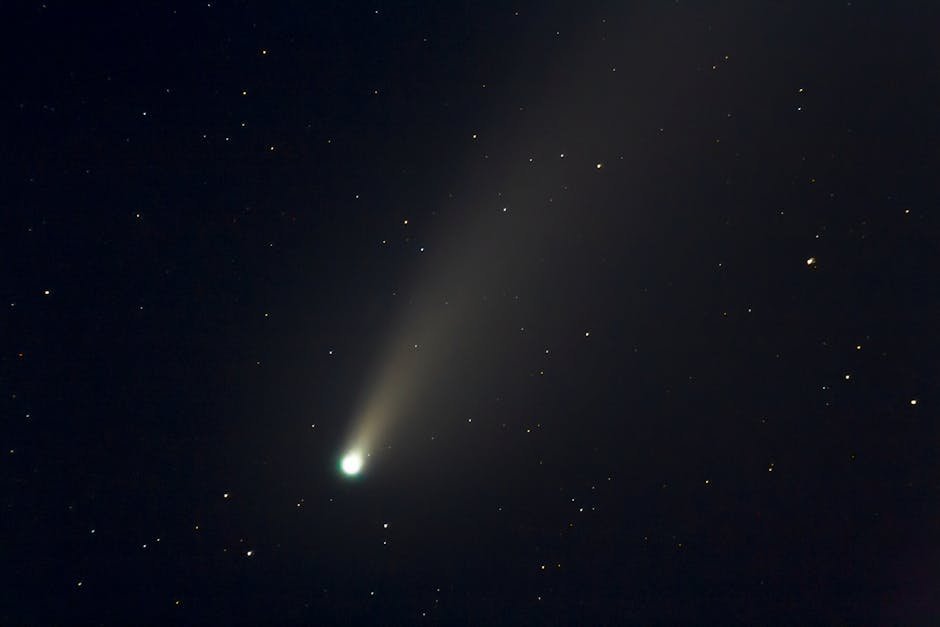
Astronomers witnessed an extraordinary event last fall when the interstellar comet 3I/ATLAS swung close to the Sun. This rare visitor from beyond our solar system underwent a startling transformation, erupting with renewed vigor and revealing long-buried secrets. Observations captured the comet’s sudden brightening and chemical outbursts, offering a glimpse into materials preserved since the universe’s early days.[1][2]
Third Visitor Ignites Scientific Excitement
Only the third confirmed interstellar object to grace our solar system, 3I/ATLAS captivated researchers from the moment of its discovery. The ATLAS survey telescope in Chile first spotted it on July 1, 2025, with pre-discovery images tracing back to mid-June. Its hyperbolic trajectory confirmed an origin outside our stellar neighborhood, hurtling in at a blistering 58 kilometers per second relative to the Sun.[2][3]
Unlike bound comets that loop around the Sun, this one followed a one-way path. It reached perihelion – its closest solar approach – on October 29, 2025, at 1.36 astronomical units, safely inside Mars’ orbit but far from Earth. Ground telescopes tracked its faint glow until it dipped too close to the Sun’s glare in September, setting the stage for its post-flyby revival.[3]
Solar Heat Triggers Unexpected Eruption
The comet’s nucleus, likely 0.5 to 0.7 kilometers across, arrived encased in a tough crust forged by galactic cosmic rays during eons in interstellar space. As sunlight warmed its surface near perihelion, this barrier cracked, unleashing violent venting of ice and dust. NASA’s SPHEREx observatory detected the outburst in December 2025, when the comet brightened rapidly and spewed water vapor, carbon dioxide, and organic molecules.[1][2]
Astronomer Carey Lisse described the scene: the comet was “full-on erupting into space.” Its coma – a hazy envelope of gas and dust – expanded dramatically, reaching hundreds of thousands of kilometers. Infrared data revealed fine dust grains and gases like carbon monoxide and carbonyl sulfide, marking a shift from subdued pre-perihelion activity.[1][3]
Earlier, in July and August, the coma had reddened as dust dominated. Post-flyby, subtle color shifts hinted at fresh exposures of icy interiors. This transformation defied expectations for such a fast-moving interloper, which survived intact where some solar system comets fragment.[3]
Comet Arsenal Mobilized for Unprecedented Views
A fleet of space telescopes and probes turned their gaze on 3I/ATLAS, yielding the most comprehensive study of an interstellar object yet. Hubble imaged a teardrop-shaped dust cocoon around the nucleus in July. The James Webb Space Telescope analyzed its near-infrared spectrum, detecting water ice and heavy carbon dioxide isotopes.[2][3]
Mars-orbiting spacecraft provided close-range snapshots: the Mars Reconnaissance Orbiter’s HiRISE camera captured details from 18.6 million miles away in early October. Rovers like Perseverance imaged it against the Martian sky. Even solar probes like Parker Solar Probe and SOHO glimpsed it amid the Sun’s glare.[2]
- Hubble Space Telescope: Nucleus size and dust plume.
- James Webb Space Telescope: CO2, water, and OCS emissions.
- SPHEREx: Post-perihelion brightening and molecular inventory.
- MAVEN: Hydrogen cloud and coma structure.
- PUNCH and STEREO: Tail evolution.
Peering into Alien Chemistry
The eruption exposed a composition unlike typical solar system comets. Carbon dioxide dominated emissions at rates far exceeding water early on, with methane later confirmed as the comet departed. Atomic nickel vapor appeared without iron, and carbon chains remained scarce.[3]
This profile suggested origins in a metal-poor environment, possibly from a distant protoplanetary disk billions of years old. The comet’s high speed and retrograde path pointed to the Milky Way’s thick disk, a region of ancient stars. Researchers noted its dust production matched 2I/Borisov but lagged behind inner solar system comets.[3]
| Object | Speed (km/s) | Perihelion (AU) | Eccentricity |
|---|---|---|---|
| 1I/’Oumuamua | 26 | 0.25 | 1.2 |
| 2I/Borisov | 32 | 2.0 | 3.4 |
| 3I/ATLAS | 58 | 1.36 | 6.14 |
These differences highlighted diverse interstellar wanderers.[3]
Lessons from a Fleeting Passage
Though 3I/ATLAS now fades toward interstellar space, its data endures. Open archives from NASA missions fuel future analysis, from rotation studies via TESS to water production estimates rivaling 70 Olympic pools daily. The event underscored how solar encounters peel back cosmic time capsules.[2][3]
Key Takeaways
- Crust from cosmic rays preserved pristine ices, cracked by solar heat.
- Post-perihelion eruption released CO2, water, and organics unseen before.
- Multi-mission observations set record for interstellar object scrutiny.
The comet’s journey reminds us of the solar system’s porous boundaries. What secrets might the next visitor hold? Share your thoughts in the comments.