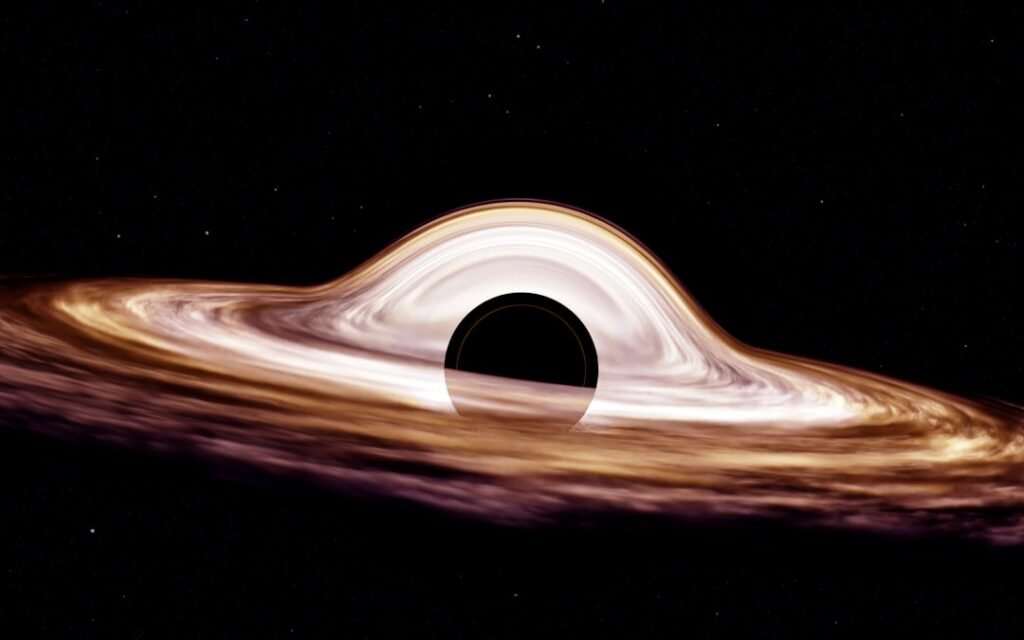
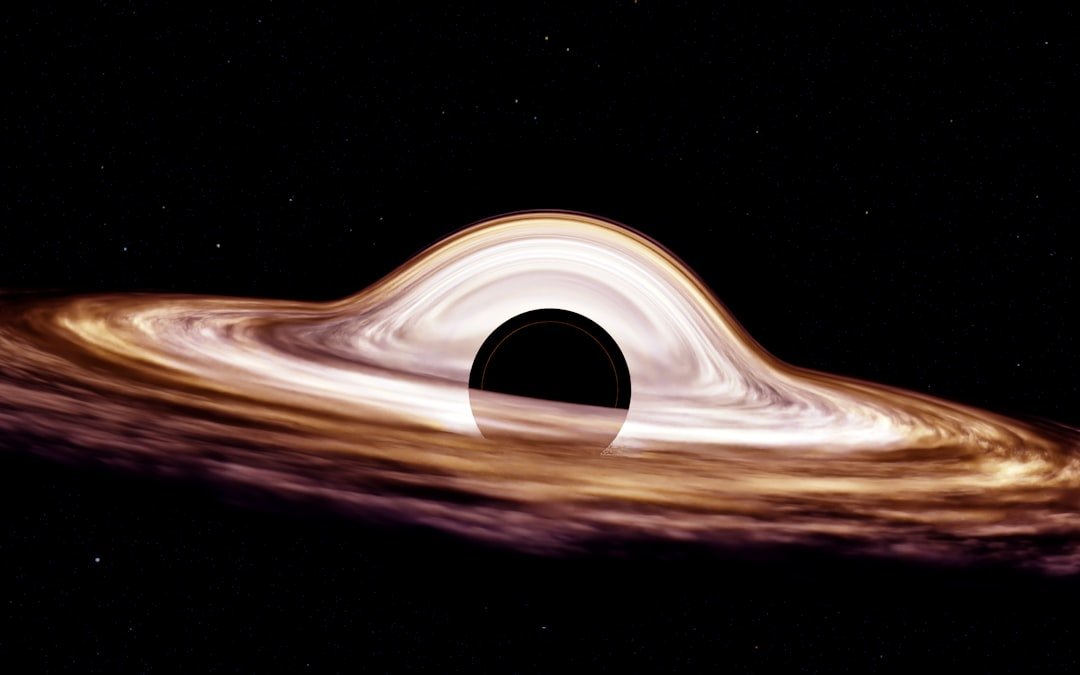
No-Hair Theorem Meets Its Fermionic Challenge (Image Credits: Unsplash)
Black holes have long been viewed as unyielding to certain external gravitational influences, maintaining a rigid structure encapsulated by general relativity. A recent investigation challenges this view, revealing that fermionic fields can induce measurable tidal deformations in these cosmic giants. Published in Physical Review D, the work demonstrates nonzero tidal Love numbers for black holes perturbed by such fields, marking a significant departure from established theory.[1][2]
No-Hair Theorem Meets Its Fermionic Challenge
Physicists once assumed black holes respond to static tidal fields with perfect rigidity, a property tied to their vanishing tidal Love numbers. These numbers quantify how much an object deforms under external gravitational pulls, much like the Moon’s effect on Earth’s oceans. For decades, calculations confirmed zero values for black holes under bosonic influences, reinforcing the no-hair theorem that describes these objects solely by mass, charge, and spin.
The new research upends this for fermionic perturbations. Researchers Sumanta Chakraborty from the Indian Association for the Cultivation of Science, Pierre Heidmann from Ohio State University, and Paolo Pani from Sapienza University of Rome derived closed-form expressions showing nonzero Love numbers. This fermionic “hair” suggests black holes might carry subtle signatures from quantum fields, evading classical symmetries.[3]
Bosons Versus Fermions: A Fundamental Split
Bosonic fields, associated with integer-spin particles like photons and gravitons, trigger no permanent deformation in black holes. Ladder symmetries in the equations of general relativity enforce this zero response, ensuring solutions decay without residue. Fermions, however, obey half-integer spin statistics and the Pauli exclusion principle, behaving differently under these mathematical constraints.
The study focused on massless Dirac fields, akin to neutrinos, probing Kerr black holes – rotating vacuums described by general relativity. Unlike bosons, fermions lack superradiance in static limits, leading to zero dissipation numbers but nonzero conservative Love numbers. This distinction arises from broken hidden symmetries, allowing regular, decaying solutions that imprint tidal effects.
- Bosonic perturbations: Zero Love numbers due to SL(2,R) symmetries; possible dissipation in rotating cases.
- Fermionic perturbations: Nonzero, real Love numbers; vanishing dissipation for static fields.
- Key example: For spin-1/2 fermions in Schwarzschild black holes, Love numbers read ±4^{-2ℓ-1}, independent of azimuthal mode m.
- Extremal Kerr limits: Finite values, with exponential growth for large multipoles in near-extremal spins (a ≳ 0.95M).
Inside the Calculations: Kerr Black Holes Under Scrutiny
The team analyzed perturbations across generic spins, from spin-1/2 Dirac to higher Rarita-Schwinger fields. Their expression for fermionic Love numbers F_{sℓm} incorporates the black hole’s angular momentum parameter a, horizon radii r±, and multipole indices. This formula holds for arbitrary rotation, confirming nonzero responses even in non-rotating Schwarzschild cases.
“We present the first exception to this rule: the Love numbers of a black hole perturbed by a fermionic field are nonzero,” the authors stated. They emphasized the role of ladder symmetries, which chain solutions to zero for bosons but permit finite values for fermions. Plots in the paper illustrate how these numbers remain stable at extremality and vary with spin, offering testable predictions.[3]
Validation came through invariance under spin-frame rotations and tetrad choices, ensuring physical robustness. No parity-odd responses appeared, aligning with expectations for these fields.
Implications Reshape Black Hole Probes
This discovery extends beyond theory, potentially influencing gravitational wave observations. LIGO and future detectors could seek fermionic signatures in mergers, especially near-extremal spins common in astrophysical binaries. Embedding these effects in worldline effective field theories might refine waveform models, enhancing parameter estimation.
Black holes surrounded by fermionic matter could exhibit “hair” without violating no-hair theorems outright, prompting nonlinear stability analyses. Extensions to charged Reissner-Nordström black holes or dynamical perturbations loom large. Observers might detect spin-up/down asymmetries tied to these responses, probing quantum gravity interfaces.
| Object Type | Bosonic Love Numbers | Fermionic Love Numbers |
|---|---|---|
| Schwarzschild Black Hole | Zero | Nonzero (e.g., spin-1/2: ±4^{-2ℓ-1}) |
| Kerr Black Hole | Zero | Nonzero, spin-dependent |
| Neutron Star | Nonzero | Nonzero (expected) |
These findings underscore fermions’ unique role, potentially bridging general relativity and quantum field theory in extreme gravity.
- Black holes deform under fermionic tidal fields, defying bosonic rigidity.
- Closed-form Love numbers enable precise predictions for Kerr metrics.
- New probes for gravitational waves and black hole “hair” emerge.
This fermionic revelation redefines black hole passivity, inviting scrutiny of fundamental interactions in the universe’s darkest realms. Future mergers observed by LIGO-Virgo-KAGRA may confirm these effects, reshaping our cosmic worldview. What implications do you see for quantum gravity? Share your thoughts in the comments.