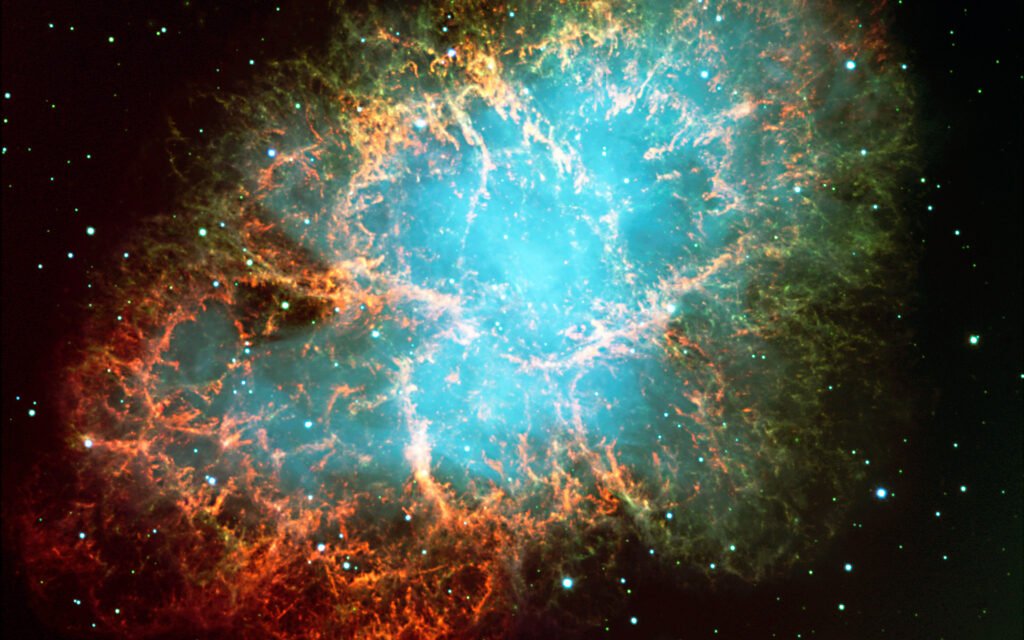

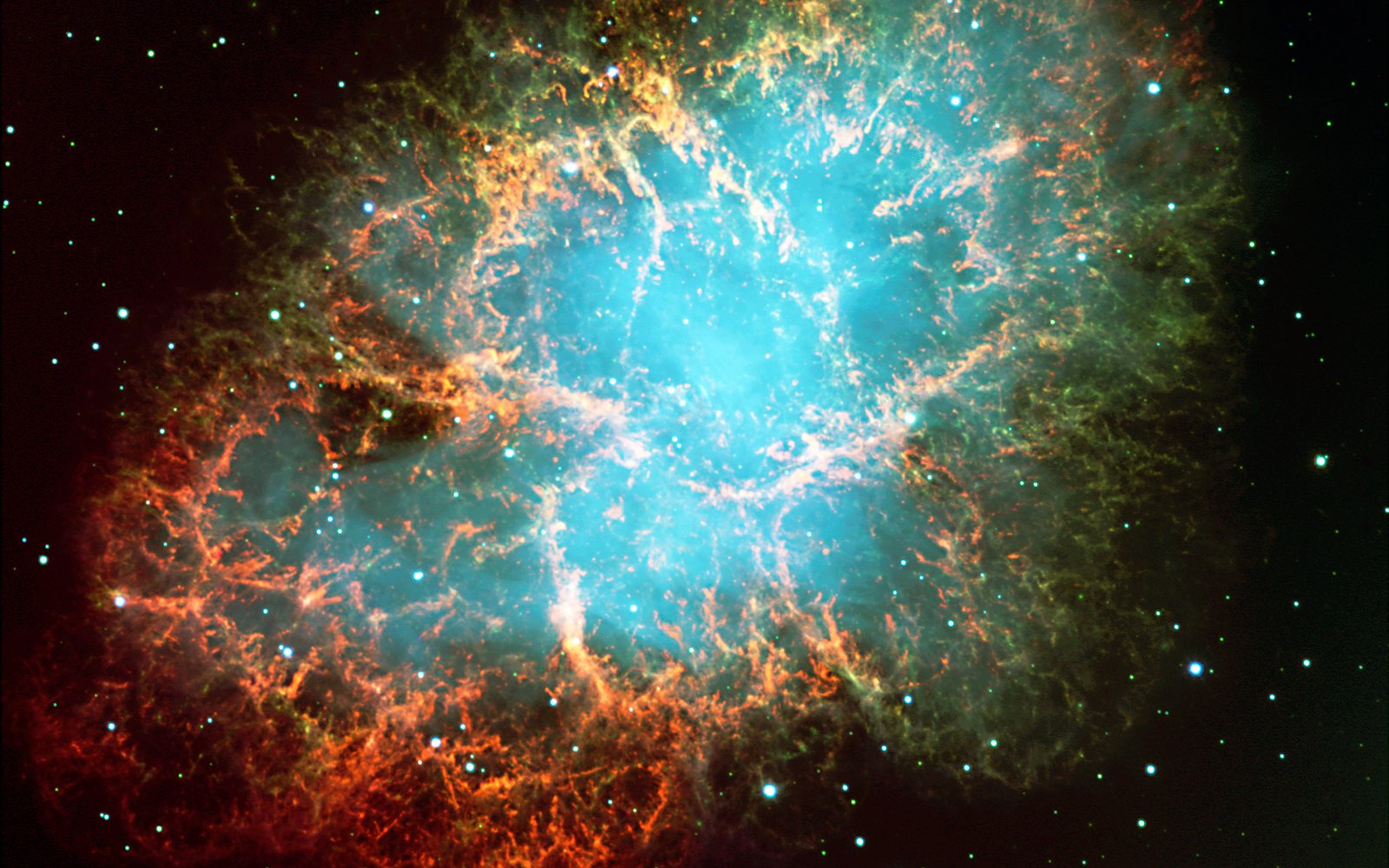
A Legacy from a Medieval Supernova (Image Credits: Upload.wikimedia.org)
Nearly a millennium after a brilliant supernova lit up the daytime sky in 1054, the Crab Nebula continues its dramatic expansion in the constellation Taurus, 6,500 light-years from Earth. NASA’s Hubble Space Telescope recently provided astronomers with a detailed comparison of the nebula’s structure, revealing how its glowing filaments have shifted over a quarter-century.[1][2] This fresh perspective highlights the ongoing evolution of one of the most studied supernova remnants, powered by a dynamic pulsar at its core.
A Legacy from a Medieval Supernova
Astronomers in 1054 documented a “guest star” that shone brightly enough to see during the day for several weeks. That event marked the explosion of a massive star, leaving behind the Crab Nebula as its remnant. Discovered in the mid-18th century, the nebula gained its name from its crab-like appearance in early telescopic views. In the 1950s, researchers, including Edwin Hubble, connected it to the ancient Chinese records, solidifying its historical significance.[1]
At the heart lies a pulsar, a rapidly spinning neutron star that pumps energy into the surrounding material. This central engine drives the nebula’s expansion through interactions between the pulsar’s magnetic field and the ejected gas, producing synchrotron radiation that illuminates the intricate filaments. Unlike typical supernova remnants propelled by shockwaves, the Crab operates as a pulsar wind nebula, offering unique insights into stellar death and rebirth.
Hubble’s Quarter-Century Comparison
Hubble first imaged the full Crab Nebula around 1999 using its Wide Field and Planetary Camera 2 (WFPC2). Astronomers reprocessed those images to align with newer data captured in 2024 by the Wide Field Camera 3 (WFC3), installed during Hubble’s final servicing mission in 2009. The updated views reveal subtle shifts in the nebula’s filaments, with colors reflecting variations in gas temperature, density, and chemical makeup.[1][3]
William Blair of Johns Hopkins University led the observations. “We tend to think of the sky as being unchanging, immutable,” Blair noted. “However, with the longevity of the Hubble Space Telescope, even an object like the Crab Nebula is revealed to be in motion, still expanding from the explosion nearly a millennium ago.”[1] Joseph DePasquale of the Space Telescope Science Institute handled the image processing, enhancing details for precise analysis.
Filaments in Full Motion
The new data showed filaments near the nebula’s edges advancing farther than those closer to the center. This pattern arises because outer filaments move more directly toward observers in the plane of the sky, while inner ones shift partially along the line of sight. Overall, the structures expanded uniformly without significant stretching or major brightness changes.[3]
Measured at 3.4 million miles per hour, the outward rush underscores the pulsar’s relentless push.[1] Blair added, “Any changes in the brightness or structure of the filaments over this time are very modest… It has just expanded fairly uniformly over this time.”[3] Shadows cast by some filaments onto the synchrotron haze further map the nebula’s three-dimensional layout, with brighter ones appearing on the far side.
| Aspect | 1999 Observation (WFPC2) | 2024 Observation (WFC3) |
|---|---|---|
| Instrument | Wide Field and Planetary Camera 2 | Wide Field Camera 3 |
| Key Advantage | Initial full mosaic | Enhanced resolution and filter range |
| Filament Shift | Baseline position | Outward movement at 3.4 million mph |
Unveiling Deeper Cosmic Secrets
These observations stand out due to Hubble’s unique combination of long-term monitoring and high resolution. No other telescope matches this capability for tracking such gradual changes. The data also complement recent infrared views from NASA’s James Webb Space Telescope, opening doors to multiwavelength studies.[1]
- Filaments reveal 3D structure through shadows and positioning.
- Expansion driven by pulsar wind, not shocks.
- Colors indicate evolving gas properties over time.
- Uniform growth persists nearly 1,000 years post-explosion.
- Pairs well with data from other observatories.
A detailed paper on the findings appeared in The Astrophysical Journal, cementing Hubble’s role in supernova remnant research.
Key Takeaways
- Hubble’s 25-year span captures filament motion at 3.4 million mph, powered by a central pulsar.
- Peripheral filaments show greater visible shift due to viewing angle.
- New data enhances understanding of the Crab’s 3D evolution and gas dynamics.
Hubble’s enduring gaze reminds us that the universe remains in constant flux, even for ancient spectacles like the Crab Nebula. As observations continue across wavelengths, scientists anticipate richer revelations about stellar explosions and their long-term legacies. What aspects of the Crab Nebula intrigue you most? Share your thoughts in the comments.