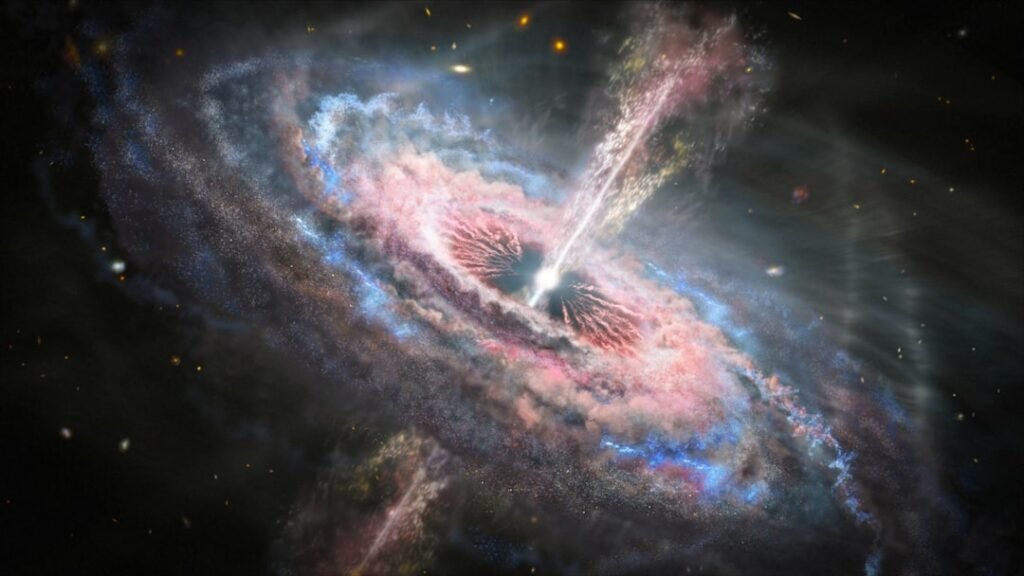
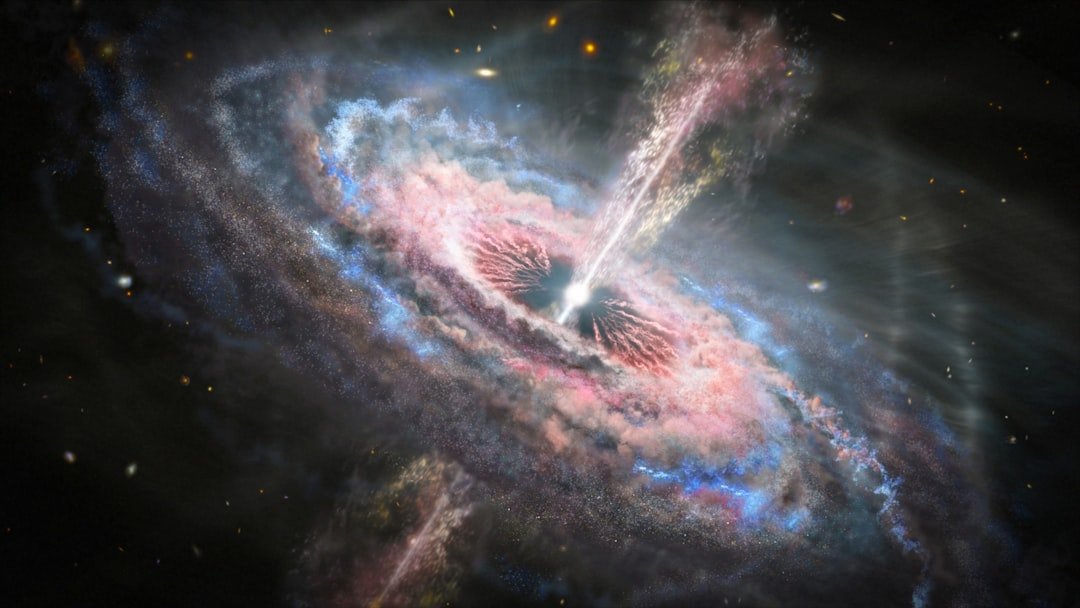
Jets Twist and Turn in Cosmic Winds (Image Credits: Unsplash)
Astronomers recently captured the dynamic motion of high-speed jets from the black hole in Cygnus X-1, a pioneering system first identified decades ago. Researchers led by Curtin University measured these jets’ power instantaneously, revealing an output equivalent to 10,000 suns. The findings confirm that roughly 10% of the energy from infalling matter escapes via these jets, validating key assumptions in cosmic simulations.[1]
Jets Twist and Turn in Cosmic Winds
These jets, hurtling outward at half the speed of light – about 150,000 kilometers per second – do not travel in straight lines. Instead, they bend dramatically under the influence of powerful winds from the system’s supergiant companion star. As the black hole and star orbit each other, the jets shift directions, earning the vivid description of “dancing jets.”[1]
Cygnus X-1 stands out as the first black hole confirmed in a binary system with a massive star. The stellar wind pushes the jets aside much like earthly winds scatter a fountain’s spray. This deflection provided scientists with a unique way to gauge the jets’ strength directly.[1]
Breakthrough in Jet Power Measurement
Prior efforts averaged jet power over thousands or millions of years, making direct ties to fleeting energy releases from infalling matter impossible. The new approach changed that. Teams linked radio telescopes across vast distances to snap precise images of the jets’ paths.[1]
By tracking how much the stellar wind bent the jets, researchers calculated instantaneous power. Dr. Steve Prabu, the lead author formerly at Curtin Institute of Radio Astronomy, highlighted the precision: “A key finding from this research is that about 10% of the energy released as matter falls in towards the black hole is carried away by the jets.”[1]
This method relied on known stellar wind strengths and orbital positions. Collaborators from the University of Oxford, University of Barcelona, and others contributed to the observations. The sequence of images revealed deflections tied to the black hole’s orbital motion.
| Method | Time Scale | Key Advantage |
|---|---|---|
| Previous Approaches | Thousands to millions of years | Average power estimates |
| New Technique | Instantaneous | Direct comparison to X-ray emissions |
Energy Output on a Stellar Scale
The jets’ power rivals that of 10,000 suns combined. This immense release stems from the black hole’s accretion process, where matter spirals inward and heats up. Yet only a fraction – around 10% – fuels the jets, with the rest powering X-ray bursts.[1]
Professor James Miller-Jones, from Curtin Institute and the International Center for Radio Astronomy Research, noted the broader reach: “Because our theories suggest that the physics around black holes is very similar, we can now use this measurement to anchor our understanding of jets, whether they are from black holes 10 or 10 million times the mass of the sun.”[1]
- Cygnus X-1 hosts a stellar-mass black hole orbiting a supergiant star.
- Jets move at 150,000 km/s, half light speed.
- Power equals 10,000 suns’ luminosity.
- 10% of accretion energy goes to jets.
- First instantaneous power measurement achieved.
Shaping Galaxies and the Cosmos
Black hole jets influence vast regions, depositing energy that alters gas clouds and star formation. This feedback mechanism drives galaxy evolution. The Cygnus X-1 data now calibrates models for distant supermassive black holes.
Future telescopes like the Square Kilometer Array Observatory will detect millions of such jets. Accurate power estimates from this study will refine predictions about cosmic structures. The research appeared in Nature Astronomy (DOI: 10.1038/s41550-026-02828-3).[1]
- Jets carry 10% of black hole accretion energy, confirming simulation assumptions.
- Power output matches 10,000 suns, measured via jet bending.
- Findings apply across black hole masses, aiding galaxy evolution studies.
This landmark measurement bridges theory and observation, illuminating how black holes sculpt the universe. It promises refined insights into the energetic processes powering cosmic change. What do you think about these powerful jets? Tell us in the comments.