
There’s something quietly shocking hidden inside modern cosmology: if our best physics is right, then time itself had a beginning. Not just stars and galaxies and matter, but the very stage on which events unfold seems to have switched on in a kind of ultimate “now.” That means the classic late-night question – what was there before the universe began? – might not simply be hard, but actually meaningless in the way “north of the North Pole” is meaningless.
This sounds abstract until you realize it hits everything: our ideas about origins, about causality, even about what it means for something to exist. In a universe where time itself is part of the story rather than the background, the usual way we think about “before” and “after” starts to crumble. Let’s take this apart slowly, like pulling on a loose thread in a sweater, and see why so many cosmologists think time began, what that really means, and why physics may literally not allow us to ask what came before.
The radical idea that time is not a backdrop but part of the universe
We grow up imagining time as a kind of invisible conveyor belt endlessly rolling along, with the universe just sitting on top of it. In that picture, it feels natural to ask what was happening earlier, and earlier, and earlier still, as if you could zoom back along the belt forever. Relativity punches a hole straight through that intuition by turning time into something physical, woven together with space into what physicists call spacetime.
In this framework, time is not an external clock ticking away in some cosmic hallway. It is one dimension of the universe itself, flexible and responsive, influenced by matter and energy the way a trampoline is bent by a bowling ball. When you accept that time is part of the fabric rather than the stage, the idea that it might have a beginning stops sounding mystical and starts sounding like a property of the geometry of the universe, just like a line segment has an endpoint.
The Big Bang: not an explosion in space, but the beginning of spacetime
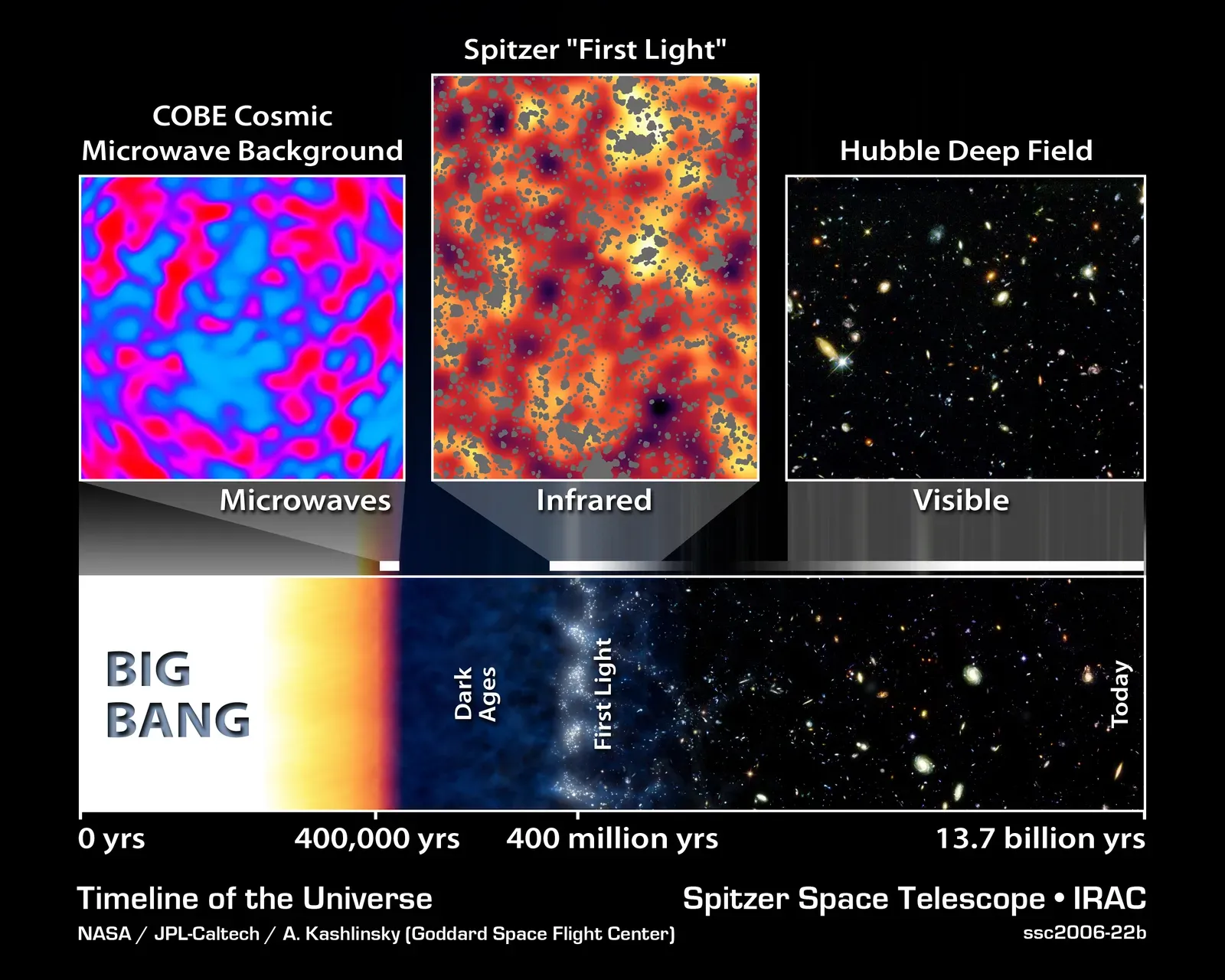
Popular images make the Big Bang look like a fireball exploding into a pre-existing emptiness, as if a bomb went off in a dark room. That mental picture is deeply misleading. In modern cosmology, the Big Bang is more like the moment when the entire fabric of space and time is pulled into existence in an extremely hot, dense state, and then expands and cools. There is no outside space for it to expand into; space itself is what is stretching.
If you trace the expansion backward with general relativity, distances between points shrink, densities grow, and after a finite amount of time you hit a boundary where the equations break down – a singularity. Interpreted literally, that boundary marks the beginning of spacetime itself. In that mathematical sense, asking “what was before the Big Bang?” is like asking what is earlier than the first frame of a movie: the timeline you are using simply does not extend any further back.
Why “before time” is like asking for a time earlier than the first moment
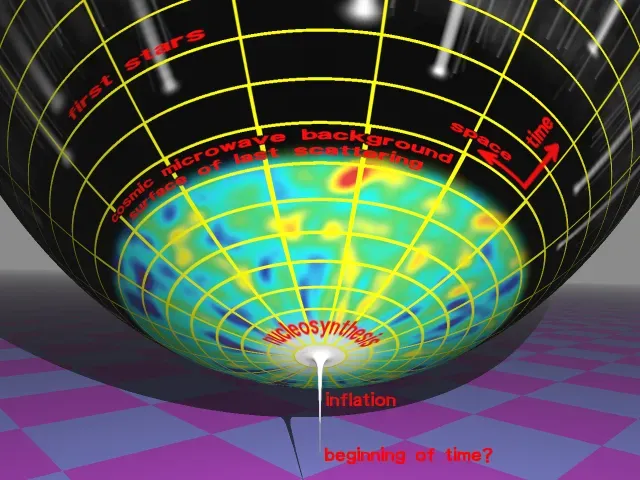
The question “what existed before time?” hides a subtle trap. The word “before” is a time-word; it assumes a context in which you can order events, with one happening earlier and another later. If time is part of the universe that begins with the Big Bang, then the concept of “earlier” does not apply outside or before that event, in exactly the way the idea of “Monday before the first Monday” fails to make sense.
A simple analogy that helped me personally is geography: you can walk north, and keep walking north, but when you reach the North Pole, asking what lies further north is not just unanswerable, it is mis-posed. The direction “north” stops being defined there. Cosmology is suggesting something similar about the temporal direction: you can run the universe’s clock back billions of years, but at some finite point, you hit a boundary where the notion of “earlier” ceases to be meaningful rather than being hidden from us behind a veil.
Singularity theorems and why many cosmologists think time had a beginning
This is not just philosophy layered on top of guesswork; it is rooted in hard mathematics. In the late twentieth century, physicists used general relativity to prove so-called singularity theorems, showing that under quite broad and realistic conditions, a universe like ours that is expanding and filled with matter must have had a past boundary. In those models, if you follow any path back in time, it hits an edge after a finite duration rather than stretching into the infinite past.
Those theorems do not tell us exactly what the beginning looks like, only that the classical description cannot be extended indefinitely. They effectively say: if relativity plus some reasonable assumptions are correct, you cannot avoid some kind of beginning of spacetime. That conclusion makes a lot of physicists uneasy, because singularities signal that our theories are incomplete, but discomfort is not enough to erase the mathematical arrow pointing to a first moment.
Quantum cosmology: attempts to tame the beginning without restoring a “before”
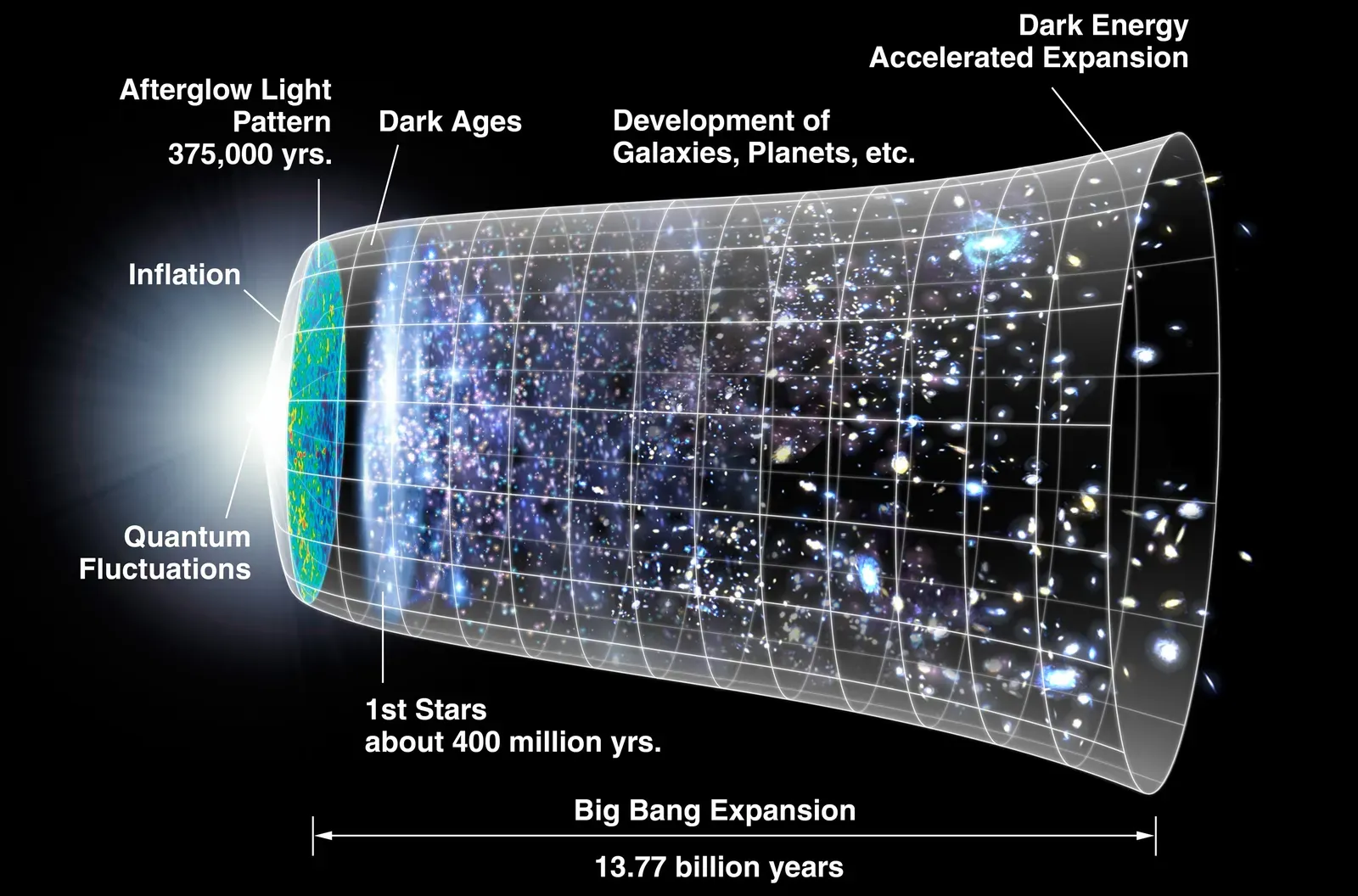
Everyone agrees that near the Big Bang, the densities and energies are so extreme that quantum effects cannot be ignored, and classical relativity on its own is no longer reliable. This has led to quantum cosmology proposals where the universe’s beginning is smoothed out, described in terms of quantum states or wave functions instead of a sharp singularity. Some models even talk about a universe that is “finite but without boundary,” borrowing ideas from curved geometry.
What is striking, though, is that even in more exotic scenarios, the usual sense of a time “before” the universe often does not reappear. Time might emerge from a timeless underlying description the way temperature emerges from the motion of atoms, or it might reverse direction or become fuzzy near the earliest stages. But the common theme is that you still cannot meaningfully ask what happened earlier in an everyday sense, because the very variable you are trying to compare events along either dissolves or becomes something different there.
On the other hand, there are also modern bounce or cyclic models where a previous contracting phase precedes our expanding universe. These ideas are interesting and worth studying, but they usually push the question of a true beginning further back or change its character, rather than giving a simple, well-defined “before” within the same notion of time we use now. And crucially, we do not yet have decisive observational evidence that any particular pre-Big-Bang story is correct, which makes it risky to talk about a definite “earlier” era as if it were established fact.
Why our brains rebel against a beginning of time
Part of the emotional punch of all this comes from the way our minds are wired to think in stories, with causes and effects strung out along a timeline that feels unbroken. When you are told that the timeline itself has a starting point, it clashes with a deeply rooted intuition that for every event there must be some earlier reason. I remember the first time I really sat with this; it felt less like learning a new fact and more like discovering that a basic mental tool I had relied on my whole life had a blind spot.
It also does not help that every example in everyday life involves time already in place: every birth happens in an existing world, every new project begins within an existing calendar. We instinctively project that pattern outward to the universe itself, imagining a cosmic “before” that must be lurking just out of sight. So when physics says that time may simply not stretch back indefinitely, it does not just challenge a theory; it challenges the way we habitually structure our thoughts about existence.
So what, if anything, can we sensibly say about “before” the Big Bang?
Here is where opinion enters, because the honest scientific position is that our current theories do not provide a clear, testable answer about any realm “before” the Big Bang, if such a realm even exists in a meaningful way. From a strict physics point of view, if time and space emerge with the Big Bang, then the only questions we can reliably address are those that lie within that spacetime. Pushing our language of “before” beyond that boundary may just be stretching a useful concept past its domain, the way asking about the color of a smell stretches sensory categories until they break.
Personally, I think there is value in distinguishing between two different attitudes here. One is to say that anything before time is literally nonsense and should not even be entertained. The other, which feels more honest to me, is to admit that our current physical concepts are tied to time, so any story about a timeless “prior” state is speculative philosophy rather than tested science. It is not that curiosity is wrong; it is that we should be blunt about when we have stepped off the solid ground of physics onto a foggy shoreline where our usual questions may not apply at all.
Conclusion: a universe with a first moment and a question that bites its own tail
If you follow modern cosmology to where it naturally leads, you end up with a surprisingly stark picture: the universe appears to have a finite age, and the very fabric of time seems to begin with it. Our best tools, built on cause-and-effect within a temporal framework, cannot be straightforwardly extended to a realm where that framework is absent or radically transformed. In that sense, the question “what existed before time?” does not just lack an answer; it folds back on itself, using the very concept that is supposedly missing.
My own take is that this is not a failure of physics so much as a spotlight on the limits of certain human questions. We are very good at asking why something changed from one moment to the next, less good at confronting the possibility that “moments” themselves are part of the thing we are trying to explain. A universe with a beginning of time is deeply unsettling, but it is also strangely liberating: it reminds us that not every instinctive question is guaranteed a coherent answer. Faced with that, maybe the more interesting challenge is not “what came before?” but “how far can we push our understanding of a cosmos where time itself had to start somewhere?”