Articles for category: News, Space

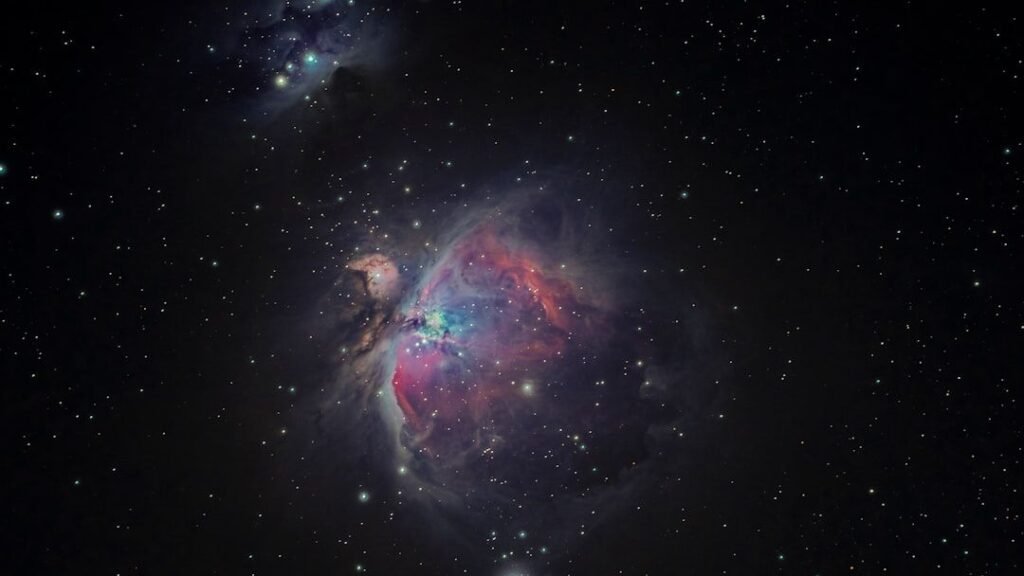
light didn't emerge unfettered after the Big Bang. Here, we see the phases following the Big Bang (top left), about 13.8 billion years ago, to present day (lower right).

Was the Early Universe Dark or Full of Light?

Jan Otte

For most of human history, the night sky has been a place where stars, planets, and faraway galaxies can be seen. But what was there before the first stars came to life? Was the universe full of light when it was young, or was it a dark void? The answer is much more interesting than ...

Photo of the constellation Lupus produced by NOIRLab in collaboration with Eckhard Slawik

Nova V462 Lupi Ignites the Skies: A Rare Stellar Explosion Captivates Earth

April Joy Jovita

A spectacular astronomical event has unfolded in the southern constellation of Lupus as a newly discovered nova, V462 Lupi, surged into view this June. Initially recorded on June 12, 2025, by the All-Sky Automated Survey for Supernovae (ASAS-SN), the nova has rapidly brightened to naked-eye visibility, stunning both professional astronomers and casual skywatchers alike. With ...

A hycean planet is a hypothetical type of planet, described as a hot, water-covered planet with a hydrogen atmosphere. The presence of extraterrestrial liquid water makes Hycean planets promising candidates for planetary habitability. According to researchers, density data imply that both rocky Super-Earths and Sub-Neptunes can fit this type, and it is thus expected that they will be common exoplanets. Currently there are no confirmed hycean planets, but the Kepler mission detected many candidates. Hycean planets could be considerably larger than what habitable planets were previously thought to be, with radii reaching 2.6 R⊕ (2.3 R⊕) and masses of 10 M⊕ (5 M⊕). Moreover, the habitable zone of such planets could be considerably larger than that of Earth-like planets. The planetary equilibrium temperature can reach 500 K (227 °C; 440 °F) at late M-dwarfs. There could also exist tidally locked 'Dark Hycean' planets (habitable only on the side of permanent night) or 'Cold Hycean' planets (with negligible irradiation). Hycean worlds could be soon investigated for biosignatures by terrestrial telescopes and space telescopes like the James Webb Space Telescope. The term "Hycean planet" was coined in 2021 by a team of exoplanet researchers at the University of Cambridge, as a portmanteau of "hydrogen" and "ocean", used to describe planets that are thought to have large oceans and hydrogen-rich atmospheres. Hycean planets are thought to be common around red dwarf stars, and are considered to be a promising place to search for life beyond Earth. Although the presence of water may help them be habitable planets, their habitability may be limited by a possible runaway greenhouse effect. Hydrogen reacts differently to starlight's wavelengths than do heavier gases like nitrogen and oxygen. If the planet orbits the star at one Astronomical unit (AU), the temperature would be so high that the oceans would boil and water would become vapor. Current calculations locate the habitable zone where water would remain liquid at 1.6 AU, if the atmospheric pressure is similar to Earth's, or at 3.85 AU if it is the more likely tenfold to twentyfold pressure. All current Hycean planet candidates are located within the area where oceans would boil, and are thus unlikely to have actual oceans of liquid water. Hycean planets have hydrogen-rich atmospheres. The atmospheres on Hycean planets are thought to be made up of hydrogen, helium, and water vapor. They are thought to be covered in oceans. The oceans on Hycean planets are thought to be much deeper than the oceans on Earth. They are thought to be common around red dwarf stars. Red dwarf stars are the most common type of star in the Milky Way galaxy. They are considered to be a promising place to search for life beyond Earth. Hycean planets have the ingredients necessary for life, including liquid water, energy, and organic molecules. The discovery of Hycean planets may represent a new frontier in the search for life beyond Earth. These planets are thought to be very different from Earth, but they could still be home to forms of life. Astronomers plan to use telescopes like the James Webb Space Telescope to search for Hycean planets and to learn more about their potential for human habitability. One such candidate planet is K2-18b, which orbits a faint star with a period of about 33 days. It could have liquid water, contains a considerable high amount of hydrogen gas in its atmosphere, and is far enough from its star. It clearly resides in its star’s habitable zone. It is discovered to contain water in its atmosphere. Such candidate planets can be studied for biomarkers. Image created by Pablo Carlos Budassi in 2023 (pablocarlosbudassi.com)

Do Deep Exoplanet Oceans Hide Clues to Life? Exploring Hycean Habitable Zones

Jan Otte

The quest for life beyond Earth has centered for decades on rocky, Earth-like planets, but a new class of enigmatic worlds called Hycean planets may upend this way of thinking about habitability. These ocean-laden exoplanets, cloaked in dense hydrogen atmospheres, could have great hidden seas thousands of miles below their surfaces, and tidal forces and geothermal heat ...

This artist’s impression of the water snowline around the young star V883 Orionis, as detected with ALMA.

Across 460 Light-Years, Webb Telescope Reveals Water That May Have Shaped Earth

Jan Otte

Water in the great, cold nurseries where stars birth has a cosmic fingerprint. Astronomers using the James Webb Space Telescope (JWST) have found, for the first time, a rare form of water ice surrounding a young star remarkably similar to our infant Sun. Published in The Astrophysical Journal Letters, this finding implies that some of ...

This artist’s impression shows dust forming in the environment around a supernova explosion. VLT observations have shown that these cosmic dust factories make their grains in a two-stage process, starting soon after the explosion, but continuing long afterwards.

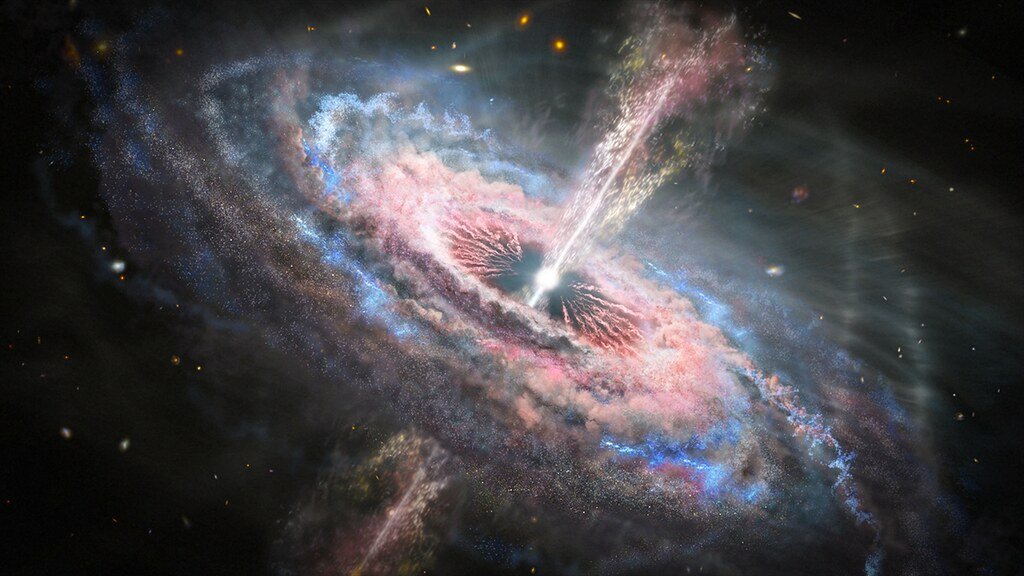
Brighter Than 100 Suns: Scientists Discover Record-Breaking Space Explosions

Suhail Ahmed

Among the most energetic events in the universe’s catalog of violent events since the Big Bang, astronomers have found a new extreme in the class of cosmic explosions. Dubbed extreme nuclear transients (ENTs), these rare, ultra-luminous events were seen in the centers of far-off galaxies where supermassive black holes split apart large stars in catastrophic ...

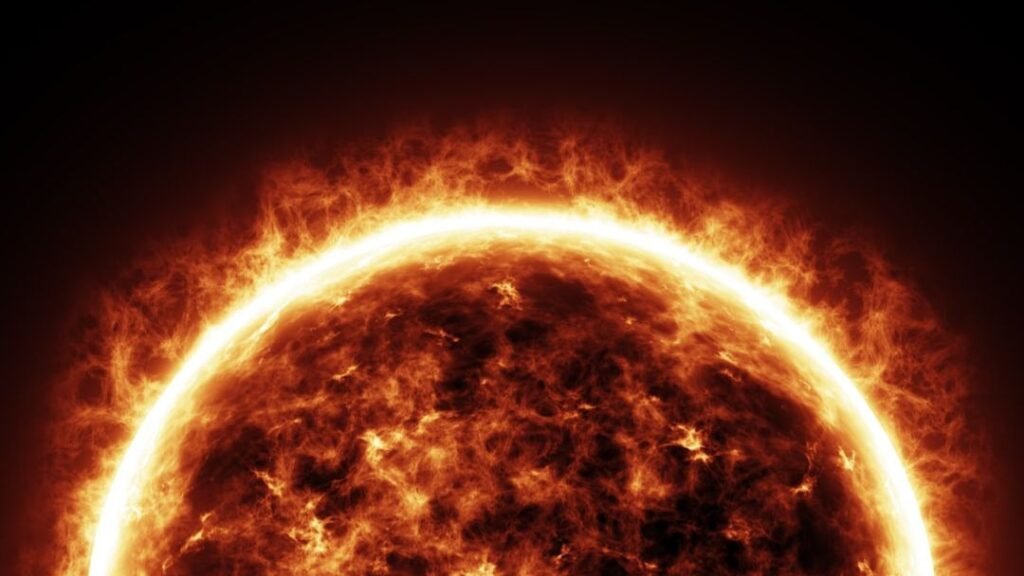
bottom of the sun

Sun’s Hidden Face: Humanity Views the Bottom of the Sun for the First Time

Suhail Ahmed

The Sun’s poles have long been a cosmic mystery buried from Earth’s perspective by the simple fact that our planet, along with every other spacecraft, orbits within the equatorial plane. Thanks to the European Space Agency’s (ESA) Solar Orbiter spacecraft, however, mankind has now seen the solar south pole in history. Captured in March 2025, ...