
Deciphering IC 1262’s Turbulent Environment (Image Credits: Upload.wikimedia.org)
A recent examination of archival telescope data has illuminated how turbulent gas motions reshape the chemical landscape of IC 1262, a nearby galaxy group. Researchers detected prominent cold fronts where cooler, denser gas interfaces with hotter surroundings, carrying elevated levels of heavy elements forged in stellar explosions. These structures, driven by sloshing from past gravitational encounters, offer clues to metal transport in smaller cosmic environments beyond massive clusters.[1][2]
Deciphering IC 1262’s Turbulent Environment
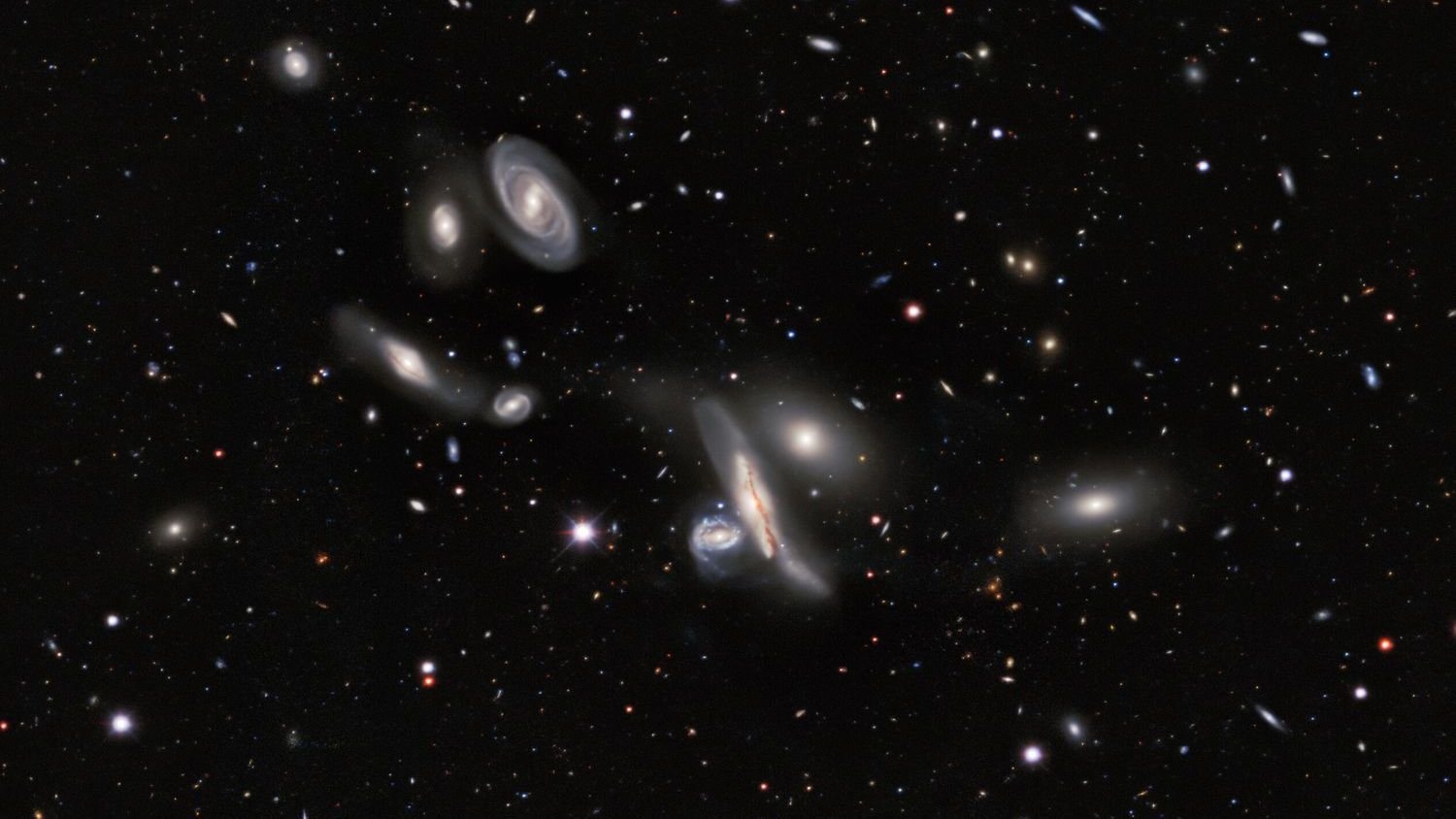
Astronomers led by Satish S. Sonkamble from North-West University in South Africa, along with collaborators from India, turned to existing observations to probe this system. IC 1262 lies at a redshift of 0.032, placing it roughly 140 million light-years away, with each arcsecond spanning about 0.62 kiloparsecs. The group centers on a bright central galaxy that harbors a radio-active nucleus, fueling a north-south jet amid a web of hot intragroup gas.[1]
Four Chandra pointings delivered 142 kiloseconds of exposure in the X-ray band from 0.5 to 7 keV, capturing diffuse emission from multimillion-degree plasma. Complementary radio images came from the Giant Metrewave Radio Telescope at 325 MHz, revealing extended emission aligned with the jet. Gaussian Gradient Magnitude filtering sharpened views of edges in the X-ray brightness, exposing arcs that signal dynamic disruptions.[1]
Mapping Cold Fronts and Surface Edges
Processed Chandra images highlighted two sloshing cold fronts – one prominent to the east and another northwest of the core – stretching up to 200 kiloparsecs. These features appeared as sharp boundaries where surface brightness jumped, with cooler gas (around 1.6-1.9 keV) on the brighter side abutting hotter plasma (2.3-2.4 keV). Pressure remained roughly balanced across them, consistent with hydrodynamic simulations of gentle agitation rather than outright collisions.[1]
Farther out, faint edges emerged at about 100 kiloparsecs east, while a southern arc marked a shock front at a projected 78 kiloparsecs. Density profiles across this shock yielded a compression factor of 1.54, implying a mild Mach number of 1.45 and inflow speeds near 950 kilometers per second. A narrow X-ray ridge, over 180 kiloparsecs long, traced potential past activity linking these phenomena.[1]
Sharp Shifts in Metal Abundance
Spectral fits across 32 regions revealed metallicity gradients tied to these structures. Gas enclosed by the cold fronts proved notably richer in heavy elements, measured relative to solar values (Z⊙). The eastern front showed the starkest contrast, dropping from 0.77 ± 0.10 Z⊙ inside to 0.22 ± 0.05 Z⊙ outside at 25 kiloparsecs projected radius. Overall, interior gas carried 45 ± 8 percent more metals than exterior regions.[1]
| Feature | Metallicity Inside (Z⊙) | Metallicity Outside (Z⊙) | Projected Distance (kpc) |
|---|---|---|---|
| Eastern Cold Front | 0.77 ± 0.10 | 0.22 ± 0.05 | 25 |
| Northwestern Cold Front | 0.57 ± 0.06 | 0.37 ± 0.06 | 37 |
| Southern Shock Front | 0.45 ± 0.05 | 0.22 ± 0.04 | 78 |
These patterns held in deprojected profiles, though caveats persist: measurements reflect projected distances, and non-equilibrium ionization near shocks could inflate abundances by 10-40 percent.[1]
Mechanisms Fueling the Mix
Sloshing emerged as the dominant force, with cold fronts peeling metal-laden core gas outward over gigayears-long timescales. The orthogonal radio jet contributed too: nine of twelve regions along its axis required dual-temperature models, hinting at heated outflows entraining enriched material. The southern shock likely stirred additional turbulence, though its metal drop suggests dilution of inflowing pristine gas.[1]
Radio contours from GMRT overlaid on X-ray maps confirmed jet alignment with brighter emission, underscoring active galactic nucleus feedback’s role. Northern lobes appeared cooler than southern extensions, possibly reflecting asymmetric uplifting.
Insights into Group-Scale Enrichment
IC 1262 exemplifies how mergers and black hole activity interplay in galaxy groups, which host over half of cosmic mass yet remain understudied compared to clusters. The observed transport challenges simple diffusion models, favoring convective sloshing and jet-induced flows. Flat metallicity profiles beyond the fronts contrast with steeper declines elsewhere, signaling widespread core pollution.[2]
Future deeper surveys could quantify non-thermal biases and track multi-phase gas, refining our grasp of chemical evolution in these environments. For now, IC 1262 stands as a nearby laboratory demonstrating nature’s efficient alchemy in the cosmos.