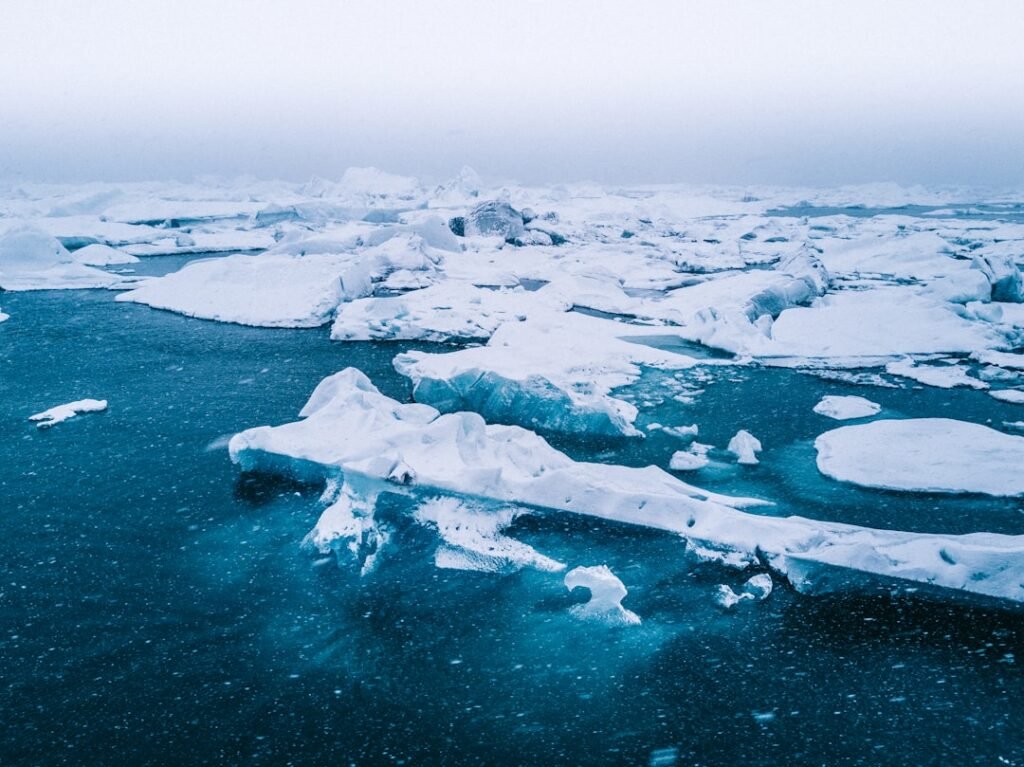
Winter Ice Hits Ominous Milestone (Image Credits: Unsplash)
The Arctic – A region long defined by its frozen expanse now faces profound changes as warming accelerates. Sea ice reached a record-low winter maximum in March 2026, tying the previous year’s extent and underscoring a persistent downward trend.[1] Temperatures there have climbed four times faster than the global average, thinning ice and exposing vast resources beneath.[2] These shifts promise shorter shipping routes and economic gains, yet they heighten rivalries among nations vying for influence in the far north.
Winter Ice Hits Ominous Milestone
Arctic sea ice peaked at 14.29 million square kilometers on March 15, 2026, matching the 2025 low and falling well below the 1981–2010 average.[1] Scientists attributed the decline to reduced new ice formation and scant multi-year ice buildup. Thinner ice prevailed in areas like the Barents Sea and Sea of Okhotsk.
September extents have dropped about 12 percent per decade since the 1980s, with multi-year ice – at least five years old – plunging 90 percent from 1979 to 2018.[2] Models project the first ice-free summer day as early as before 2030 in some scenarios, driven by rapid loss events and internal variability.[3] Such changes amplify regional warming, as less ice reflects fewer sun rays.
Opening Doors to Commerce and Extraction
Melting ice unlocks shipping lanes like Russia’s Northern Sea Route, where transit rose 37 percent from 2013 to 2023.[2] These paths cut travel times versus traditional routes through the Suez or Panama, potentially slashing costs for global trade. Russia has invested heavily in infrastructure to support liquefied natural gas projects and cargo flows.
Beneath the ice lie oil, gas, and critical minerals such as rare earths, graphite, and lithium, drawing interest from powers beyond the Arctic Circle.[2] Greenland emerges as a hotspot, with its deposits vital for green technologies. The European Union forged a partnership there in 2023 to secure sustainable supplies, countering reliance on other processors.
Local communities face mixed impacts. Some Indigenous groups in Alaska, Canada, and Greenland could gain economically from development, bolstering sovereignty claims. Yet thawing permafrost threatens traditional ice-based travel, as noted in past Indigenous reports.[4]
Geopolitical Strains Intensify
Russia dominates current Arctic shipping but faces isolation from bodies like the Arctic Council since its 2022 actions in Ukraine.[5] NATO has ramped up presence, with new members Sweden and Finland, while U.S. bases in Greenland aid surveillance. Disputes persist, such as U.S.-Canada differences over the Northwest Passage.
China pursues minerals aggressively, funding dual-use projects like Russian ports. Climate shifts blur civilian and military lines, raising accident risks in crowded waters and straining governance.[5] Non-Arctic states like India eye influence amid cooling ties among rim nations.
- Russia leverages the Northern Sea Route for energy exports.
- China invests in infrastructure and resource claims.
- NATO bolsters defenses against perceived threats.
- U.S. and allies focus on sovereignty and open seas.
- Indigenous voices push for inclusion in decisions.
Navigating Uncertain Scenarios
Experts outline three overlapping paths: an extractive Arctic with oil and gas booms led by Russia and the U.S.; an endangered one trapped in a cycle of melting enabling more fossil fuels; and an adversarial landscape of rivalry involving Arctic and distant powers.[4] These trends already unfold, intertwining environmental and strategic pressures.
| Scenario | Key Features | Potential Outcomes |
|---|---|---|
| Extractive | Resource development | Economic gains, Indigenous benefits |
| Endangered | Climate-extraction loop | Ice-free acceleration |
| Adversarial | Power competition | Increased tensions, blurred activities |
Permafrost thaw adds urgency, eroding infrastructure and releasing trapped gases.[5] Governance forums, once cooperative, now grapple with mistrust.
Key Takeaways
The Arctic’s transformation demands balanced action to harness opportunities while averting conflict. As ice recedes, global powers must prioritize cooperation over contest. What steps should nations take next? Share your views in the comments.