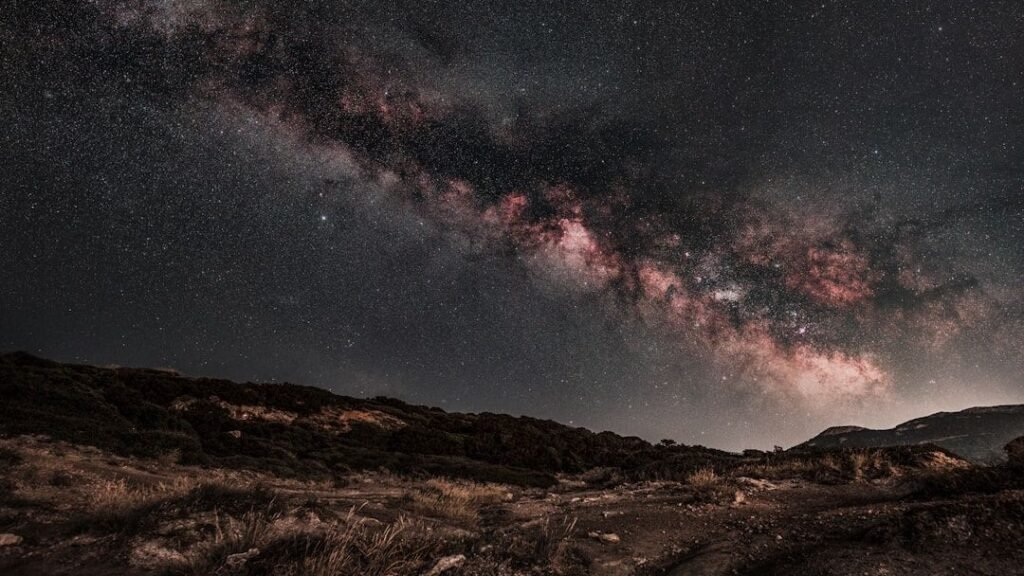

A lost galaxy called ‘Loki’ may be hiding inside the Milky Way – Image for illustrative purposes only (Image credits: Unsplash)
In the bustling disk of the Milky Way, just a few thousand light-years from the Sun, a cluster of exceptionally ancient stars orbits in unexpected ways. These 20 very metal-poor stars, with iron contents less than 1% of the Sun’s, share chemical signatures that set them apart from their neighbors.[1][2] Astronomers analyzed their high-resolution spectra and orbits, uncovering evidence of a long-ago merger with a now-disrupted dwarf galaxy. This finding sheds light on how our galaxy assembled itself in its turbulent youth.
Unusual Orbits Near Home
Astronomers selected these stars from surveys like Pristine and LAMOST because they followed tightly planar paths close to the galactic plane, with maximum heights under 4 kiloparsecs from the midplane. Eleven stars travel in the prograde direction, matching the overall rotation of the Milky Way, while nine move retrograde, against the flow. All exhibit high eccentricities between 0.5 and 0.9, sending them plunging close to the galactic center before swinging out again.[3]
Located within about 2 kiloparsecs of the Sun, the stars reach pericenters under 3 kiloparsecs from the center and apocenters between 8 and 18 kiloparsecs. Such kinematics differ from the more scattered halo population, hinting at a shared history. One star stands out as a potential outlier with a higher vertical excursion, but the group as a whole clusters tightly in chemical space.[2]
Chemical Fingerprints of a Distant Birth
The stars’ spectra, obtained with the ESPaDOnS instrument on the Canada-France-Hawaii Telescope, revealed abundances for 23 elements. Their patterns overlapped with those of Milky Way halo stars but showed notably narrower dispersions, akin to stars from classical dwarf galaxies. Alpha elements like magnesium, silicon, calcium, and titanium lacked the telltale “knee” from Type Ia supernovae, suggesting star formation lasted less than 1 billion years.[3]
Odd-Z elements such as sodium, aluminum, and potassium aligned with halo trends, though potassium appeared slightly elevated. Iron-peak elements like chromium, manganese, cobalt, nickel, and zinc displayed negative slopes with decreasing iron content, with manganese enhanced at higher metallicities. Neutron-capture elements including strontium, yttrium, zirconium, barium, lanthanum, neodymium, and europium pointed to enrichment from high-energy supernovae, hypernovae, fast-rotating massive stars, and neutron star mergers, but not white dwarf explosions.
No significant differences emerged between prograde and retrograde subgroups, reinforcing a common origin. Phylogenetic analysis grouped 19 of the 20 stars closely, with dispersions tighter than in halo samples – probabilities of random halo matches hovered around 0.044%. Chemical evolution models fit a closed-box scenario with an initial baryonic mass of about 1.4 billion solar masses and a star formation rate around 0.1 solar masses per year.[1]
These traits indicate the stars formed in a compact, short-lived system where massive stars exploded rapidly, polluting the gas uniformly before the dwarf’s demise. The absence of longer-lived supernova types underscores the brevity of this environment’s star-forming phase.
The ‘Loki’ Progenitor Emerges
Researchers proposed that these stars hailed from a proto-galactic building block dubbed Loki, named for the Norse trickster god whose chaotic nature mirrors the system’s elusive remnants hidden amid the galactic disk’s dust and stars. Cosmological zoom-in simulations from the NIHAO-UHD suite supported an early, in-plane infall: the dwarf merged with the infant Milky Way, scattering its stars into both prograde and retrograde planar orbits.[3]
Loki’s estimated mass reached roughly 2% of the modern Milky Way’s, potentially twice that of the Large Magellanic Cloud. This places it among significant early contributors to our galaxy’s mass assembly. The merger predated the settling of the Milky Way’s disk around 10 to 12 billion years ago, allowing orbits to randomize without the stabilizing influence of a mature disk.[1]
Early Mergers and Galactic Evolution
The Milky Way grew not through gentle accumulation but via violent cannibalism of smaller satellites. Loki represents a candidate for one of the earliest such events, its stars now tracing chaotic paths through the inner galaxy. While kinematics overlap somewhat with structures like Gaia-Sausage-Enceladus, chemical mismatches – such as differing carbon and chromium trends – argue against simple association.[2]
- Prograde stars (11): Align with disk rotation but high eccentricity.
- Retrograde stars (9): Counter-rotate, rare in the plane.
- Metallicity: [Fe/H] < -2.0, ancient by definition.
- Enrichment sources: Core-collapse supernovae, neutron star mergers.
- Alternatives considered: In-situ formation or multiple dwarfs, but single Loki fits best.
Comparisons with other planar very metal-poor stars reveal broader chemo-dynamical scatter, suggesting multiple progenitors fed the disk’s ancient population. Uncertainties persist, including exact merger timing and whether prograde and retrograde stars truly share one parent or twins with identical chemistry.
Future spectroscopic surveys promise to expand the sample, testing Loki’s reality and mapping more merger fossils. As these detective efforts continue, the Milky Way’s hidden history emerges one star at a time, revealing a cosmos built on disruption and rebirth.[4]