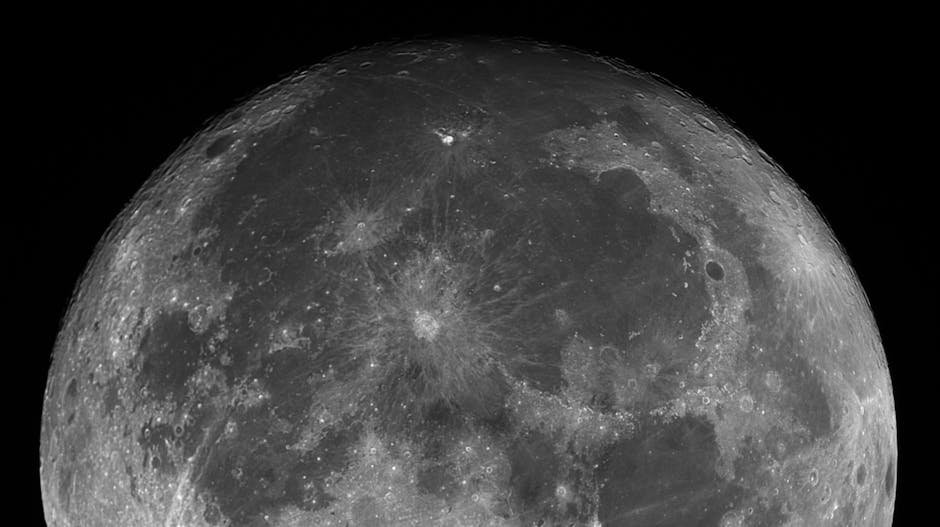
Used SpaceX rocket could crash into the moon’s Einstein crater this summer, report predicts – Image for illustrative purposes only (Image credits: Pexels)
A discarded upper stage from a SpaceX Falcon 9 rocket launched earlier this year is expected to slam into the moon’s Einstein crater on August 5. Trajectory analysts predict the impact will occur around 2:44 a.m. EDT near the lunar body’s edge between its Earth-facing and far sides. The event highlights the challenges of managing space junk amid a surge in lunar missions.
The Origins of the Wayward Booster
SpaceX deployed the 45-foot-tall (13.8 meters) Falcon 9 upper stage in early 2025 to deliver two lunar-bound spacecraft. Firefly Aerospace’s Blue Ghost lander touched down successfully in March 2025, while ispace’s Hakuto-R mission ended in a crash-landing the following June. Once its payloads separated, mission controllers released the booster into an orbit around the Earth-moon system.
The stage has tumbled through space ever since, tracked by asteroid surveys more than 1,000 times over the past year. Its path placed it at roughly the moon’s average distance from Earth, setting the stage for an eventual gravitational encounter. SpaceX did not direct the hardware into a solar orbit, a practice some experts recommend to avoid such lunar risks.
Tracking the Inevitable Path
Astronomer Bill Gray, who runs Project Pluto, calculated the booster’s trajectory using observations of its motion. His software accounts for pulls from Earth, the moon, the sun, and other planets. Solar radiation pressure adds minor perturbations, but these should not shift the predicted strike zone significantly.
Gray detailed his findings in a recent report, reviewed by fellow astronomers though not formally peer-reviewed. He noted, “The motion of space junk is mostly quite predictable; it simply moves under the influence of the gravity of the earth, moon, sun, and planets.” Past successes bolster confidence in the forecast: Gray pinpointed a 2022 lunar crash to within seconds and miles.
Impact Details and Minimal Fallout
The booster will hit at about 5,400 mph (8,700 km/h), roughly seven times the speed of sound on Earth. Observers on our planet likely will miss any flash, as it promises to be too dim even for large telescopes. The report emphasizes that the object “poses no risk to the moon or any working spacecraft.”
Any new crater formed could hold minor scientific value for later probes. Einstein crater sits in a remote area, far from current or planned landing zones. No human outposts exist on the lunar surface to worry about debris scatter.
Key Impact Specs:
- Date/Time: Aug. 5, 2026, ~2:44 a.m. EDT
- Site: Einstein crater, near lunar near/far side border
- Size: 45 feet (13.8 meters) tall
- Speed: 5,400 mph (8,700 km/h)
Rising Stakes in Lunar Traffic
This incident underscores a broader issue as moon missions proliferate. The U.S. eyes Artemis IV and V launches starting in 2028, while China plans taikonaut landings by 2030. More traffic means more discarded hardware unless operators adopt safer disposal routes.
Experts urge sending spent stages into heliocentric orbits beyond Earth-moon influence. Gray’s work serves as a reminder that even predictable junk demands attention in an increasingly crowded cislunar space. The August event may pass unnoticed, but it signals the need for better debris protocols ahead.