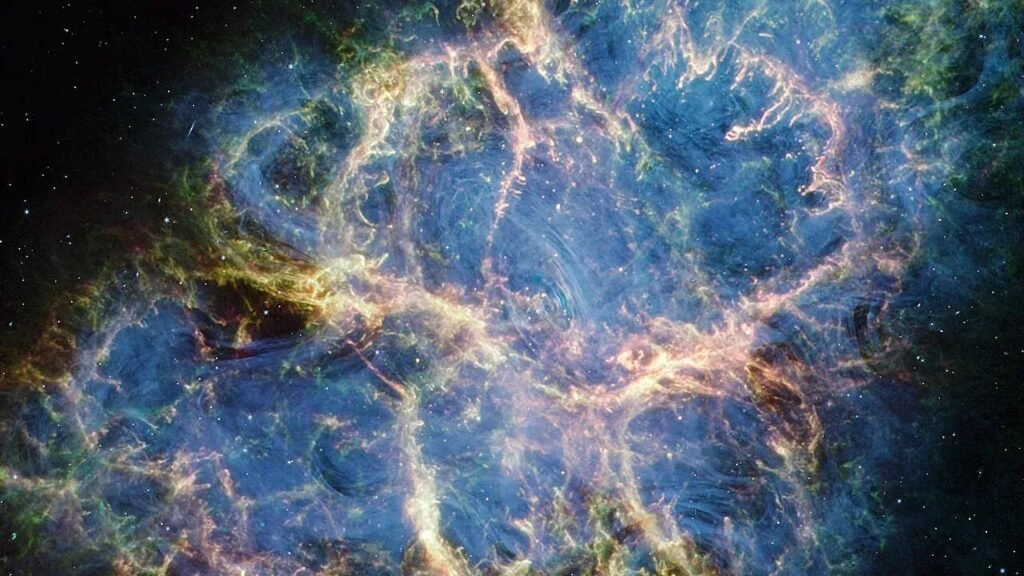
Deep inside the remnants of an ancient stellar explosion, something extraordinary is happening. A dead star no bigger than a city is waging what scientists are now calling a cosmic war, and the battlefield is nothing less than the fabric of space itself.
The Crab Pulsar has fascinated astronomers for decades. It spins dozens of times per second, blazes with energy, and sits at the heart of one of the most studied objects in the night sky. Yet new research is revealing that we barely scratched the surface of understanding what this bizarre object is actually doing. Let’s dive in.
A Dead Star That Refuses to Be Quiet
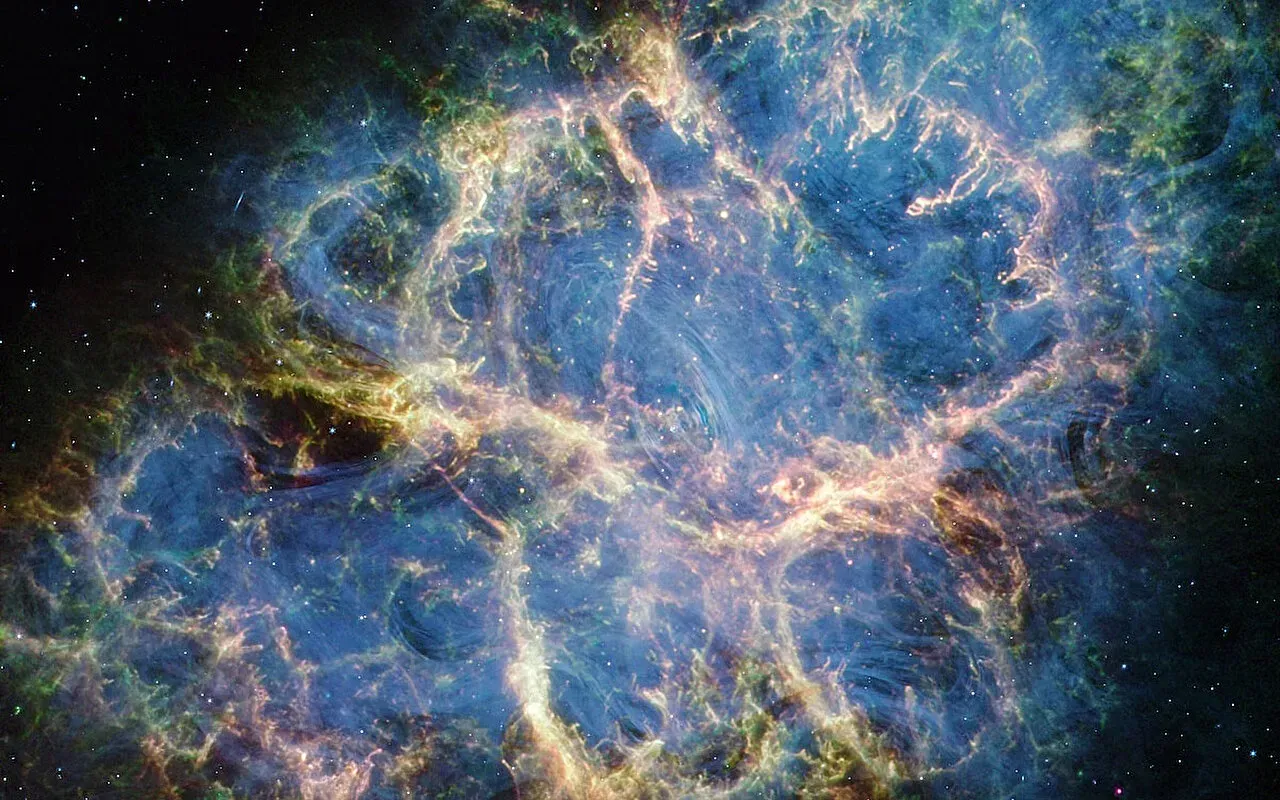
Here’s the thing about neutron stars: they’re supposed to be the quiet aftermath of a catastrophe. A massive star explodes, the core collapses, and what’s left is a dense, spinning remnant that should slowly wind down over millions of years. The Crab Pulsar, however, did not get that memo.
Located roughly six and a half thousand light-years from Earth in the constellation Taurus, this pulsar spins about thirty times every single second. It’s the collapsed heart of a supernova explosion that ancient Chinese astronomers actually recorded witnessing back in 1054 AD. Think about that for a moment. A star exploded, humans saw it happen with the naked eye, and the chaotic aftermath is still making headlines today.
What makes it especially remarkable is the sheer volume of energy it radiates. The pulsar pumps out energy at a rate comparable to roughly a hundred thousand times the total output of our Sun. For a dead star, it’s absurdly alive.
What Scientists Discovered About the Pulsar’s Wind
The new research focuses on something called the pulsar wind nebula, essentially a bubble of particles and magnetic fields being constantly inflated by the spinning neutron star at its center. Imagine blowing into a balloon that never stops expanding, except instead of air, you’re blasting electrons and positrons traveling at nearly the speed of light.
Scientists found that the interaction between this wind and the surrounding supernova remnant is far more turbulent and dynamic than models previously suggested. There’s a genuine clash happening at the boundary where the pulsar’s outward-blowing wind collides with the slower-moving debris from the original explosion. That boundary is called the termination shock, and it turns out to be an incredibly violent, complex place.
The findings reveal that magnetic fields in the nebula are behaving in ways that challenge long-standing theoretical predictions. Honestly, that’s the kind of result that makes astrophysicists both excited and slightly uncomfortable.
The Role of Magnetic Fields in the Cosmic Conflict
Magnetic fields are the unsung heroes, or villains depending on your perspective, of neutron star physics. They shape how energy is transferred, how particles are accelerated, and how the entire nebula evolves over time. In the Crab Pulsar’s case, the magnetic field structure appears to be far more disordered and tangled than clean theoretical models ever anticipated.
What researchers are finding is that this magnetic turbulence is actually driving particle acceleration to extraordinary energies. Particles are being flung to speeds and energies that shouldn’t be achievable given what the simple, tidy models predict. It’s a bit like expecting a gentle stream and finding a raging river instead.
This disordered magnetic environment could explain why the Crab Nebula has long been a source of high-energy gamma rays and X-rays that don’t quite fit neatly into the theoretical boxes scientists had built. The “war” metaphor starts to feel very appropriate here. Two competing physical forces, order and chaos, are constantly fighting for dominance inside this nebula.
New Observational Data That Changed the Picture
The breakthrough came from combining data across multiple wavelengths, pulling together X-ray observations, radio wave data, and high-energy gamma-ray measurements into one unified picture. This kind of multi-wavelength approach is genuinely transformative in modern astrophysics, because each wavelength reveals a different layer of what’s happening.
Using this approach, researchers identified structures within the nebula that shift and evolve over surprisingly short timescales. We’re talking about changes visible on the scale of years, even months, which is essentially the blink of an eye in cosmic terms. Most nebulae change on timescales of thousands to millions of years.
The observation of these rapid structural changes confirms that the energy dynamics inside the Crab Nebula are not static or predictable. They are, to put it simply, wild. And the driving force behind all of this chaos continues to be that tiny, relentlessly spinning neutron star at the center of it all.
Why the Crab Pulsar Matters Beyond Itself
Let’s be real: most astronomical discoveries sound abstract. Distant galaxy does something interesting. Black hole detected somewhere impossibly far away. But the Crab Pulsar is different, and here’s why. It’s close enough and bright enough to serve as a living laboratory for testing fundamental physics theories.
The processes happening inside that nebula, things like particle acceleration, magnetic reconnection, and shock-driven energy transfer, are the same processes that operate in environments across the entire universe. Understanding the Crab is essentially understanding a core set of rules that govern energetic phenomena everywhere from gamma-ray bursts to the jets shooting out of supermassive black holes.
I think this is genuinely one of those cases where studying one object teaches us something profound about the entire cosmos. It’s not just about the Crab. It’s about the physics engine that runs much of the visible, high-energy universe.
Challenges to Existing Theoretical Models
For decades, the standard model of pulsar wind nebulae described a relatively smooth, ordered flow of energy from the spinning star outward into the surrounding nebula. The new findings are punching notable holes in that tidy picture. Repeatedly. The data simply does not match the clean, idealized version of events.
Specifically, the so-called sigma problem, which refers to a long-standing mismatch between the magnetic energy predicted near the pulsar and what is actually observed farther out in the nebula, appears to be even more complicated than previously thought. Rather than resolving the problem, the new data deepens it in interesting ways. The magnetic energy seems to be dissipating through chaotic processes that the standard models didn’t account for.
It’s hard to say for sure whether this means the fundamental models need a minor update or a wholesale revision. The astrophysics community is actively debating this, and the conversation promises to get louder as better observatories come online over the next few years.
What Comes Next for Pulsar Research
With next-generation telescopes either already operating or approaching launch, researchers are in a genuinely exciting position. Instruments capable of higher spatial resolution and broader spectral coverage will allow scientists to watch the Crab Nebula’s internal dynamics with unprecedented detail. We may finally get clear snapshots of the magnetic reconnection events that theory predicts but observation has only hinted at.
There is also growing interest in comparing the Crab Pulsar’s behavior to other younger and older pulsar wind nebulae scattered across the galaxy. Is the Crab truly exceptional, or is it simply the best example of processes happening everywhere? That comparative approach could be the key to building better models.
Either way, the Crab Pulsar is not done surprising us. A dead star born from an explosion nearly a thousand years ago, still churning out data that challenges our smartest theories. That’s not just science. That’s a story worth following closely.
Conclusion: When a Dead Star Teaches Us Something New
It’s genuinely humbling when an object we’ve studied for generations still manages to throw a curveball at the scientific community. The Crab Pulsar research isn’t just a minor update to a footnote in astrophysics textbooks. It signals that our models of how energy, magnetism, and matter interact in extreme environments still have significant gaps.
What I find most compelling about this story is the reminder that the universe doesn’t simplify itself for our convenience. Nature is messy, dynamic, and wonderfully resistant to tidy equations. The cosmic war playing out inside the Crab Nebula is, in a strange way, a perfect metaphor for science itself: a constant struggle between what we think we know and what reality keeps insisting on showing us.
The Crab Pulsar has been surprising humans since 1054. Something tells me it’s far from done.
What do you think? Does it change how you see the night sky knowing that a silent pinpoint of light is actually the site of a raging cosmic battle? Share your thoughts in the comments.