Something strange is happening in the forests of West Africa. Chimpanzees have been spotted picking up shiny crystals, carrying them around, and even placing them carefully inside hollow trees. No eating, no tool use, no obvious survival benefit. Just… collecting.
It sounds almost too human. And that’s precisely what makes it so fascinating. Scientists are now asking whether this behavior hints at something deeper – a shared root between chimpanzee minds and our own ancient ancestors’ mysterious fascination with stones and shiny objects. The implications are genuinely exciting, and honestly a little mind-bending. Let’s dive in.
The Discovery That Started It All
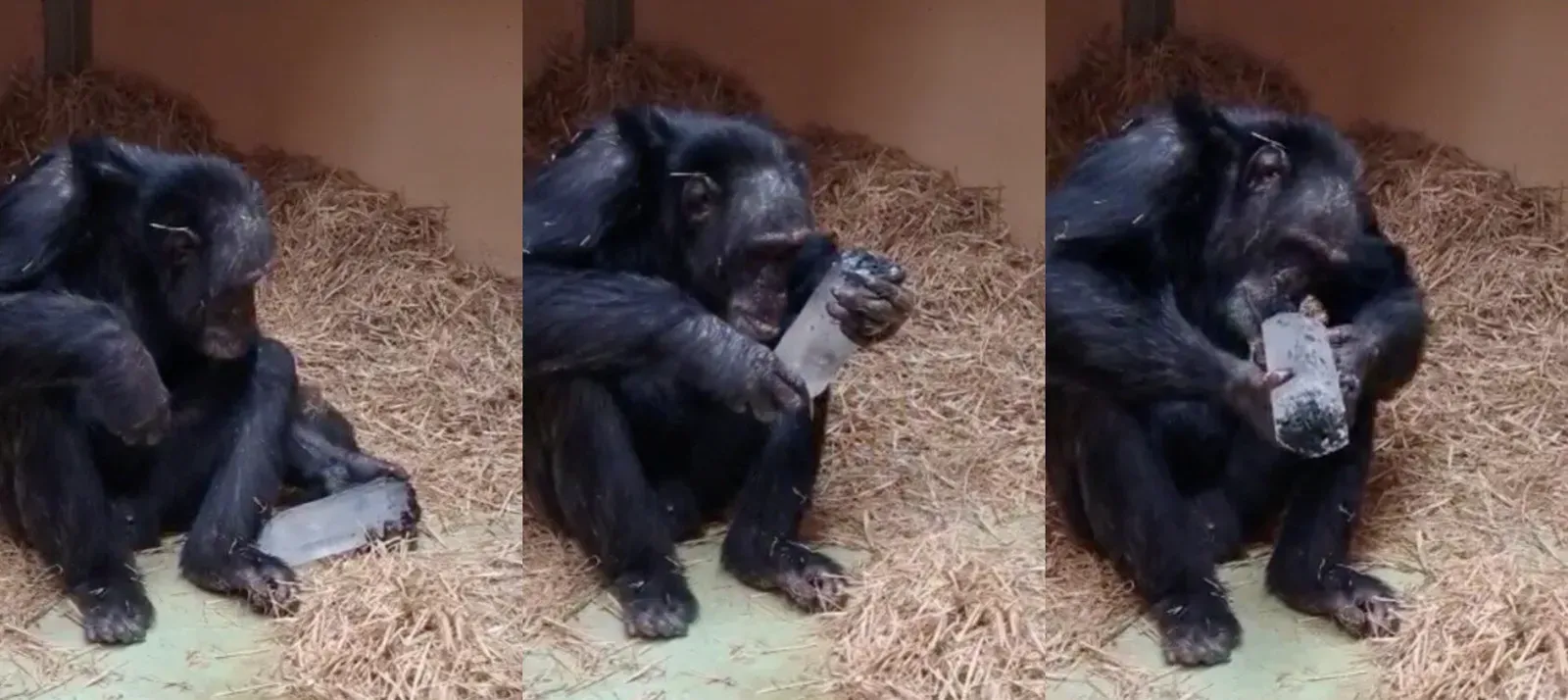
Here’s the thing – researchers didn’t go looking for this. Observations of chimpanzees accumulating crystals and shiny stones at specific sites emerged somewhat by surprise during ongoing behavioral studies in Guinea, West Africa. The chimps were seen repeatedly returning to the same locations, depositing quartz crystals inside tree cavities with what appeared to be deliberate, almost ritualistic care.
What struck scientists immediately was the complete absence of any functional explanation. These stones weren’t being used to crack nuts or dig for food. They were simply being collected and stored. That distinction matters enormously, because it separates this behavior from ordinary tool use and pushes it into far more mysterious territory.
Not Just One Chimp – A Community Behavior
You might think this was a quirk of a single eccentric chimp. It wasn’t. The behavior was observed across multiple individuals within the same community, suggesting it’s socially transmitted rather than a random individual habit. That’s a critical distinction in primatology – when behavior spreads through a group, it starts looking a lot like culture.
It also means younger chimps are likely learning this behavior by watching older members of the group. Think of it like a tradition being passed down, not unlike the way human children absorb rituals they don’t fully understand but participate in anyway. The parallels to early human symbolic behavior are hard to ignore, even if researchers are careful not to overstate them.
What Are the Chimps Actually Doing With the Crystals?
The specific action of placing objects inside hollow trees is particularly intriguing. Researchers describe it as “accumulative throwing” – a behavior where objects are tossed or placed into specific spots repeatedly over time. These accumulation sites become something like shrines, though scientists rightly avoid that word without more evidence.
The crystals themselves are often quartz, which has a natural sparkle and catches light in a visually striking way. It’s hard to say for sure, but the chimps do seem to be selecting objects based on visual properties rather than grabbing whatever is nearby. That selective attention to appearance suggests something beyond simple instinct. It hints at preference, maybe even aesthetic sensitivity.
Could This Explain Early Human Fascination With Shiny Objects?
This is where things get genuinely profound. Archaeological records show that early humans were collecting non-functional shiny or colorful stones tens of thousands of years ago, long before art or language as we understand them existed. For years, researchers struggled to explain this behavior. Now, seeing it mirrored in our closest living relatives, a new hypothesis is forming.
The idea is that a shared ancestor of both humans and chimps may have already possessed this tendency to be drawn to visually interesting objects. Rather than humans inventing the behavior from scratch, it could be something inherited – a cognitive trait with deep evolutionary roots. Honestly, I find that remarkably humbling. The person admiring a gemstone necklace today might be expressing an impulse that is millions of years old.
The Science of “Sacred” Spaces in the Animal Kingdom
Researchers have been cautious but increasingly open to the idea that certain animal behaviors may reflect rudimentary forms of ritual or symbolic thought. The chimp crystal sites fit into a broader conversation about so-called “sacred spaces” in the animal world. Bowerbirds, for example, construct elaborate structures decorated with specific colored objects purely for display purposes – beauty for its own sake.
The chimp behavior adds a new dimension to this discussion because chimpanzees are cognitively far closer to humans than bowerbirds. If chimps are engaging in accumulative, location-specific, non-functional object placement, it raises the question of what else might be happening in their inner lives that we simply can’t observe. The concept of animal “culture” is no longer fringe science – it’s increasingly mainstream, and discoveries like this are exactly why.
What This Means for Understanding Chimpanzee Intelligence
Let’s be real: we have consistently underestimated chimpanzee cognition throughout the history of primatology. They use tools, grieve their dead, wage coordinated group conflicts, and now apparently collect shiny stones with apparent deliberateness. Each new discovery nudges our understanding of the chimp mind further from “clever animal” and closer to something uncomfortably familiar.
This crystal-collecting behavior, if confirmed as a widespread and culturally transmitted practice, would represent a significant addition to the growing catalog of chimpanzee complexity. It suggests chimps may have something resembling preference for beauty, a concept once considered exclusively human. That’s not a small claim. Researchers are still cautious, and rightly so, but the evidence is building in a direction that’s hard to dismiss.
The Bigger Picture: What It Means for Human Uniqueness
Every few years, science chips away at another behavior we assumed made humans categorically unique. Language, tool use, mourning, problem-solving – the list of “only humans do this” keeps shrinking. Crystal collecting might be the latest item to join that list, and it’s one of the most symbolically loaded examples yet.
The question isn’t really whether chimps are “becoming more human.” They’re not. The more accurate and more interesting interpretation is that humans were never as separate from the rest of the animal kingdom as we liked to believe. Our fascination with beautiful, shiny, seemingly useless objects may be an ancient inheritance – a glittering thread connecting us to a shared evolutionary past.
A Closing Thought Worth Sitting With
There’s something almost poetic about this discovery. Deep in a West African forest, a chimpanzee carefully tucks a sparkling crystal into a hollow tree, for reasons no scientist can fully explain yet. Thousands of miles away, humans fill museums with glittering gems, hang crystals from their windows, and pass down heirloom stones through generations. Different species, different contexts, same inexplicable pull toward the shiny and the beautiful.
Maybe the drive to find meaning in a glittering stone isn’t uniquely human after all. Maybe it’s just what minds like ours – and apparently theirs – naturally do when they reach a certain level of awareness. What does it say about us that we’re only now starting to recognize ourselves in them?