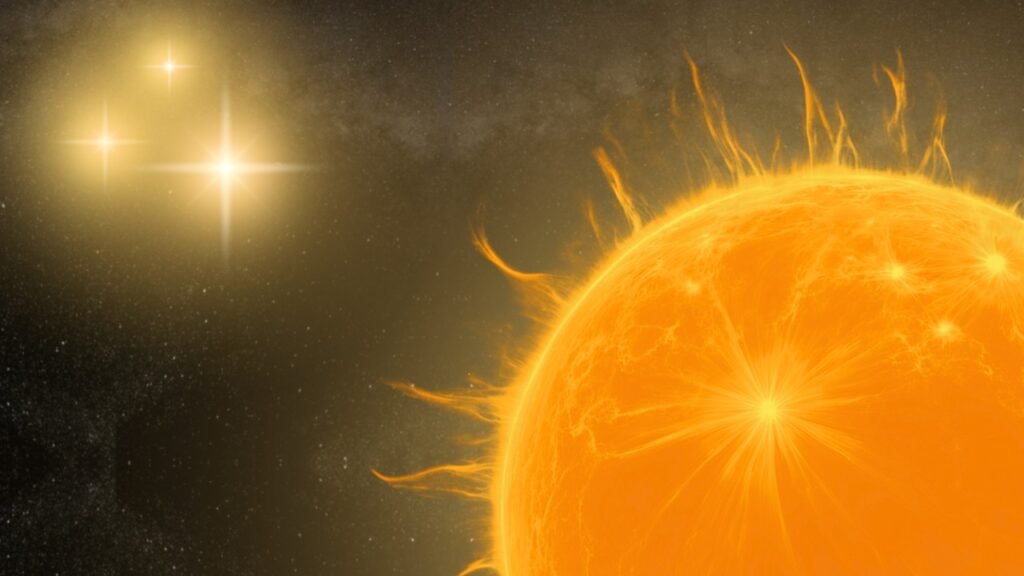
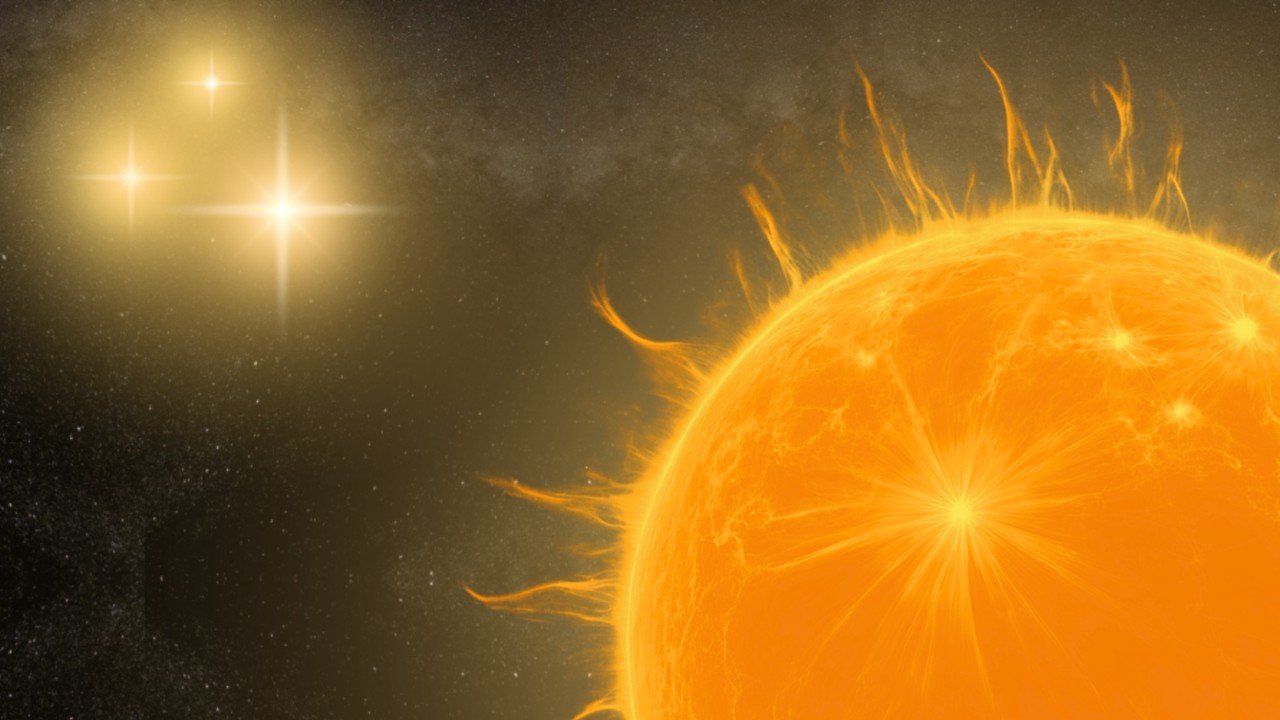
TESS Spots an Unusual Light Show (Image Credits: Cdn.mos.cms.futurecdn.net)
Astronomers recently unveiled TIC 120362137, the tightest known 3+1 quadruple star configuration, where three Sun-like giants whirl in a space smaller than Mercury’s orbit.[1][2]
TESS Spots an Unusual Light Show
NASA’s Transiting Exoplanet Survey Satellite first detected the system during observations spanning 2019 to 2024. Brightness dips revealed an eclipsing binary pair, but additional fadings hinted at more complexity. Researchers analyzed nine sectors of TESS data and spotted eclipse timing variations that pointed to a third star.[1]
Ground-based follow-up sealed the quadruple nature. Teams collected 73 spectra from observatories in Hungary, Arizona’s Fred L. Whipple Observatory, the Czech Republic, and Slovakia. The QUADCOR algorithm separated spectral lines from all four stars, enabling precise measurements of masses, radii, and orbits.[3]
Inner Triple Pushes Density Boundaries
The core features an eclipsing binary labeled Aa and Ab. Star Aa weighs 1.75 solar masses with a radius three times the Sun’s, while Ab tips the scales at 1.36 solar masses and 1.5 solar radii. Both burn hotter than the Sun, at around 6600-6700 Kelvin.[1]
A third star, B, at 1.48 solar masses and 1.76 solar radii, circles this pair every 51.3 days. The entire inner trio occupies a volume more compact than Mercury’s 88-day solar orbit. Their close quarters – innermost period just 3.28 days – defy expectations for stability in multi-star setups.[2]
| Component | Mass (M☉) | Radius (R☉) |
|---|---|---|
| Aa | 1.75 | 3.0 |
| Ab | 1.36 | 1.5 |
| B | 1.48 | 1.76 |
Fourth Star Completes the Hierarchy
The outer companion, C, mirrors the Sun at 1.0 solar mass and 0.93 solar radius, orbiting the inner triple every 1046 days. This period marks the shortest outer orbit recorded for a 3+1 system. Its path lies closer to the central stars than Jupiter sits from our Sun.[1][4]
Such hierarchical arrangements keep chaos at bay. Mutual inclinations stay low – A-B at 0.47 degrees, A,B-C under 10 degrees – ensuring long-term stability per Mardling & Aarseth criteria. Simulations project the setup endures over a billion years.[1]
- Innermost binary (Aa-Ab): 3.28 days
- Triple orbit (A-B): 51.3 days
- Outer quadruple (ABC): 1046 days
Insights into Stellar Birth and Evolution
Lead author Zoltán Dencs and colleagues, including Tamás Borkovits from Baja Astronomical Observatory, detailed findings in Nature Communications. “This inner subsystem… is more spatially compact than Mercury’s orbit around our Sun,” the team noted in the abstract.[1]
Co-author Tibor Mitnyan highlighted formation challenges. “Stars are generally formed in groups… However, the formation of compact hierarchical systems is a very actively studied area,” he explained. Models suggest disk fragmentation and migration shaped this rarity.[4]
Looking ahead, the inner stars face mergers, evolving the system into a double white dwarf pair. This outcome underscores how compact multiples mask their origins over time.
Key Takeaways
- TIC 120362137 holds the record for compactness in 3+1 quadruples.
- Inner three stars exceed solar mass, packed tighter than Mercury’s orbit.
- Stable hierarchy promises insights into multi-star dynamics.
This discovery reframes how tightly stars can coexist, inviting deeper probes into cosmic crowding. What surprises might TESS uncover next in stellar families?