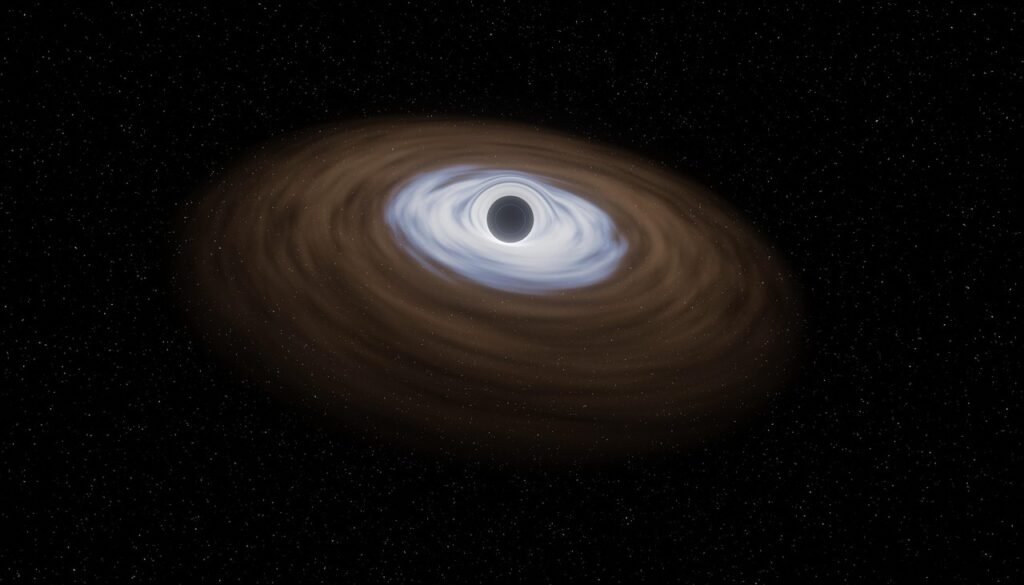
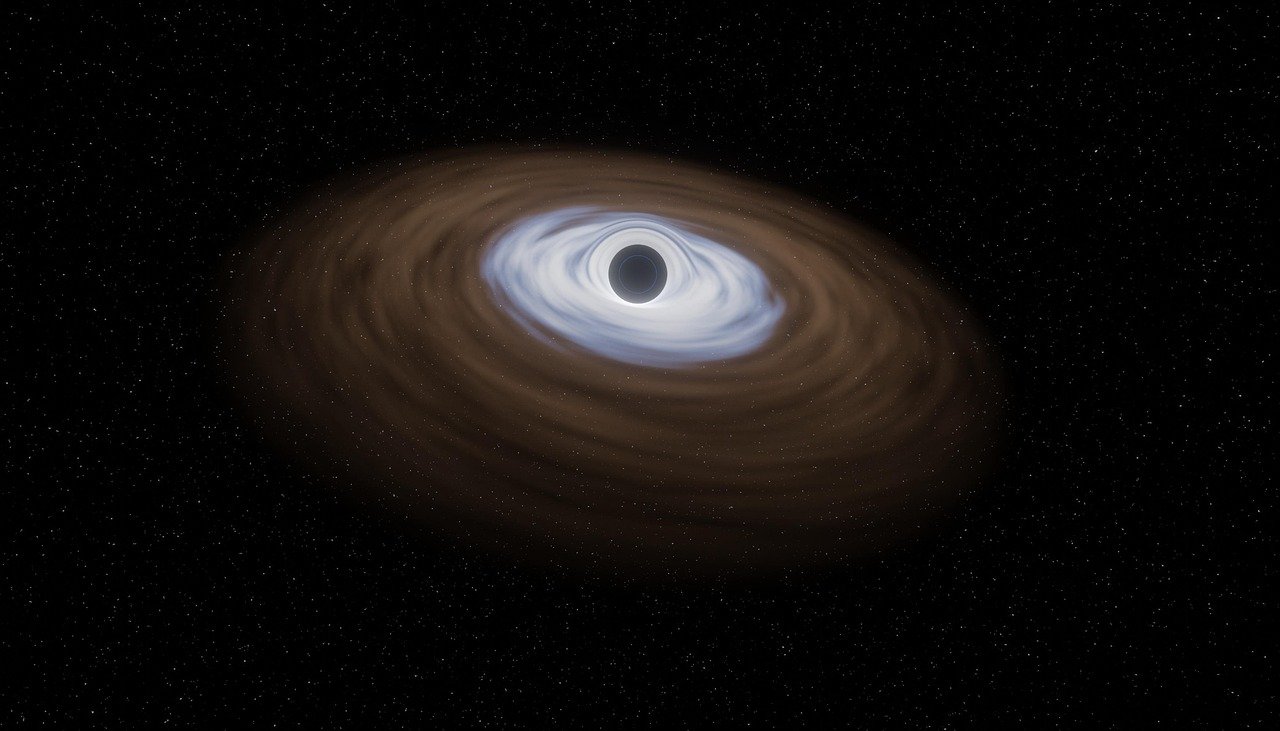
Rare Tidal Disruption Reveals Hidden Giant (Image Credits: Pixabay)
Astronomers pinpointed a supermassive black hole roaming 2,600 light-years from its galaxy’s core after it ripped apart a star 600 million light-years from Earth.[1][2]
Rare Tidal Disruption Reveals Hidden Giant
Researchers detected the event, known as AT2024tvd, through the Zwicky Transient Facility’s optical sky survey. The flare’s position stood out immediately – far removed from the host galaxy’s nucleus. Follow-up observations confirmed all hallmarks of a tidal disruption event, or TDE, where intense gravity stretches and shreds an unlucky star.[3]
This marked the first such offset TDE captured by optical surveys among roughly 100 recorded examples. Previous off-nuclear cases involved smaller intermediate-mass black holes in dwarf galaxies. Here, the culprit proved far larger and more displaced within a massive host galaxy.[1]
How a Star’s Demise Lit the Way
TDEs unfold when a star ventures too close to a black hole. Tidal forces overcome the star’s self-gravity, elongating it into a stream of debris. One stream plunges inward, heating up as it forms a glowing accretion disk, while the other stretches outward.[2]
The process unleashed radiation across wavelengths, from X-rays to visible light. Early phases showed a bright flare, followed by a plateau where disk emission dominated. Broad emission lines of hydrogen, helium, carbon, nitrogen, and silicon further distinguished the outburst from a supernova.[3]
Such events briefly reveal otherwise dormant black holes, occurring roughly once every 10,000 to 100,000 years per galaxy.
Probing the Black Hole’s Identity
A team modeled the light curve and spectral energy distribution during the plateau phase. They employed the kerrSED framework, accounting for disk temperature, size, black hole spin, viewing angle, and Comptonization effects that boost X-ray output.[1]
The analysis yielded a mass of about one million solar masses – firmly supermassive territory. Deep images revealed scant surrounding stars, stripped away by the parent galaxy’s gravity, yielding an extreme black hole-to-stellar-mass ratio exceeding 3 percent.
| Telescope | Role |
|---|---|
| Hubble Space Telescope | Precise optical/UV positioning and emission lines |
| Chandra X-ray Observatory | X-ray offset confirmation |
| Zwicky Transient Facility | Initial flare detection |
| XMM-Newton | Detailed X-ray spectra |
Lead researcher Yuhan Yao of UC Berkeley noted, “AT2024tvd is the first offset TDE captured by optical sky surveys, and it opens up the entire possibility of uncovering this elusive population of wandering black holes.”[2]
Origins and Cosmic Implications
The black hole likely arrived via galaxy merger, sinking slowly toward the center while shedding stars. The host harbors a larger 100-million-solar-mass black hole at its core, but the pair remains unbound.[4]
- Alternative scenario: Ejection from the core through three-body interactions with other black holes.
- No compact dwarf galaxy or star cluster accompanies it, unlike prior cases.
- Disk properties align with nuclear TDEs from supermassive black holes.
- Mass estimation proved reliable without host-galaxy assumptions.
Ryan Chornock, also from UC Berkeley, stated, “Tidal disruption events hold great promise for illuminating the presence of massive black holes that we would otherwise not be able to detect.”[2] Future surveys like the Vera C. Rubin Observatory promise to uncover more wanderers.
Key Takeaways
- First supermassive off-nuclear TDE pins down a 1-million-solar-mass drifter.
- Multi-wavelength modeling confirms mass independently.
- Galaxy mergers likely seed these cosmic nomads.
This discovery reshapes views on black hole dynamics post-merger. It signals TDEs as prime detectors for displaced giants. What do you think this means for understanding galaxy growth? Tell us in the comments.