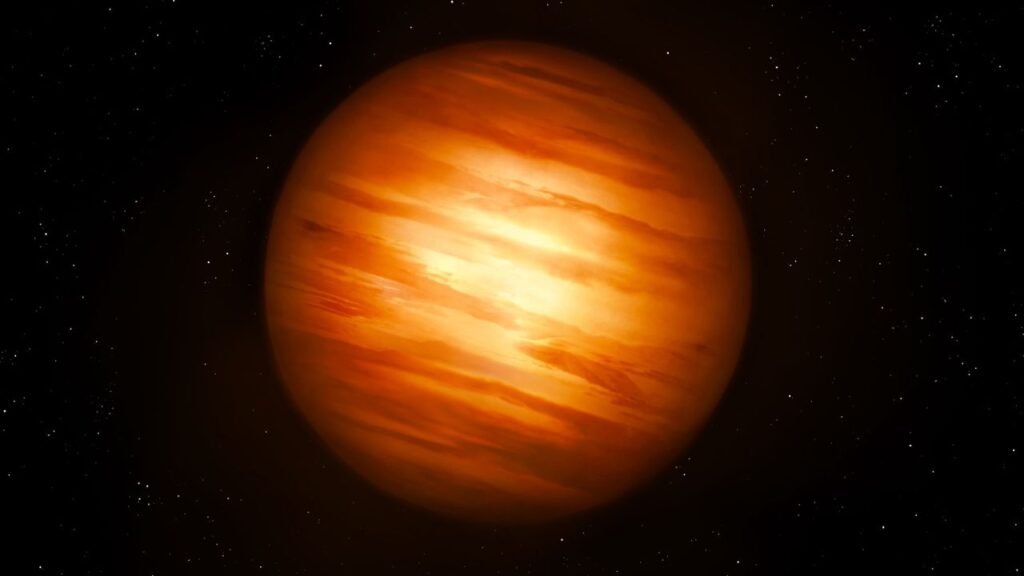
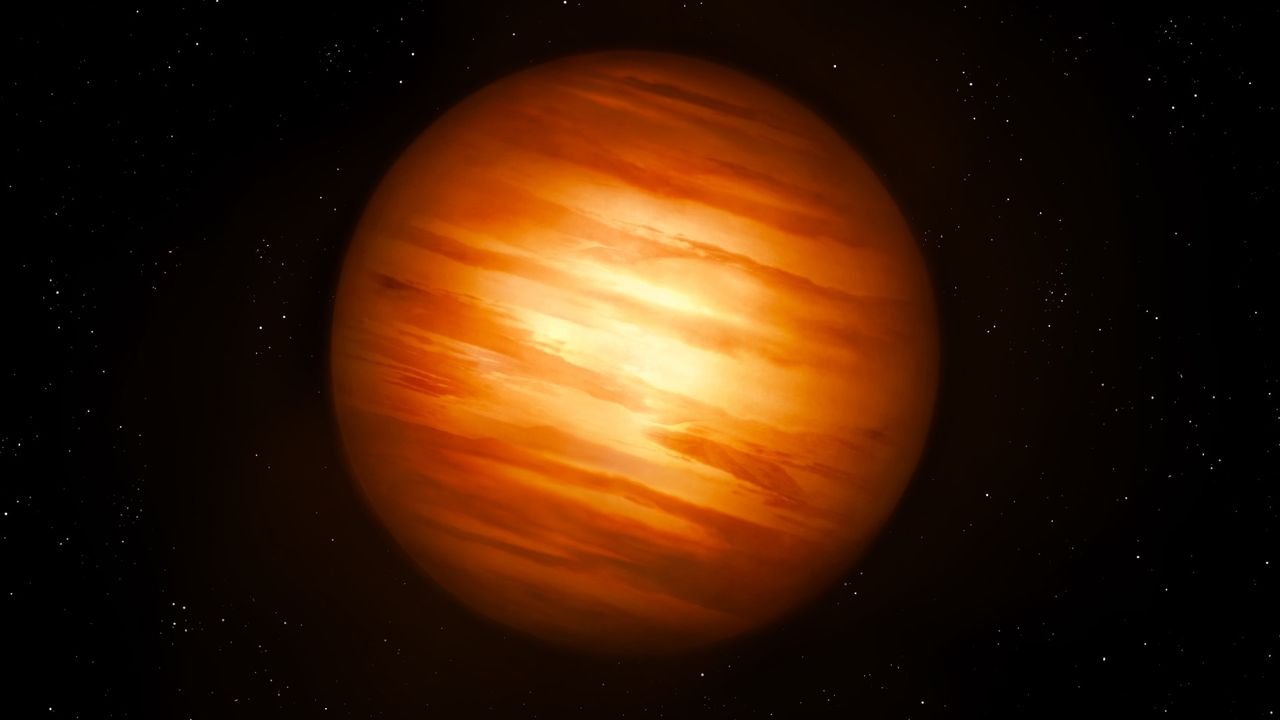
Straddling the Cosmic Divide (Image Credits: Cdn.mos.cms.futurecdn.net)
Astronomers face a persistent challenge in classifying brown dwarfs, celestial bodies that occupy the ambiguous space between gas giant planets and true stars.[1][2]
Straddling the Cosmic Divide
Brown dwarfs emerge as too massive to fit neatly as planets yet too small to shine as stars. These objects typically range from 13 to 80 times the mass of Jupiter, placing them well beyond the heftiest gas giants like Jupiter itself.[1]
Unlike stars, which sustain hydrogen fusion in their cores, brown dwarfs lack the gravity to ignite this process steadily. However, those above roughly 13 Jupiter masses can briefly fuse deuterium, a heavier hydrogen isotope, marking a key distinction from planets.[3] This fleeting nuclear activity generates initial heat and light before the objects cool over billions of years.
Spectral analysis reveals their evolution: early types resemble red dwarfs, shifting to cooler L, T, and Y classes with temperatures dropping below 600 Kelvin. Such traits evoke Jupiter’s stormy atmosphere but on a grander scale.[1]
Formation Mysteries Unraveled
Researchers long debated whether brown dwarfs arise like stars or planets. Evidence points to star-like origins through the gravitational collapse of molecular clouds, rather than accretion in protoplanetary disks around host stars.[2]
“I typically say, brown dwarfs form in the same way stars like our sun form, but are very low mass and look more like Jupiter,” notes astronomer Kelle Cruz.[2] Turbulent fragmentation in collapsing gas clouds appears to produce these loners, often found isolated or in wide binaries.
Lower-mass examples blur lines further, prompting questions about disk ejection or hybrid formation. Observations confirm thousands exist, detected via infrared surveys since the 1990s discoveries of Teide 1 and Gliese 229B.[1]
| Category | Mass Range (Jupiter Masses) | Formation | Fusion Type |
|---|---|---|---|
| Planets | <13 | Disk accretion | None |
| Brown Dwarfs | 13-80 | Cloud collapse | Deuterium (brief) |
| Stars | >80 | Cloud collapse | Hydrogen (sustained) |
Insights from Cutting-Edge Studies
A recent analysis of 70 objects spanning Jupiter-mass worlds to near-stellar brown dwarfs highlights spectral similarities, challenging rigid classifications.[4] These “weird stars” exhibit traits that could tilt interpretations toward overgrown planets or underdeveloped stars.
Upcoming missions like SPHEREx promise detailed atmospheres, while the Vera C. Rubin Observatory will track their motions for formation clues. Such data bridges gaps in understanding exoplanets and low-mass stellar evolution.[2]
- Deuterium burning sets the planet-brown dwarf boundary at about 13 Jupiter masses.
- Brown dwarfs cool rapidly, shifting spectral types over time.
- They often roam freely, unlike bound planetary systems.
- Infrared telescopes revolutionized their detection.
- They inform models of young Jupiter-like worlds without stellar glare.
Broader Implications for the Universe
Brown dwarfs reshape views of cosmic populations, potentially outnumbering stars in the galaxy. Their study reveals how mass dictates destiny – from glowing behemoths to dim wanderers.
By mimicking planetary atmospheres sans host-star interference, they offer labs for exoplanet science. Future surveys will refine the star-planet continuum, illuminating formation across scales.[2]
Key Takeaways
- Brown dwarfs form via stellar processes but fail hydrogen fusion.
- Mass threshold of 13 Jupiter masses enables deuterium burning.
- They bridge stars and planets, aiding exoplanet research.
Brown dwarfs remind us that nature defies neat boxes, urging deeper probes into the universe’s building blocks. What aspect of these cosmic misfits intrigues you most? Share in the comments.