You expect seasons to repaint forests and skies, but not entire lakes. Yet in a few rare corners of the world, you can watch a body of water shift from milky turquoise to deep cobalt, from dull green to fiery red, or even to bubblegum pink as the months roll by. These colours are not tricks of camera filters; they are chemistry unfolding on a landscape scale, right in front of you. As you meet these six shape‑shifting lakes, you are really meeting six different natural laboratories. Minerals, microscopic algae, ice, salt, and sunlight all collide in precise ways to bend light differently at different times of year. Once you see how it works in each place, you start noticing the science in every patch of water you walk past.
Moraine Lake, Canada: Rock Flour Turning Sunlight Into Turquoise
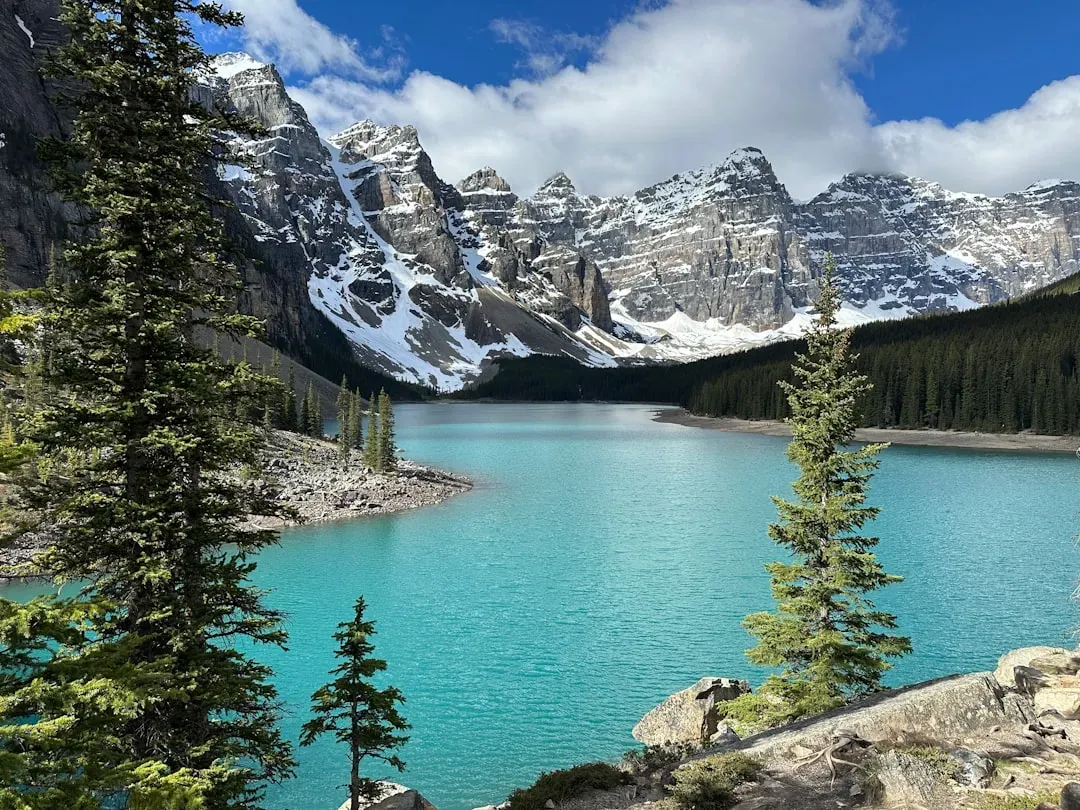
If you stand at Moraine Lake in early spring, you might be surprised by how underwhelming it looks: dark, cold, still partly ice‑covered. Come back in mid‑summer, though, and it is like someone swapped the water for liquid gemstone, a vivid turquoise that does not seem real. You are watching one of the simplest but most dramatic seasonal colour switches on Earth, driven by glacial “rock flour.” ([nps.gov](https://www.nps.gov/articles/glacialtillandglacialflour.htm?utm_source=openai)) High above the lake, grinding glaciers shave the surrounding rock into ultra‑fine dust that rivers carry into the basin as the weather warms. These suspended particles are just the right size to scatter shorter blue and green wavelengths of sunlight back to your eyes, while letting longer reds pass through. In late summer, when meltwater is heaviest and rock flour is thickest, you see the most electric turquoise; in late autumn and winter, with less fresh sediment and more ice, the colour deepens toward a duller blue‑grey.
Blue Lake, Australia: A Seasonal Switch From Steel Grey to Cobalt
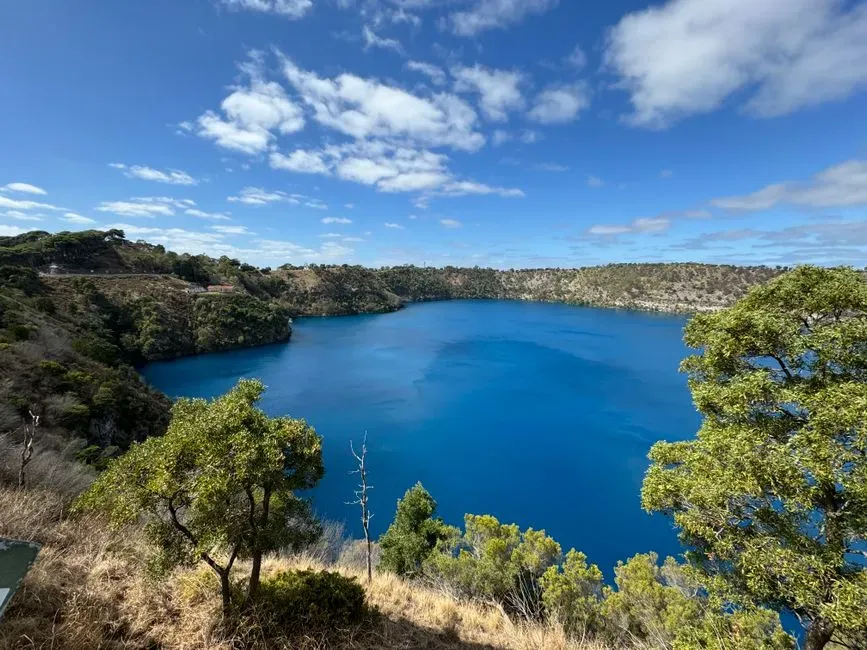
At South Australia’s Blue Lake on Mount Gambier, you could almost think someone flips a hidden light switch each year. In winter the lake can look greyish blue, a bit gloomy under overcast skies. Then, as late spring and summer arrive in the Southern Hemisphere, the water abruptly turns an intense cobalt blue that seems to glow from within. ([mdpi.com](https://www.mdpi.com/2073-4441/12/3/771?utm_source=openai)) You are seeing chemistry between dissolved limestone and changing temperature. The lake sits in a volcanic maar surrounded by carbonate‑rich rocks. In cooler months, the water holds more dissolved calcium and bicarbonate. As the surface warms in late spring, tiny calcite crystals begin to precipitate out. Those microscopic crystals scatter short‑wavelength light, particularly blue, much more strongly than red, so the whole lake brightens into that saturated colour. When the water cools again and mixing changes, the scattering weakens, and the lake slides back toward its muted winter tone.
Five Flower Lake, China: Travertine, Algae and a Moving Palette
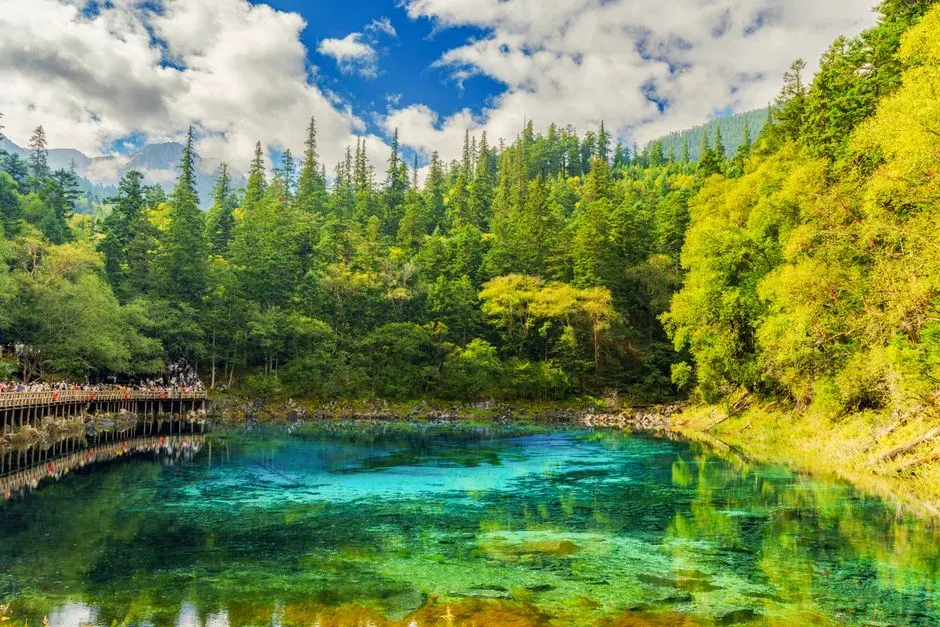
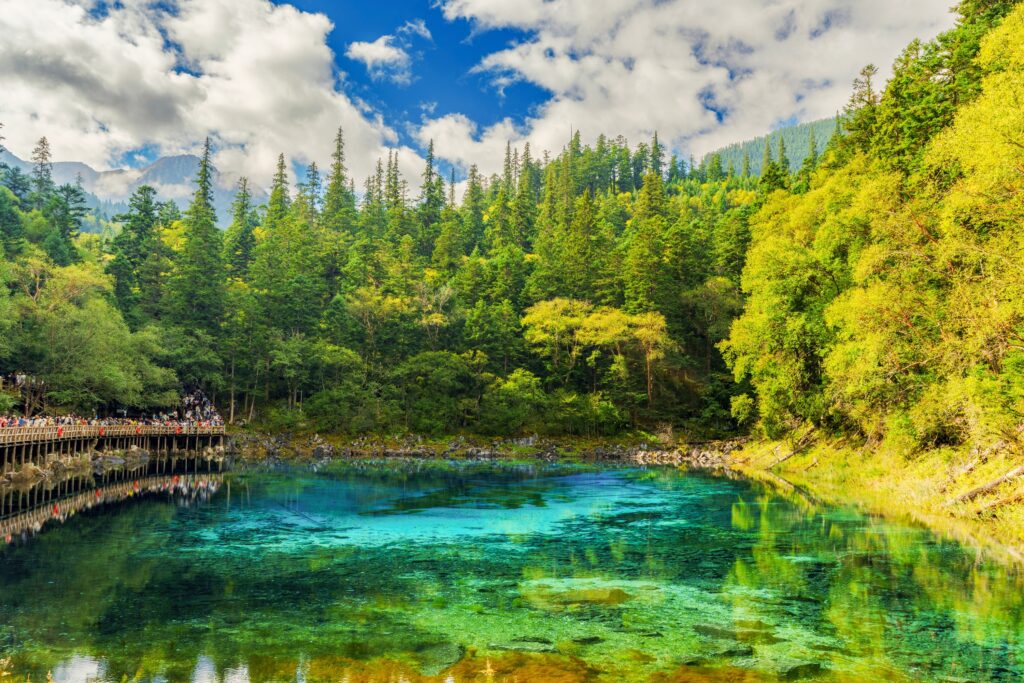
In Jiuzhaigou’s Five Flower Lake, you do not just see one colour change; you see entire bands of turquoise, emerald, sapphire, and golden brown appear and fade as the seasons rotate. In summer, the lake feels like a stained‑glass window laid flat on the ground. By winter, under snow and low sun, it shifts toward deeper blue‑greens, with some hues almost disappearing. ([jiuzhaigou-travel.com](https://www.jiuzhaigou-travel.com/five-flower-lake-jiuzhaigou/?utm_source=openai)) The magic comes from two things you might not expect to work together: white mineral deposits called travertine and layers of algae clinging to submerged trunks and terraces. The travertine is mostly calcium carbonate, which makes the water very clear and enhances blue‑green scattering, while different algae and aquatic plants add their own pigments. As temperature, sunlight, and nutrient levels change through the year, some algae bloom and others fade. That seasonal shuffling of pigments, on top of a crystal‑clear, mineral‑rich base, is what lets you watch the lake’s colours migrate and remix from one month to the next. ([planchinatrip.com](https://www.planchinatrip.com/cities/jiuzhaigou/attractions/five-flower-lake?utm_source=openai))
Laguna Colorada, Bolivia: Red Microalgae Painting a High‑Altitude Lagoon
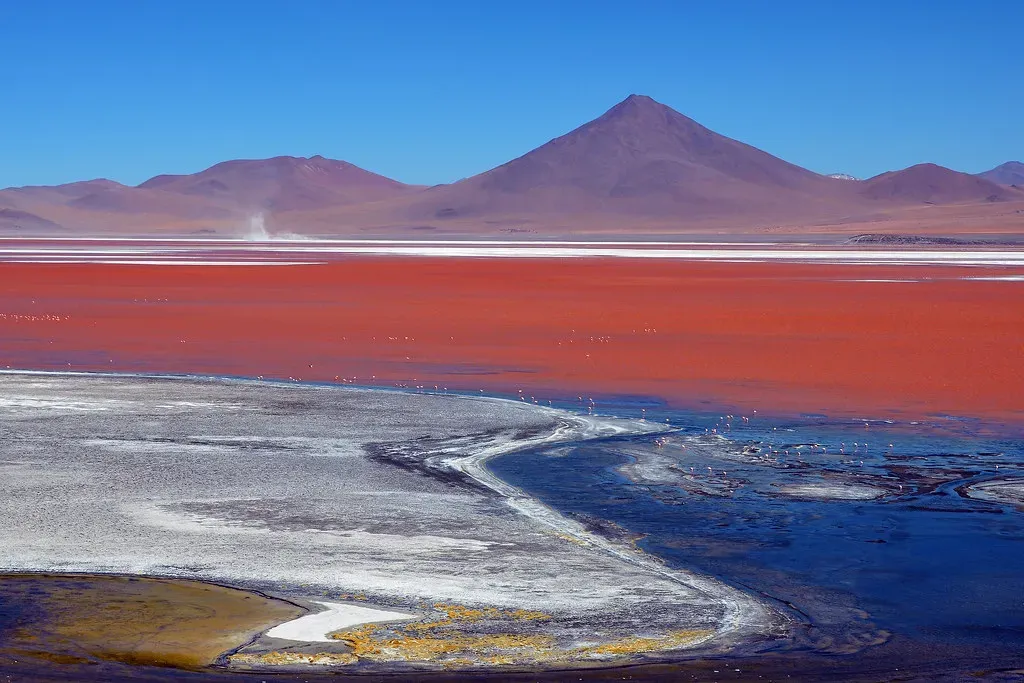
When you first see photos of Bolivia’s Laguna Colorada, it almost looks edited: a shallow lake stained rusty red, framed by snow‑tipped volcanoes and dotted with flamingos. What you might not realise is that the red is not constant. At some times of year, you would see more brick‑red streaks and patches; at others, the water leans toward brownish or even greenish tones. ([en.wikipedia.org](https://en.wikipedia.org/wiki/Laguna_Colorada?utm_source=openai)) Here the key players are halophilic (salt‑loving) microalgae, especially a species called Dunaliella salina, and other microorganisms that produce carotenoid pigments. These pigments are chemically similar to the ones that colour carrots and flamingos, and they build up more when the water is very salty and sunlit. As rainfall, evaporation, and temperature change across the seasons, salinity and water depth shift, which in turn alters how well the algae grow and how many pigments they produce. That is why you might see Laguna Colorada blazing red in one season and noticeably duller or greener in another, even though the lagoon itself has not moved an inch.
Seasonal Pink Lakes in Western Australia: Microbes, Salt and Sunlight
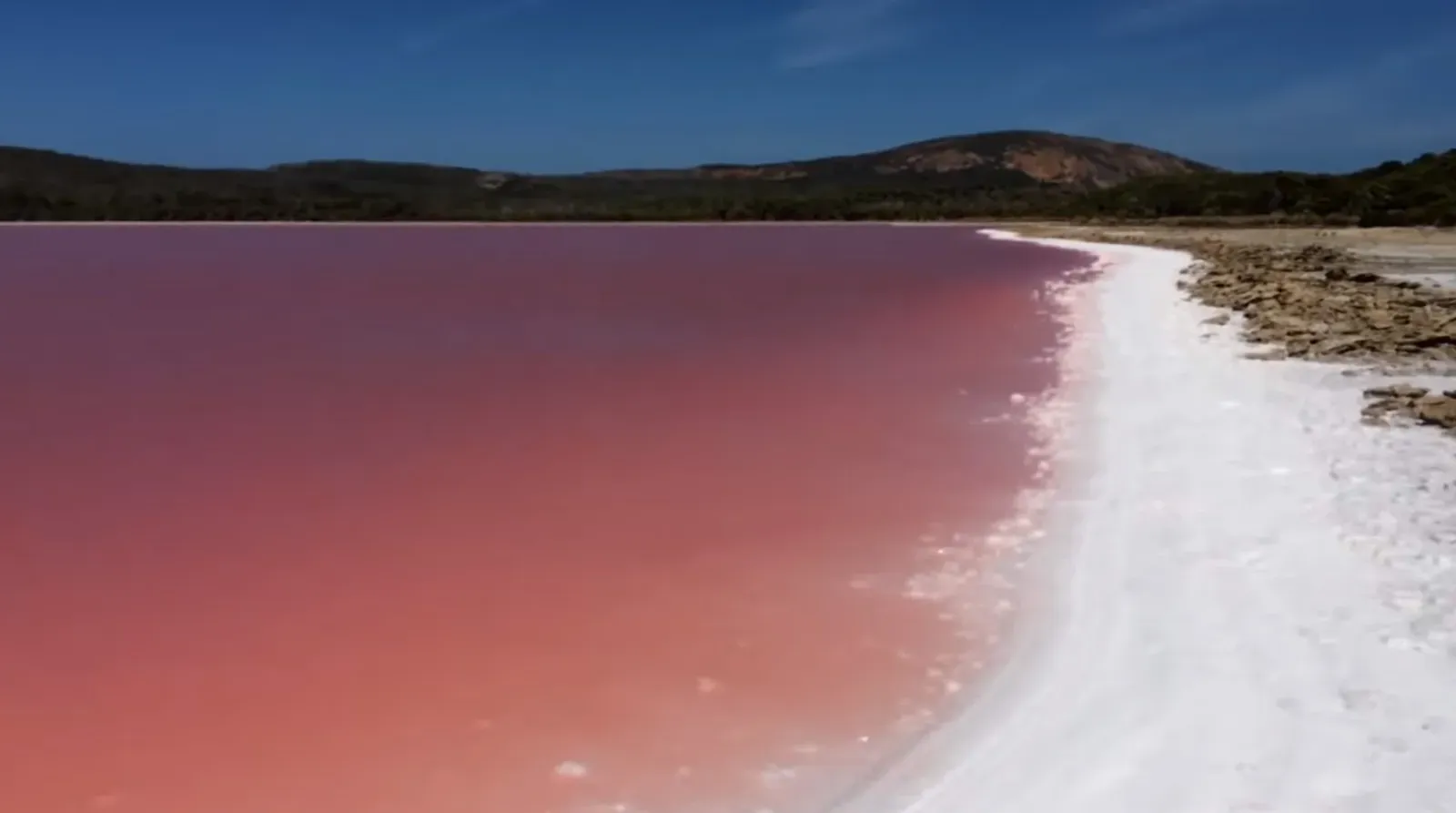
Western Australia is dotted with salt lakes that can look ordinary after rain, only to blush pink as dry weather returns. If you visit during a wetter spell, the water might be pale blue or milky; come back after a hot, dry period, and you could find the same lake transformed into a pastel rose or vivid bubblegum sheet. You are watching microscopic algae and bacteria respond to changing salinity like a dimmer switch. ([abc.net.au](https://www.abc.net.au/news/science/2022-01-05/pink-lakes-why-does-australia-have-so-many/100664354?utm_source=openai)) As water evaporates in dry seasons, the salt concentration rises to many times that of the ocean. Under these conditions, salt‑loving microalgae such as Dunaliella salina and red bacteria like Salinibacter start producing protective carotenoid pigments to shield themselves from intense sunlight and salt stress. Those pigments are what turn the water pink, and their intensity depends on how salty, shallow, and warm the lake becomes. Heavy rain can dilute the salt, suppress the pigment‑makers, and let other, less colourful algae take over, so the lake swings back toward blue or green until the next dry spell tightens the chemical screws again.
Lonar Lake, India: An Alkaline Crater That Blushed Pink Overnight
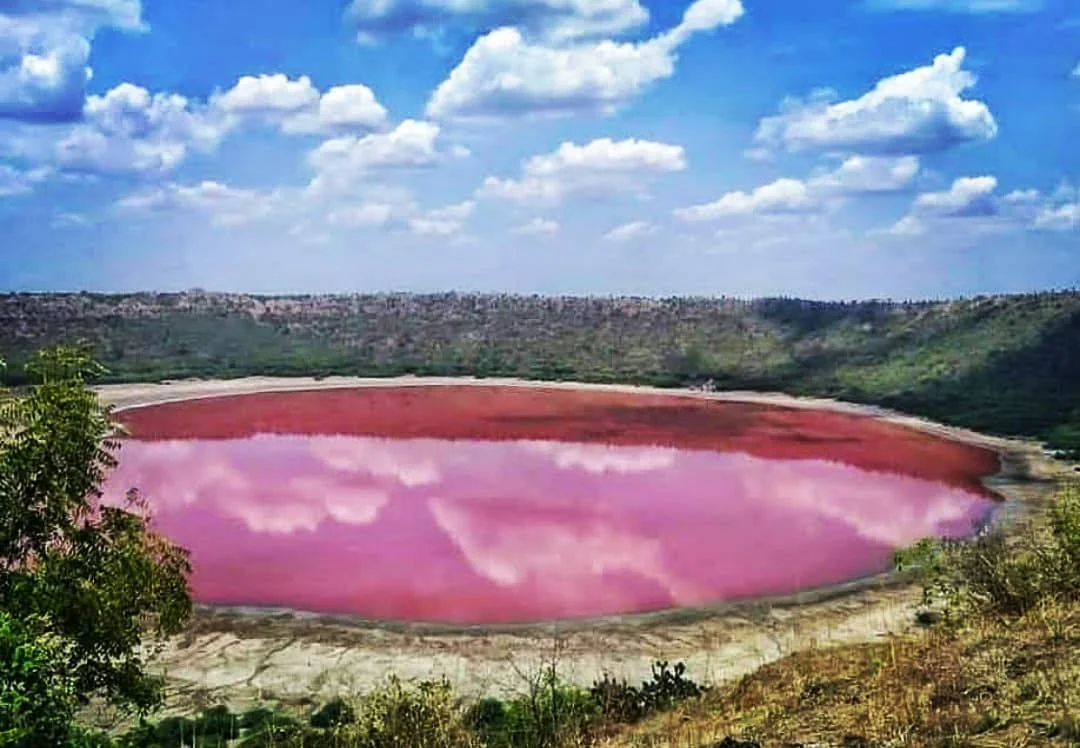
In 2020, people living near Lonar Lake in Maharashtra woke up and thought their phones were lying to them. A lake they knew as greenish or brownish had turned a soft, eerie pink in just a few days. While the most dramatic shift grabbed global attention that year, the crater lake had already been quietly sliding between greener and redder tones as water levels, salt content, and biology changed over the seasons. ([science.nasa.gov](https://science.nasa.gov/earth/earth-observatory/lonar-lake-tries-on-a-rosy-color-146859/?utm_source=openai)) Lonar Lake sits in a meteorite impact crater and is both saline and alkaline, which makes it an ideal test tube for halophilic microorganisms. As inflow and evaporation vary, the lake’s salinity and pH shift, opening and closing the window for pink‑pigmented algae and bacteria to thrive. When conditions cross a threshold – warmer temperatures, higher salinity, more stable water column – you see a surge in carotenoid‑rich microbes, and the lake takes on a pink or reddish tint. When monsoon rains or cooler weather dilute and mix the water, those communities thin out, and the lake drifts back to its usual greenish look.
Conclusion: Once You See the Chemistry, You Never Look at Water the Same Way
When you line these six lakes up side by side in your mind, you start to spot the pattern: you are not just watching colours; you are watching light bounce off particles, crystals, and pigments that come and go with the seasons. Rock flour thickens and thins, calcite precipitates and dissolves, algae bloom and fade, salts concentrate and dilute. The lakes are like slow‑moving mood rings, except the mood is set by physics and chemistry rather than feeling. The next time you walk past any pond, reservoir, or mountain tarn, you can ask yourself what is actually tinting the water that day: suspended mud, algae, minerals, or maybe just the angle of the sun. Once you realise how dynamic even a “still” lake really is, these famous colour‑changing waters stop being oddities and start feeling like exaggerated versions of what is happening everywhere. If you could pick just one of these lakes to see in its most dramatic season, which one would it be?