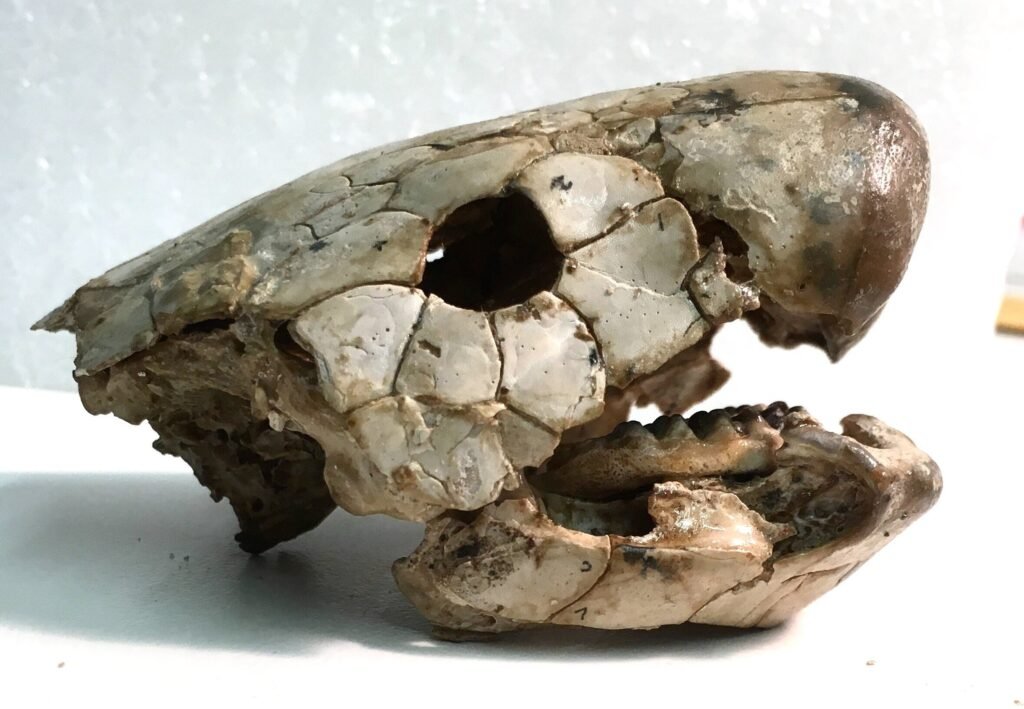

A treasure trove of 380-million-year-old fossils in the sun-baked rocks of Western Australia’s Gogo Formation is changing the story of how the first land animals hunted and ate. A new study published in iScience gives us shocking new information about the diets of ancient lungfish, which are the ancestors of fish and four-legged vertebrates like humans. Researchers have found unexpected feeding strategies among these Devonian-era predators using cutting-edge 3D biomechanical modeling. This goes against what scientists have always thought about how they acted. The results not only show how these animals lived and thrived in a reef ecosystem from long ago, but they also give us new information about how life moved from water to land.
The Gogo Formation: A Fossil Goldmine

The Gogo Formation, a remote fossil site in northern Western Australia, is one of the most amazing ways to learn about the Devonian “Age of Fishes.” Most fossil beds only keep flattened remains, but Gogo’s limestone deposits have produced beautifully three-dimensional specimens, some of which still have soft tissues. Here, lungfish have been more comprehensively studied in regard to their cognitive evolution as they possess diverse cranial morphology and undergo complex developmental processes.
“Gogo fossils are like timecapsules,” said Dr. Clement, the lead author on the study. “They are so well-preserved that we are able to explore biomechanics in ways that usually necessitate living organisms.”
Jaw Surprises: Why Slender Bites Outperformed Heavy Jaws
The team used finite element modeling (FEM), a method taken from engineering, to model the biting forces of five different types of lungfish. The results were surprising: some of the thickest, strongest jaws were surprisingly weak when put under stress, while sleeker, more delicate jaws were much better at handling stress.
It is correct to say, as Professor John Long observed, ‘this changes the way we think about fossil anatomy’. “A jaw that looks strong isn’t always made that way.” The glaring exception was Griphognathus whitei, a so-called “duck-billed” lungfish which had thin jaws and outperformed larger relatives. This indicates that some form of specialized feeding adaptation allowed him to outperform larger relatives, perhaps by snapping at soft-bodied prey rather than crushing harder-shelled animals.
Niche Partitioning: How 11 Species Coexisted

Variations in jaw morphology often denote differences in feeding adaptation within a species. Some lungfish may have consumed soft-bodied organisms, while others scavenged on shelled creatures and carrion. This form of ecological specialization is likely what allowed so many different species to coexist in the ancient Gogo reefs.
Olga Panagiotopoulou, a study co-author and doctor of biomechanics, imagines “a coral reef today with fish performing specific roles as cleaners, grazers, and hunters.” She notes, “The Devonian lungfish were doing the same thing 380 million years ago.”
Lungfish and the Leap to Land

Tetrapods, the first vertebrates to crawl onto land, are evolutionary cousins of lungfish. They are important to understanding this change because their biology is different from other animals in that they have both gills and lungs. The new study shows how changes to the jaw may have come before important changes that were needed for feeding on land.
Clement says, “These fish weren’t just waiting for legs to grow.” “Their feeding systems were already changing in ways that would later help vertebrates live in new places.”
The Engineering Behind the Discovery

As with few paleontological studies, the team analyzed the biting force of the animals with CT scans and 3D modeling. In the words of the study’s lead researcher Bland, “We treated these jaws like airplane wings to see how they would handle stress.” The models created for this study became available to the public through Morphosource, thus enabling scientists across the globe to analyze and work with the data.
What’s Next? Unlocking More Devonian Secrets

The Gogo Formation keeps surprising us. Recent finds there include fossilized hearts, muscles, and even stomach contents that give us an amazing look at life in the Devonian. Future research will try to put together whole food webs to show how these old ecosystems worked.
Long says, “Every fossil from Gogo is a piece of a puzzle.” “And we’re just beginning to see the whole picture.”
Why This Matters Today
Learning about how lungfish adapted to their surroundings can help us understand how evolution works and how ecosystems today can handle climate change. Clement says, “These fish lived through mass extinctions.” Their secrets could help us figure out how to stay alive in a world that is always changing.
For now, the Gogo fossils remind us that evolution is full of surprises and that the most dangerous bites can come from the most unlikely places.
Sources:
Suhail Ahmed is a passionate digital professional and nature enthusiast with over 8 years of experience in content strategy, SEO, web development, and digital operations. Alongside his freelance journey, Suhail actively contributes to nature and wildlife platforms like Discover Wildlife, where he channels his curiosity for the planet into engaging, educational storytelling.
With a strong background in managing digital ecosystems — from ecommerce stores and WordPress websites to social media and automation — Suhail merges technical precision with creative insight. His content reflects a rare balance: SEO-friendly yet deeply human, data-informed yet emotionally resonant.
Driven by a love for discovery and storytelling, Suhail believes in using digital platforms to amplify causes that matter — especially those protecting Earth’s biodiversity and inspiring sustainable living. Whether he’s managing online projects or crafting wildlife content, his goal remains the same: to inform, inspire, and leave a positive digital footprint.