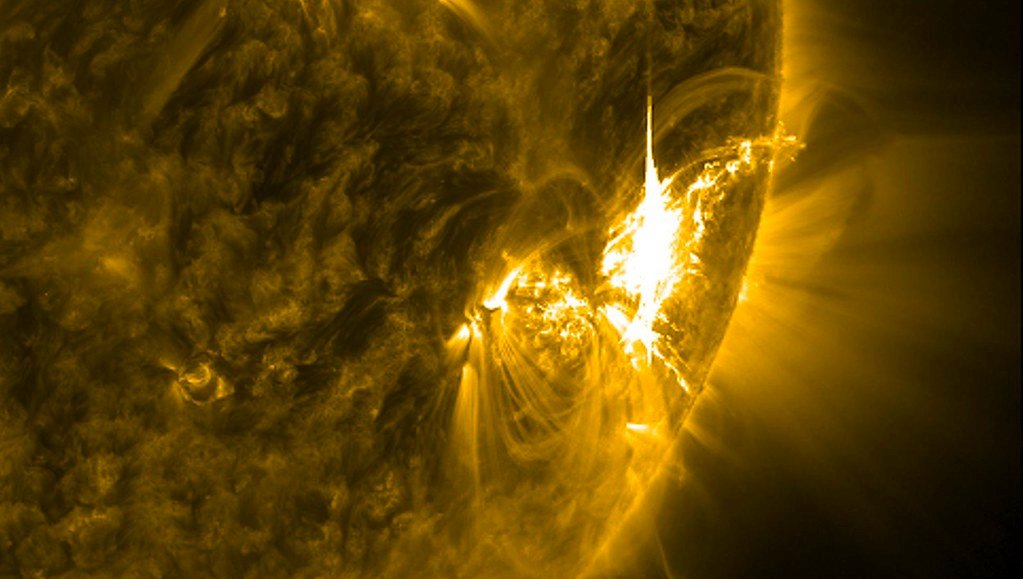
The Mechanics of a Solar Superstorm (Image Credits: Flickr)
Researchers in the United Kingdom released a comprehensive analysis in January 2026 that maps the severe consequences of an extreme space weather event occurring roughly once every century.[1][2] This report focuses on ground-based infrastructure at mid-to-high latitudes, highlighting disruptions to essential technologies that underpin daily life and national security. Such storms, driven by coronal mass ejections and solar flares, pose risks that extend far beyond auroral displays.
The Mechanics of a Solar Superstorm
Extreme space weather arises when the sun unleashes massive bursts of charged particles and magnetic energy toward Earth. These events distort the planet’s magnetic field, inducing powerful electric currents in conductive materials on the surface.[1] The STFC report defines a worst-case scenario as one with a return period of 100 to 200 years, far more frequent than million-year cataclysms but still rare enough to catch societies off guard.
Historical precedents underscore the threat. The October 2003 geomagnetic storm triggered power outages across Sweden and South Africa. More recently, solar activity in 2022 doomed up to 40 Starlink satellites shortly after launch due to atmospheric drag.[1] The May 2024 event, the strongest since 2003, illustrated modern vulnerabilities by degrading GPS signals and costing the U.S. agricultural sector hundreds of millions in losses.[3]
Power Grids Under Siege
Geomagnetic storms generate geomagnetically induced currents that surge through power lines and transformers. Safety systems often trip to prevent overloads, leading to widespread blackouts across regions.[1] In severe cases, these currents cause irreversible damage to high-voltage equipment, accelerating wear and slashing grid capacity for months or even years.
The United Kingdom’s grid, operating at latitudes where effects intensify, faces heightened risks. Restoration could stretch from days for initial outages to one or two years for specialized transformers. Cascading failures would ripple into water treatment, fuel distribution, and financial operations, amplifying economic tolls into tens of billions of pounds domestically and trillions globally.[2]
Satellites Face Annihilation Risks
Charged particles from solar radiation storms penetrate satellite shielding, frying electronics and eroding solar panels. This shortens operational lifespans dramatically or triggers outright failures.[1] Meanwhile, intense X-ray emissions from flares heat and expand Earth’s upper atmosphere, boosting drag on low-Earth orbit craft and causing premature reentries.
Tracking becomes chaotic as debris fields multiply. A Carrington-class event could decimate constellations vital for communications and Earth observation, leaving gaps in global coverage for weeks. The report stresses that northern latitudes experience amplified particle fluxes, endangering even hardened spacecraft.[2]
GPS and Communication Breakdowns
Solar flares emit radio bursts that overwhelm faint GPS signals, blacking out navigation for up to an hour on sunlit hemispheres. Geomagnetic disturbances then roil the ionosphere, scattering signals and rendering satellite positioning unreliable for days.[1]
Aviation, shipping, and precision farming suffer most. Long-range VHF and UHF communications falter, potentially grounding flights and stranding vessels. Mobile networks and WiFi face intermittent outages, while aircrews encounter elevated radiation doses, prompting flight restrictions especially at polar routes.
| Impact Area | Duration | Examples |
|---|---|---|
| Radio Blackouts | ~1 hour | GPS, radar disruption |
| Ionospheric Scintillation | Several days | Navigation errors in agriculture, aviation |
| Particle Radiation | Hours to days | Satellite electronics damage |
Charting a Course for Resilience
Recent storms during Solar Cycle 25, more active than forecasted, serve as wake-up calls. The STFC document, spanning 80 pages, urges enhanced solar monitoring and forecasting to buy critical preparation hours.[1] Investments in grid hardening, backup navigation like eLoran, and transformer reserves remain modest compared to potential damages.
Policy gaps persist despite national risk assessments ranking space weather alongside pandemics. Meaningful safeguards – hardened infrastructure and sustained observation – cost fractions of projected losses, yet implementation lags.
Key Takeaways
- A 100-200 year solar storm could trigger regional blackouts lasting weeks and satellite losses numbering in the dozens.
- GPS degradation affects precision industries, as seen in 2024’s agricultural disruptions.
- Preparation through monitoring and resilient designs offers the best defense against inevitable events.
Modern reliance on interconnected technologies magnifies solar storm threats, but proactive measures can mitigate the worst outcomes. Governments and industries must bridge the preparedness divide before the next superstorm strikes. What steps should prioritize in your region? Tell us in the comments.