Spectral Analysis Unveils Hidden Compositions (Image Credits: Pexels)
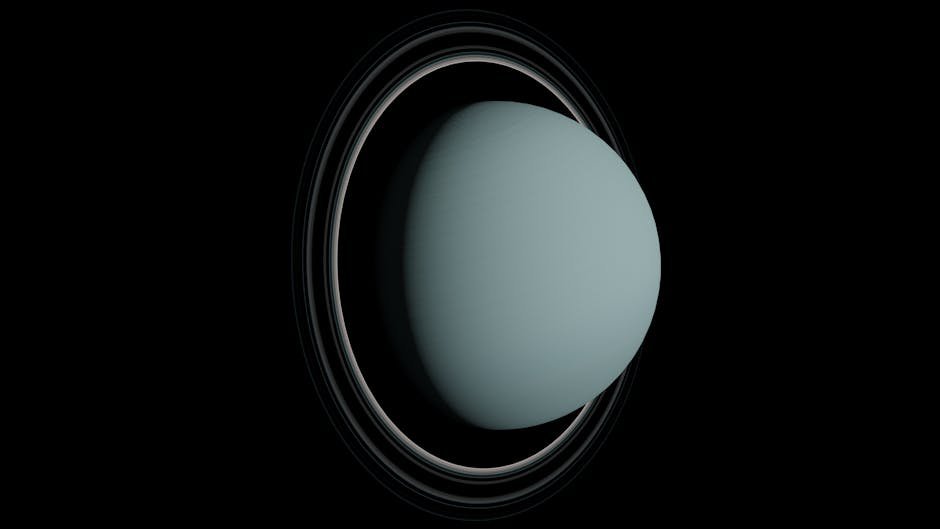
Astronomers have pieced together the first comprehensive picture of Uranus’ two outermost rings, the μ and ν, using a blend of observations from leading telescopes. Data from the W. M. Keck Observatory, Hubble Space Telescope, and James Webb Space Telescope revealed stark differences in their makeup and sources. These faint structures, orbiting amid 14 inner moons, offer clues to the planet’s dynamic history and formation processes.[1]
Spectral Analysis Unveils Hidden Compositions
Researchers constructed the initial full reflectance spectrum for these rings, spanning visible light to infrared wavelengths. Previous glimpses showed the μ ring’s blue tint, suggesting minuscule particles, while the ν ring’s reddish color indicated dustier fare. A shared absorption feature at 3 microns appeared in infrared data for both, but simulations highlighted their divergence.[1]
The μ ring’s signature matched pure water ice, while the ν ring aligned with rocky grains laced with carbon-rich organics. Imke de Pater, lead author from the University of California, Berkeley, noted that decoding this reflected sunlight traces particle sizes and origins. Such insights illuminate how Uranian rings and similar systems evolved. The study appeared in the Journal of Geophysical Research: Planets.[1]
Moon Mab Fuels the μ Ring’s Icy Particles
Tiny water-ice grains, dislodged by micrometeorite strikes, form the μ ring. These originate from Mab, a modest 12-kilometer moon. This composition verifies Mab’s predominantly icy nature, setting it apart in Uranus’ inner retinue. The ring’s blue hue stems from its extremely fine particles, akin to Saturn’s E ring but without geysers.[1]
Keck’s NIRC2 instrument captured pivotal near-infrared views during a 2007 ring-plane crossing, when edge-on geometry brightened the faint features. Combined with Hubble’s 2003-2005 discoveries, these laid groundwork. James Webb’s infrared prowess filled spectral gaps, enabling precise matches to ice models.
ν Ring Draws from Organic-Rich Shadows
In contrast, the ν ring comprises rocky material blended with 10 to 15 percent carbon-rich organic compounds prevalent in the outer solar system. Micrometeorite impacts and collisions among undetected rocky bodies supply this mix. These parent objects likely reside between known moons, fueling the ring’s reddish dust.[1]
De Pater highlighted the puzzle: why do these sources differ so profoundly from Mab? The rings’ faintness and narrow profiles complicate study, yet multi-wavelength data clarified their tales. This duality underscores varied processes shaping Uranus’ ring-moon architecture.
Evolution from Discovery to Ongoing Probes
Uranus’ rings entered history in 1977 via stellar occultations, marking it the second ringed giant after Saturn. Voyager 2 and Hubble expanded the tally, spotting the μ and ν in the early 2000s. Keck observations confirmed color disparities, hinting at compositional rifts.[1]
Today, archives like Keck’s bolster repeated scrutiny. Brightness fluctuations in the μ ring intrigue observers, possibly tied to Mab interactions. Mark Showalter of the SETI Institute called for future flybys: close-up views might explain Mab’s uniqueness. Matt Hedman of the University of Idaho anticipates monitoring via these telescopes.
| Ring | Color | Composition | Source |
|---|---|---|---|
| μ | Blue | Water ice grains | Micrometeorites on Mab moon |
| ν | Reddish | Rocky + 10-15% organics | Unseen rocky bodies |
Key Takeaways
- First complete spectra confirm μ ring’s icy purity from 12-km Mab.
- ν ring’s organics point to hidden, carbon-laced progenitors.
- Multi-telescope synergy traces ring evolution; future missions needed.
These findings challenge assumptions about uniform ring formation, spotlighting diverse parental influences in Uranus’ realm. As telescopes peer deeper, more secrets may surface. What implications do these ring origins hold for ice giant worlds? Share your thoughts in the comments.