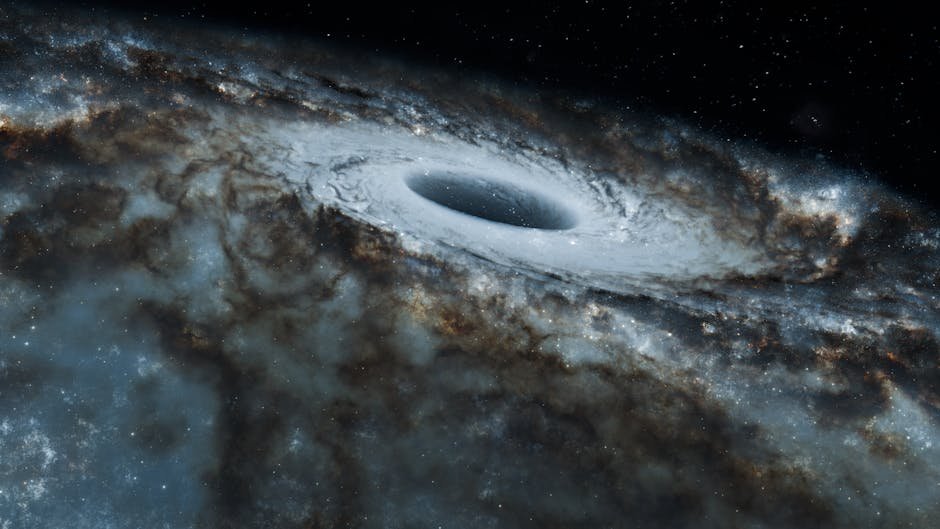
Unprecedented Scale in the Early Cosmos (Image Credits: Pexels)
Astronomers have uncovered evidence that a black hole from the universe’s earliest epochs grew so rapidly it now overshadows its host galaxy, potentially halting normal development and reshaping our view of cosmic origins. This finding, drawn from detailed observations of the distant quasar ULAS J1120+0641, highlights a period when supermassive black holes outpaced their surroundings. More than 13 billion light-years away, the object dates back to less than a billion years after the Big Bang, offering clues to how the first massive structures emerged.
Unprecedented Scale in the Early Cosmos
Researchers identified the black hole at the heart of ULAS J1120+0641 as containing billions of solar masses, an astonishing size for something formed so soon after the universe began. Current theories posit slower growth through accretion or mergers, yet this example arrived fully formed in record time. The quasar’s light, captured by advanced telescopes, revealed dynamics that suggest the black hole’s gravity dominates the system far beyond typical bounds.
Such rapid assembly challenges explanations reliant on steady feeding from surrounding gas clouds. Instead, the black hole may have feasted voraciously during a brief window, accumulating mass faster than stars could form around it. This scenario points to extreme conditions in the young universe, where dense primordial gas fueled outsized growth.
Observational Clues to a Disrupted Equilibrium
High-precision data from XMM-Newton observations in the 0.5-2.0 keV energy band exposed unusual gas motions near the quasar. Scientists noted extraction regions for the source and background, which confirmed the black hole’s influence extends to heating or ejecting material essential for star formation. These effects could starve the galaxy of fuel, stunting its expansion.
The study, published in The Astrophysical Journal, measured how the black hole warps spacetime and affects nearby matter. Findings indicated the object’s mass surpasses what the host galaxy’s gravitational well should sustain, creating an imbalance unseen in nearer systems. This disruption underscores a flipped dynamic: black holes leading rather than following galaxy buildup.
Overturning Long-Held Evolutionary Models
Standard frameworks depict black holes and galaxies co-evolving in lockstep, with feedback loops regulating both. ULAS J1120+0641 disrupts this picture, as the black hole’s dominance suppresses star birth and alters gas flows. Researchers now question whether early feedback operated differently, perhaps through super-efficient accretion or massive direct-collapse seeds.
The discovery prompts reevaluation of cosmic timelines. In the early universe, black holes apparently surged ahead, dictating galaxy fates. This shift could explain why modern galaxies host more balanced central engines.
“It appears that black holes’ consumption of material has greatly slowed down as the universe has aged,” said Niel Brandt, an astronomy and physics professor at Penn State.
Implications and Future Probes
The contrast between this quasar’s frenzy and today’s subdued black hole activity reveals evolving cosmic rules. Brandt’s observation captures how youthful abundance gave way to scarcity, influencing structure formation across billions of years. For humanity, grasping these events refines models of our Milky Way’s origins and predicts large-scale universe behavior.
- Enhanced telescopes will target gas dynamics for mass refinements.
- New missions could map radiation patterns around similar relics.
- Models must incorporate rapid early growth phases.
- Tests of alternative seed theories gain priority.
As analysis of ULAS J1120+0641 continues, the black hole remains a pivotal case study. Its story leaves astronomers pondering whether such imbalances were common in the dawn era, with lasting echoes in the cosmos we inhabit today.