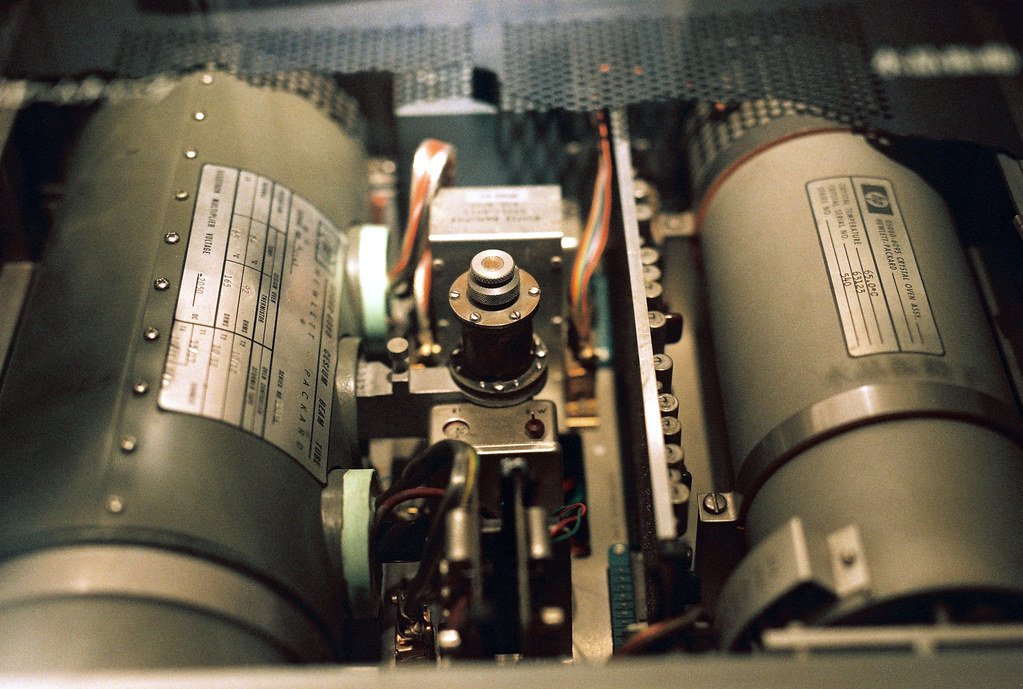
Laboratory Precision Meets Ocean Reality (Image Credits: Flickr)
Adelaide, Australia – Researchers from Adelaide University conducted the world’s first sea trial of a portable laser-cooled optical atomic clock on a Royal Australian Navy vessel in July 2024. The device maintained laboratory-grade precision amid vibrations, motion, and temperature fluctuations typical of open-water sailing. This breakthrough demonstrates the potential for ultra-accurate timekeeping in real-world environments, paving the way for resilient navigation systems independent of satellites.[1][2]
Laboratory Precision Meets Ocean Reality
A team from the Institute for Photonics and Advanced Sensing (IPAS) transported the clock 1,400 kilometers by truck from Adelaide to Sydney before craning it onto the naval ship. Over seven days, including five at sea covering more than 2,000 kilometers, the clock achieved 91 percent uptime. Ship accelerations and temperature swings of plus or minus 2.5 degrees Celsius posed significant tests, yet short-term stability matched lab results.[2]
Professor André Luiten, IPAS Chief Innovator and lead researcher, highlighted the significance. “Testing the clock on a ship was a major milestone,” he stated. “The marine environment presents vibration, movement and temperature changes that are very different from a controlled laboratory.” This success marked the debut of such a laser-cooled optical clock on a moving platform.[1]
Engineering a Ytterbium Powerhouse
The clock relies on ytterbium-171 atoms heated in a small oven to 450 degrees Celsius, then laser-cooled to boost usable atoms by a factor of 18. Atoms pass through laser beams forming an interference pattern with a 10-millihertz linewidth, enabling frequency locking at 100 corrections per second. Housed in a half-cubic-meter rack weighing 150 kilograms, it draws power from a standard outlet.[2]
In lab conditions, it showed drift of two parts in 10^14 over short intervals and reached 1.9 parts in 10^15 after 200 seconds of averaging – losing less than a second over 17 million years. During the voyage, wave motion affected one-to-ten-second averages most, with a 20 percent signal quality drop indicating field wear. Long-term stability remained solid up to 400 seconds.[2]
- Laser-cooled ytterbium beam for enhanced atom yield
- Ultra-narrow optical transition for precision
- Compact design suited for transport and deployment
- Outperforms commercial hydrogen masers
- Robust against environmental stressors
Overcoming Maritime Hurdles
Vibrations from rough seas emerged as the primary instability source for brief measurements. The team noted sensitivity to accelerations and rotations but identified potential fixes like beam direction reversal. After powering down for transport, the internal vacuum recovered fully within 10 days. No major failures occurred, proving the prototype’s durability.[3]
The trial received support from the Defence Science and Technology Group and funding via the Australian Government’s Next Generation Technology Fund, now under the Advanced Strategic Capabilities Accelerator. Collaborators included Dr. Rachel Offer, Dr. Elizabeth Klantsataya, Dr. Nicolas Bourbeau-Hebért, and Mr. Montana Nelligan. Results appeared in Optica under DOI: 10.1364/OPTICA.584095.[1]
Transforming Navigation and Beyond
High-precision clocks like this could enable GPS-denied positioning, vital for defense and autonomous systems. They promise millimeter-level accuracy for vehicle guidance and aircraft landings. Telecommunications networks would gain better synchronization for massive data flows, while radio astronomy benefits from global telescope linking.[1]
Professor Luiten emphasized broader impact: “Atomic clocks underpin many of the technologies we rely on every day, from satellite navigation to global communications.” Future work targets further refinements and deployments for commercial, scientific, and defense uses.[3]
| Application | Benefit |
|---|---|
| GPS-Independent Navigation | Sustains timing during outages |
| Telecom Sync | Handles high data volumes |
| Radio Astronomy | Links distant telescopes |
Key Takeaways
- First laser-cooled optical clock to thrive at sea, matching lab precision.
- Robust design withstands transport, vibrations, and temp shifts.
- Positions Australia as leader in quantum timing for defense and industry.
This sea trial not only validates years of innovation but also signals a shift toward resilient, portable quantum technologies. As global reliance on precise timing grows, such advancements ensure continuity even in disrupted scenarios. What do you think about the potential of these clocks in everyday tech? Tell us in the comments.