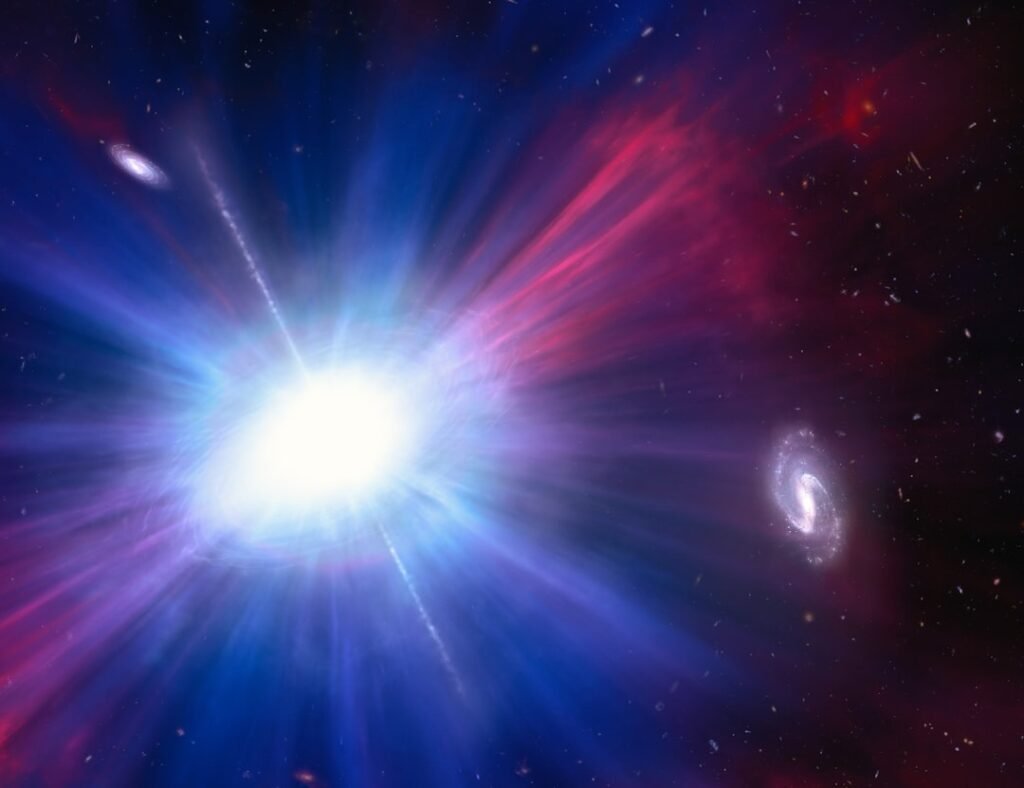
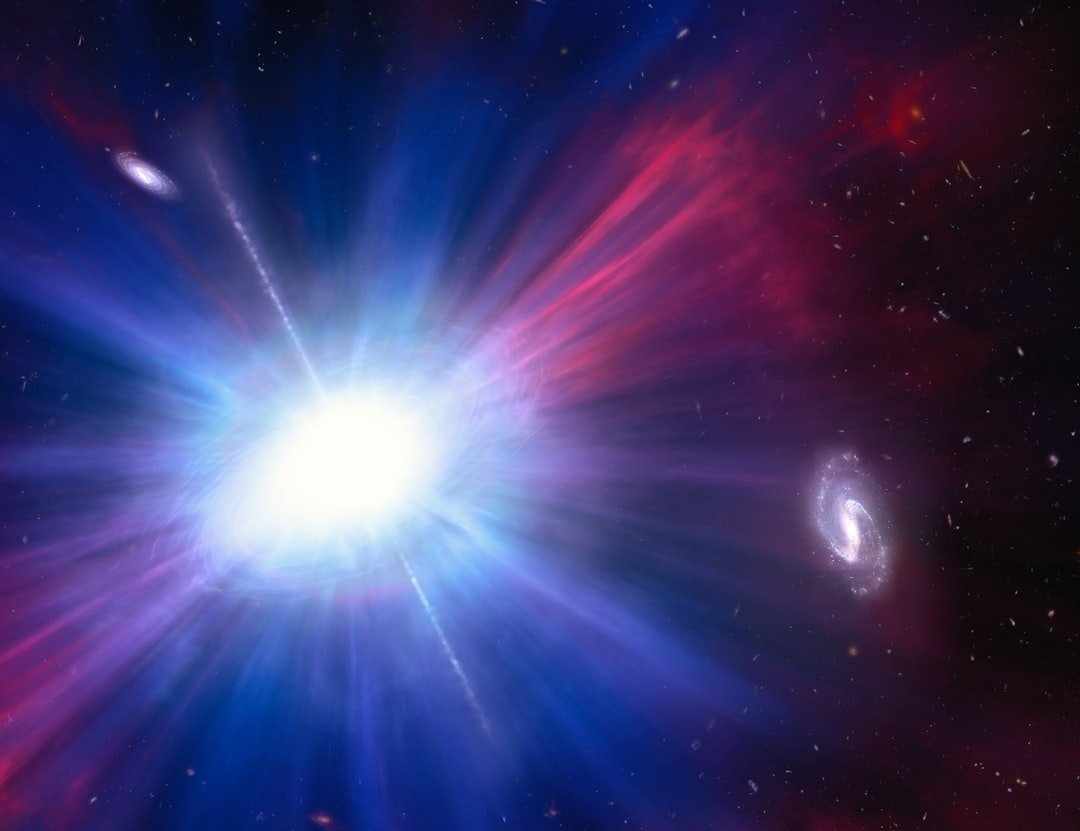
LFBOTs Defy Traditional Explosions (Image Credits: Unsplash)
Astronomers have puzzled for years over luminous fast blue optical transients, or LFBOTs, which flare up with unmatched intensity before fading into obscurity.[1] These enigmatic events, first spotted in 2018 with AT2018cow, rival the brightness of entire galaxies yet last only days. Recent analysis points to dramatic mergers between compact stellar remnants and massive Wolf-Rayet stars as the culprit behind these cosmic spectacles.[1]
LFBOTs Defy Traditional Explosions
Researchers describe LFBOTs as the universe’s brightest and most rapid stellar outbursts. They reach peak luminosity exceeding 10^43 ergs per second in optical light within just one week.[1] Unlike typical supernovae powered by the radioactive decay of nickel-56, LFBOTs drop to half their maximum brightness in the ensuing week.
This swift rise and fall sets them apart from familiar cosmic blasts. Superluminous supernovae, for instance, build to peak over weeks or months and shine 10 to 100 times brighter than ordinary supernovae but on slower timescales. LFBOTs occupy a unique niche, prompting multiple unproven theories for their genesis.[1]
Galactic Locations Offer Vital Clues
A team led by Anya Nugent from the Harvard and Smithsonian Center for Astrophysics examined the host galaxies of 11 LFBOTs. They found these explosions often ignite far from active star-forming regions, sometimes in faint galactic outskirts.[1] Host galaxies display ongoing star formation but at intermediate levels, less intense than those nurturing superluminous supernovae.
Chemical analysis revealed further distinctions. LFBOT environments show lower heavy-element enrichment than standard supernova sites yet higher metallicity than hosts of long gamma-ray bursts or superluminous supernovae. Such placements rule out central tidal disruptions, magnetar spin-down power, or failed supernova models.[1]
| Transient Type | Peak Rise Time | Fade to Half Peak | Typical Peak Luminosity |
|---|---|---|---|
| LFBOTs | 1 week | 1 week | >1043 erg/s |
| Core-Collapse Supernovae | Weeks | Months | Lower |
| Superluminous Supernovae | Weeks to months | Slower | 10-100x normal SN |
The Binary Merger Hypothesis Emerges
The leading explanation involves binary systems where a compact object – a neutron star or black hole – pairs with a Wolf-Rayet star, a massive, evolved giant stripped of outer layers. The pair originates in a bustling star-forming zone. When the progenitor star explodes as a supernova, it imparts a “natal kick” to the newborn compact remnant, ejecting the duo to the galaxy’s edges.[1]
There, stripped of interference, the compact star spirals into its partner, triggering the LFBOT eruption. This scenario aligns with observed locations and host properties. It explains why these blasts appear displaced from young stellar nurseries while linked to galaxies rich in recent star birth.[1]
- Binary begins in star-forming region.
- Supernova kick displaces the system outward.
- Merger occurs in low-density outskirts.
- Collision produces extreme brightness and speed.
- Matches 11 observed LFBOT environments.
Preliminary Findings and Ongoing Questions
Nugent’s team detailed their work in a preprint uploaded to arXiv on March 24, 2026 (arXiv:2603.23597).[1] They stressed the small sample size of just 11 events. “We emphasize that the current sample of LFBOTs is quite small; as such, our findings should be viewed as a preliminary foundation for future population studies,” the researchers noted.[1]
Alternative ideas, such as black holes devouring Wolf-Rayet stars or very massive star collapses, persist in the literature. Yet the environmental data strongly favor the kicked-binary merger model. Larger datasets will test its robustness.[1]
Key Takeaways:
- LFBOTs explode brighter and faster than known supernovae types.
- They favor galactic outskirts, hinting at displaced origins.
- Neutron star or black hole mergers with Wolf-Rayet stars fit observations best.
Horizon of Discoveries
The Vera C. Rubin Observatory promises to transform LFBOT research by detecting hundreds annually. Such volume will enable statistical tests of merger rates, host preferences, and light curve details. Confirmation could reshape views on binary evolution and compact object dynamics.
These fleeting blue beacons challenge core ideas about stellar death throes. As evidence mounts, LFBOTs may illuminate hidden chapters of cosmic violence. What mechanisms do you suspect drive these bursts? Tell us in the comments.