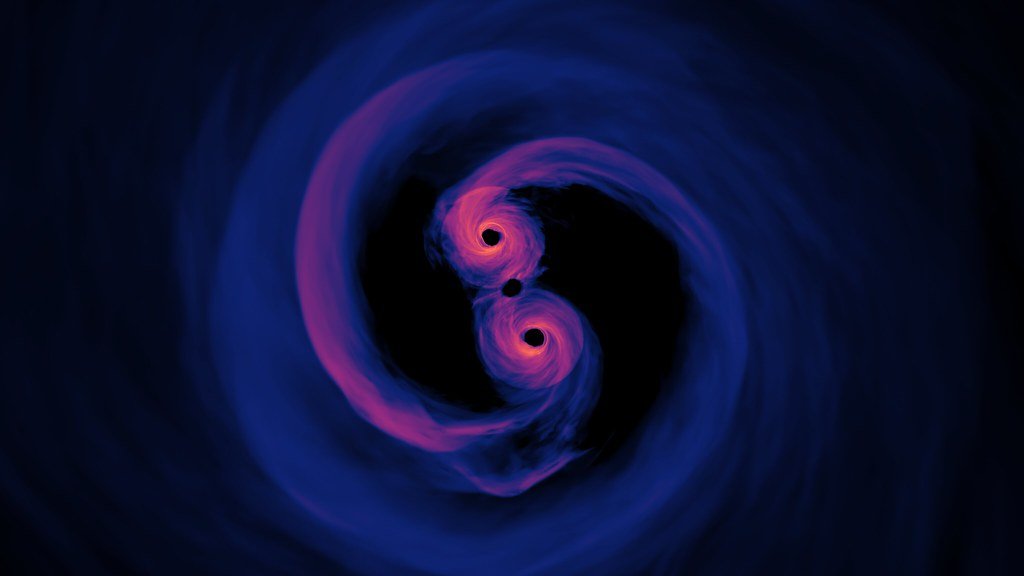
A Decades-Long Cosmic Puzzle Solved (Image Credits: Flickr)
Astronomers recently pinpointed a pair of supermassive black holes in the galaxy Markarian 501, located 500 million light-years from our solar system.[1] These enormous objects, each with a mass ranging from 100 million to a billion times that of the sun, orbit one another in a clockwise path that completes every 121 days.[1] Researchers predict the duo will merge in less than 100 years, unleashing gravitational waves powerful enough to subtly distort space-time all the way to Earth.[1]
A Decades-Long Cosmic Puzzle Solved
Radio telescope observations spanning decades first hinted at unusual activity in Markarian 501. Scientists initially viewed the galaxy’s core as an ultrabright blazar powered by a single black hole. However, meticulous analysis revealed a more complex picture: a second supermassive black hole influencing the system.
The breakthrough came from over 83 datasets collected by the Very Long Baseline Array, an international network of 10 radio telescopes. Lead researcher Silke Britzen described the moment of discovery vividly: “Realising that [there] was a second jet was awesome. For me it was like: that’s how it works? I was so amazed and overwhelmed – and wanted to tell everybody what we just found.”[1]
This finding reshaped interpretations of prior data, showing jet orientations that shifted over years.
Characteristics of the Orbiting Giants
The black holes maintain a separation of 250 to 540 times the Earth-sun distance, or astronomical units. One primary jet streams outward, while a secondary jet loops counterclockwise, providing key visual evidence of the binary nature. These jets point toward Earth, offering a rare direct line of sight into the system’s dynamics.
Each black hole’s immense gravity warps surrounding space, fueling the jets with material from accretion disks. The clockwise orbital period of 121 days indicates a stable yet tightening path, driven by energy loss through gravitational radiation.
- Primary jet: Straightforward emission aligned with the main black hole.
- Secondary jet: Curved path suggesting influence from the companion black hole.
- Orbital speed: Rapid cycle points to advanced merger stage.
- Mass range: 100 million to 1 billion solar masses per black hole.
Clues from Gravitational Lensing
In June 2022, observers captured a striking alignment: an Einstein ring formed by gravitational lensing. This phenomenon occurs when the black holes’ gravity bends light from background sources into a ring visible from Earth. Britzen noted, “Since these jets are directed towards us, an Einstein ring supports the scenario.”[1]
Such lensing confirmed the binary configuration and refined merger estimates. The ring’s appearance aligned perfectly with the predicted positions, bolstering confidence in the less-than-100-year timeline.
Earlier observations had shown varying jet structures, but the lensing event tied them together into a coherent model.
Gravitational Waves and Planetary Ripples
As the black holes spiral inward, they emit gravitational waves – ripples in space-time fabric that propagate across the universe. This merger promises waves more intense than those from previously detected stellar-mass black hole collisions. Detectors on Earth, such as those in global networks, stand ready to capture the signal.
The waves would arrive after traveling 500 million light-years, arriving subtly. They would stretch and squeeze Earth ever so slightly, on the order of atomic scales, yet measurable with precision instruments. No physical harm would result, but the event would mark a milestone in multimessenger astronomy.
Researchers published their findings on March 27 in the Monthly Notices of the Royal Astronomical Society, detailing the evidence.[1]
Key Takeaways
- Markarian 501 hosts two supermassive black holes orbiting every 121 days, separated by hundreds of AU.
- Merger expected in under 100 years, based on VLBA data and Einstein ring lensing.
- Gravitational waves will reach Earth, offering unprecedented insights into supermassive mergers.
This rare observation of a binary supermassive black hole system on the verge of merger opens new windows into galaxy evolution and cosmic violence. As detectors improve, humanity edges closer to witnessing these universe-shaking events in real time. What implications do you see for future gravitational wave astronomy? Share your thoughts in the comments.