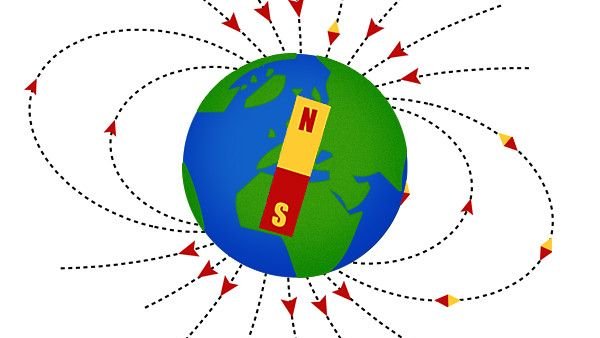

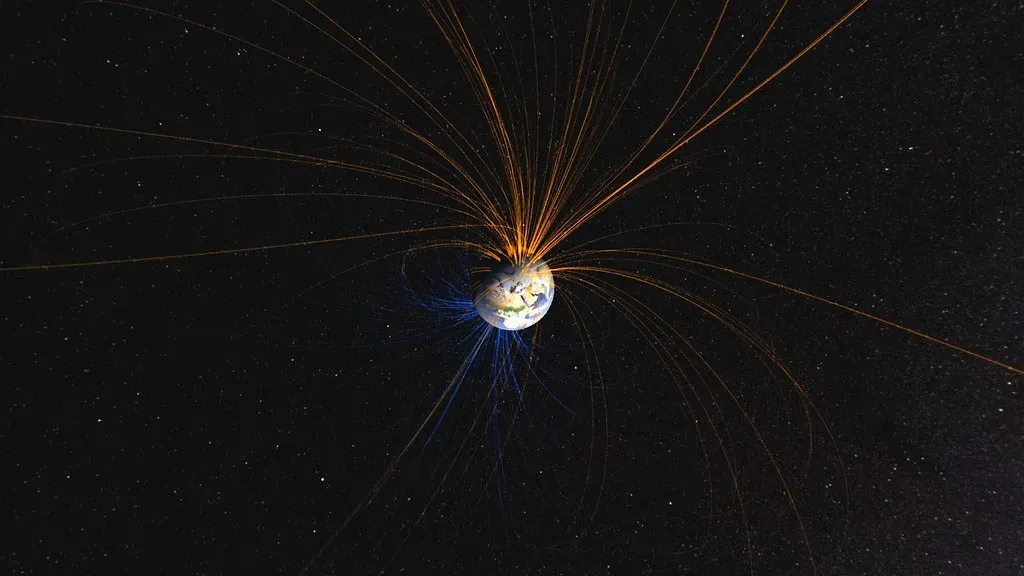
If you could see Earth’s magnetic field with your own eyes, it would look like a giant, shimmering bubble wrapped around the planet, quietly deflecting dangerous radiation from space. You live every moment of your life inside this invisible shield, trusting it without even realizing it. Yet this shield is not fixed. It drifts, warps, weakens in some places, and strengthens in others, like a heartbeat that never quite settles.
In the last century or so, you’ve been living through an especially restless phase in Earth’s magnetic story. The magnetic north pole has been racing across the Arctic, the field has been slowly weakening overall, and scientists are asking whether you might be in the early stages of a major magnetic shift. That sounds dramatic, and it is fascinating, but it’s not a doomsday script. When you understand what the magnetic field really is, why it moves, and how it has behaved over millions of years, you can replace vague fear with clear-eyed curiosity.
How Earth’s Magnetic Field Actually Works
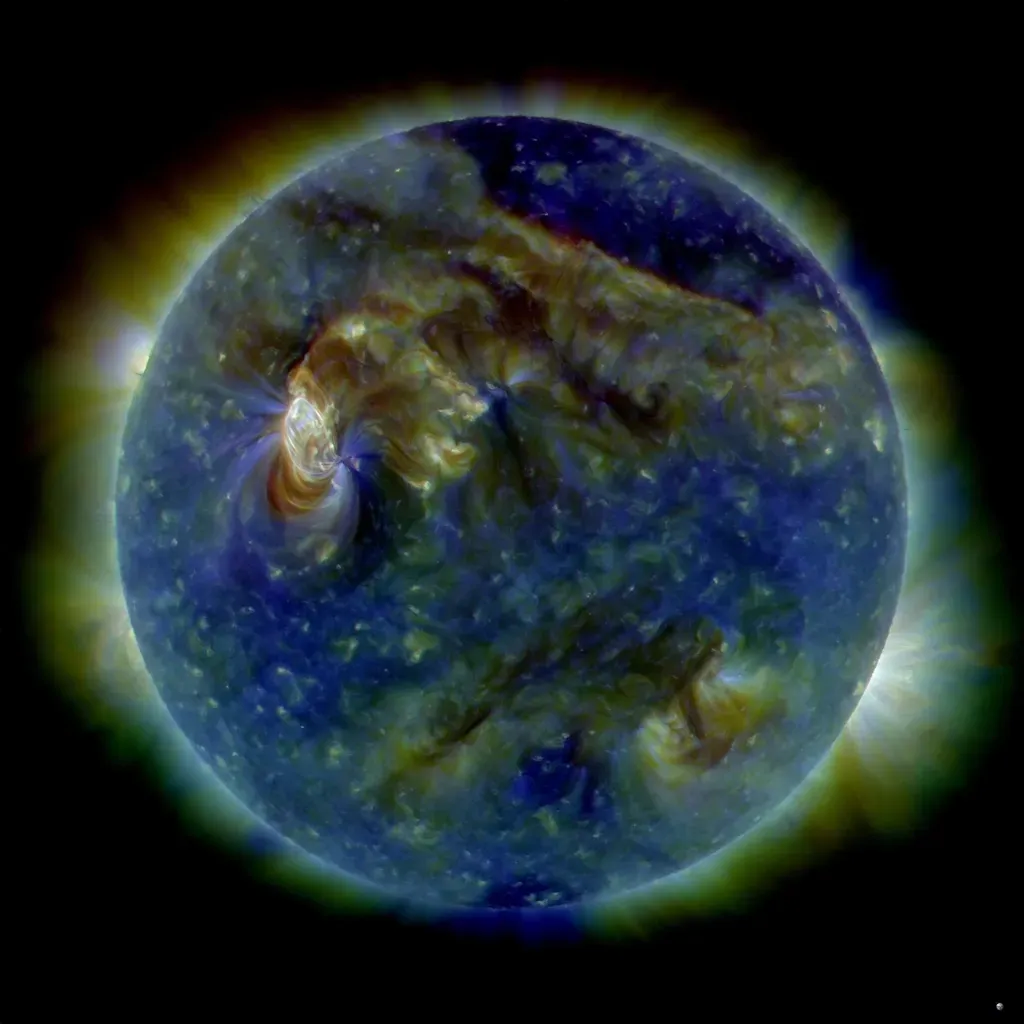
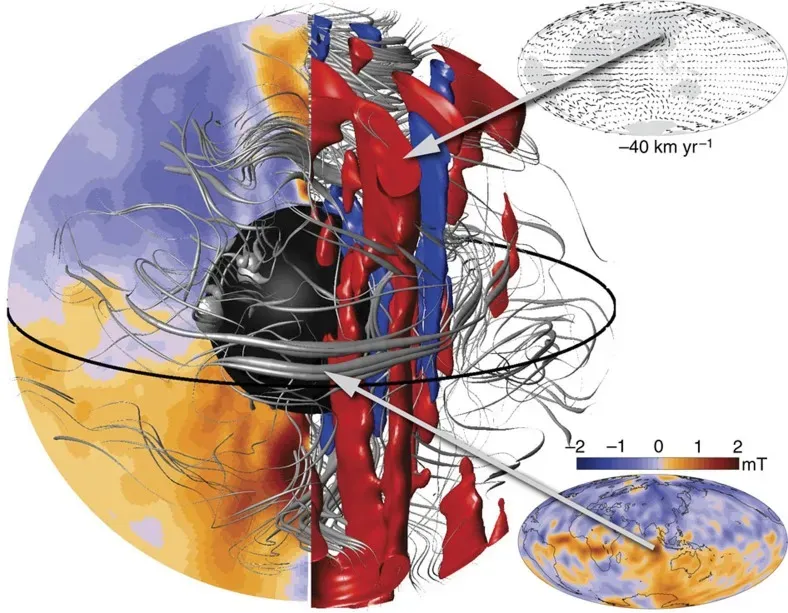
You can think of Earth’s magnetic field as a planetary-scale dynamo, not just a simple bar magnet stuck in the middle of the planet. Deep beneath your feet, roughly as far down as the distance between major cities, lies a core of molten iron and other metals swirling around a solid inner core. Those hot, electrically conducting fluids move in complex patterns driven by heat escaping from the deep interior and by Earth’s rotation, and that moving metal effectively turns your planet into a self-sustaining generator of magnetic energy.
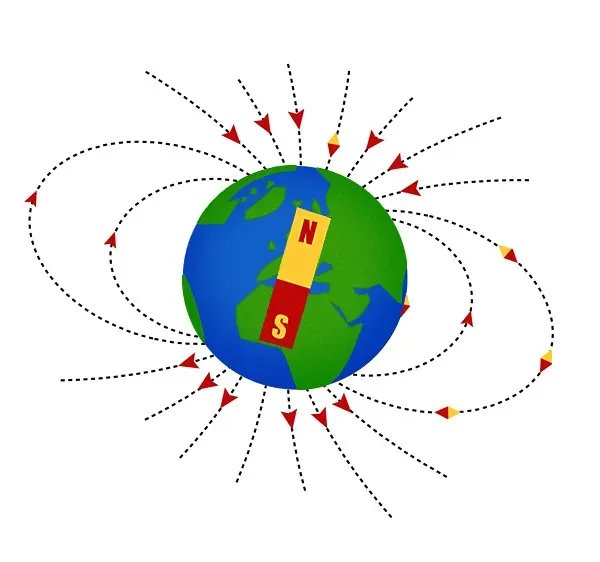
If you’ve ever played with a bike dynamo or a crank-powered flashlight, you already understand the core idea: moving conductors and rotation can create electricity and magnetism. In Earth’s case, the “wiring” is liquid iron, the “crank” is rotation, and the “device” is the magnetic field you rely on for navigation and radiation protection. The field lines loop out from near the south magnetic pole, arc through space, and dive back in near the north magnetic pole, forming the familiar dipole pattern you see in textbook diagrams. But the reality under the hood is far messier than any simple picture, and that messiness is exactly why the field shifts over time.
Why the Magnetic Poles Wander Instead of Staying Put
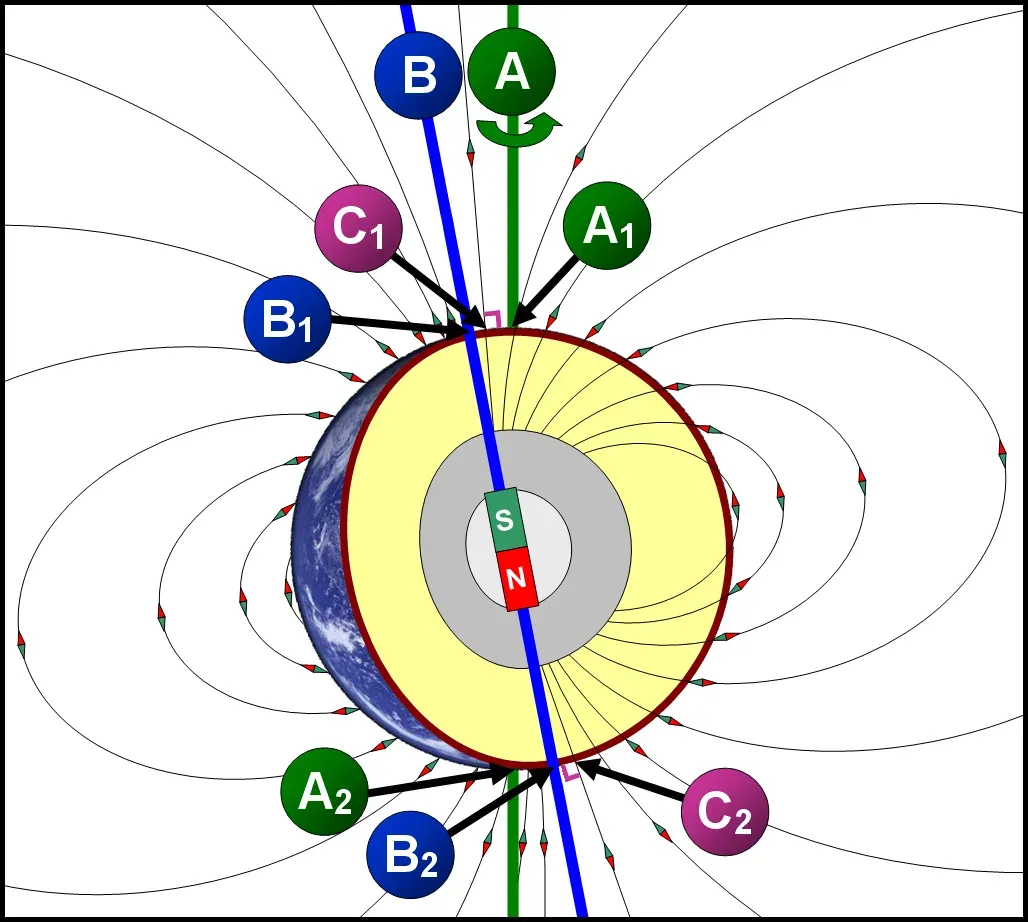
If you assume Earth’s magnetic poles ought to stay neatly aligned with the geographic poles, you’re giving the core far too much credit for being orderly. The liquid outer core behaves more like a turbulent ocean than a calm, rotating ball, with jets, eddies, and swirling plumes of metal constantly reshaping the flow. Because the magnetic field is generated by that flow, any change in the underlying motion nudges the magnetic poles, sometimes gently and sometimes surprisingly fast. Over the twentieth and early twenty-first centuries, the north magnetic pole sped up from a slow drift to a rapid sprint of dozens of kilometers per year, racing from northern Canada toward Siberia.
This wandering matters for you more than you might think. Magnetic compasses in airplanes, ships, and even handheld devices depend on an accurate understanding of where magnetic north really is, not where old maps say it used to be. That’s why agencies update models like the World Magnetic Model on a regular basis, so your navigation systems can compensate for the poles’ restlessness. When you see pilots, surveyors, or smartphone apps applying a “magnetic declination” correction, you’re watching the human world quietly adapt to a field that refuses to sit still.
What the South Atlantic Anomaly Tells You About Weak Spots
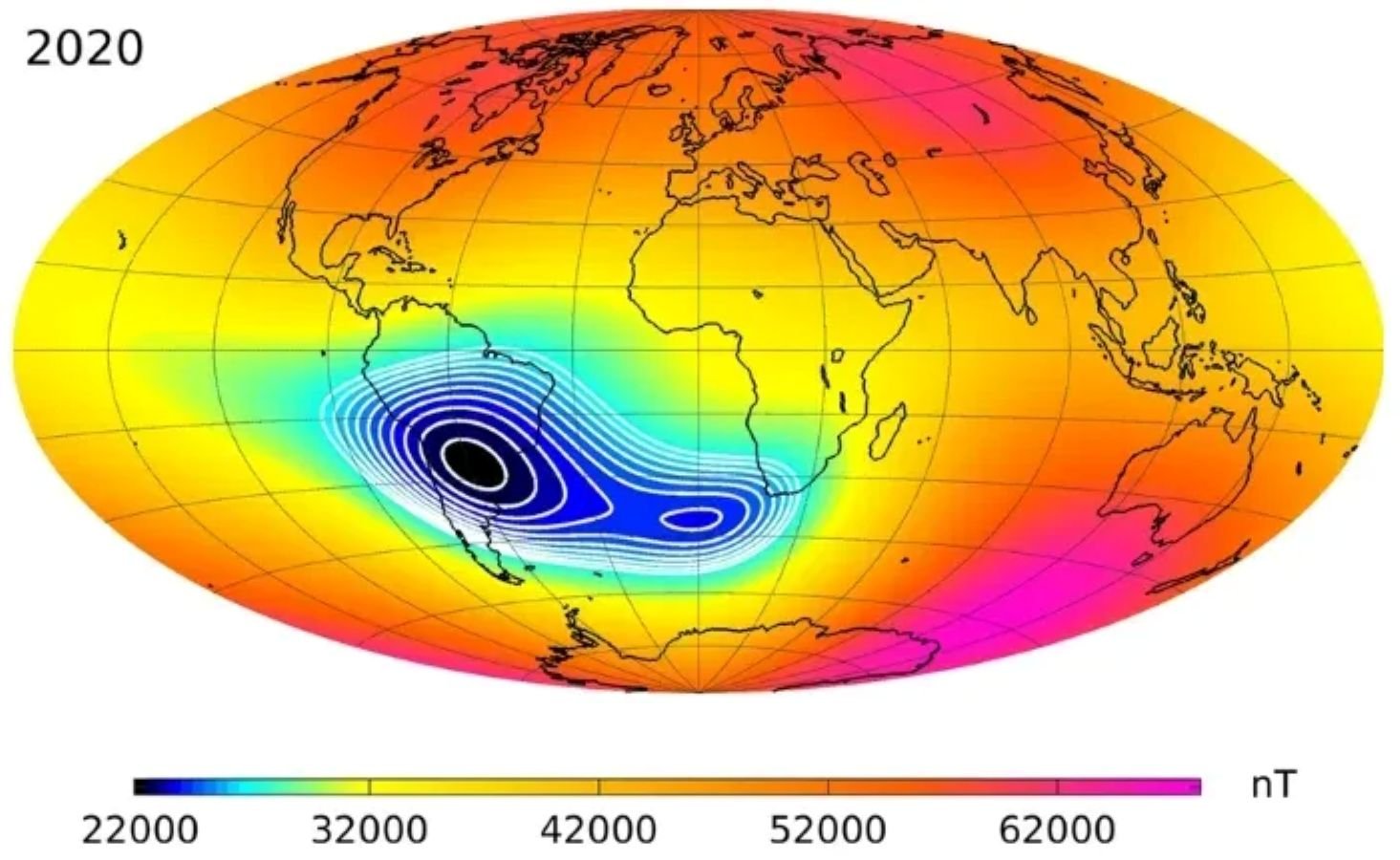
One of the strangest magnetic features affecting you today is a region called the South Atlantic Anomaly, a broad area stretching roughly over parts of South America and the South Atlantic Ocean where Earth’s magnetic field is noticeably weaker than average. You can picture it as a dent in the magnetic shield, where the protective bubble dips closer to the planet. In this zone, energetic particles from space can get closer to Earth’s surface, which makes satellites and spacecraft that pass overhead more vulnerable to radiation hits and electronic glitches.
If you operate a satellite, you already treat this anomaly with special respect, scheduling certain maneuvers or switching to safe modes when you know you’ll be flying through it. From the ground, you don’t feel it directly; you can walk across Brazil or sail the South Atlantic without sensing anything unusual. But the very existence of this weak spot hints at deep changes within the core, like a ripple on the surface of a lake hinting at something moving far below. Some researchers see this region as one possible sign that the overall field is reorganizing in a way that, over thousands of years, could feed into a larger-scale reversal or complex reshaping.
Magnetic Reversals: How Often They Happen and What They Look Like

The idea that Earth’s magnetic field might flip so that your compass needle eventually points south instead of north sounds like a science fiction plot, but it is a very real part of the planet’s history. If you look at volcanic rocks or ancient seafloor crust, you can read the record of magnetic orientation frozen in minerals like a barcode stretching back tens of millions of years. That record shows that full magnetic reversals have happened many, many times, with irregular gaps that can be as short as a couple of hundred thousand years or as long as several million. You are living in a period that has already lasted longer than some past intervals between reversals, which is one reason the topic keeps coming up.
When you imagine a reversal, it’s tempting to picture an instant flip, like turning a magnet around in your hand, but the real process is far slower and more chaotic. Over thousands of years, the main dipole field weakens, higher-order, lumpy magnetic structures grow stronger, and multiple “poles” can appear at different latitudes before a new dominant orientation emerges. From your perspective as a human with a short lifespan, you would not wake up one morning to a reversed planet. Instead, many generations would live through a gradually evolving, weaker, and more complex magnetic environment, with shifting navigation references and potentially more frequent exposure of technology to space weather effects.
What a Changing Field Means for Life and Technology
Because the magnetic field is tied to radiation shielding, you might worry that a weaker or shifting field automatically spells disaster for life on Earth. The geological record pushes back on that fear. Life has persisted through many reversals and long periods of low field strength without obvious, consistent signs of mass extinctions linked directly to magnetism. That suggests you, as a species, are more resilient than simple doomsday narratives admit, especially at Earth’s surface where the atmosphere itself provides a thick layer of protection against many harmful particles. The field is a crucial shield, but it is part of a layered defense, not the only wall between you and a hostile cosmos.
Where you really feel the consequences is in the systems you have built in the last century or two. Satellites, power grids, aviation routes, and communication networks are all more sensitive to changes in the magnetic environment and to solar storms that interact with that environment. A weaker or more tangled field can allow charged particles from the Sun to penetrate deeper into near-Earth space, which increases the risk of satellite damage, radio blackouts, and ground-induced currents in power lines. That does not mean every shift leads to catastrophe, but it does mean that if you depend on modern infrastructure, you have to take space weather and magnetic variability seriously, the same way coastal cities take tides and storms into account.
How You Already Track and Prepare for Magnetic Shifts
You might not realize it, but you are already living in a world where magnetic changes are monitored continuously and quietly built into your technology. Research stations scattered from the Arctic to the equator measure local magnetic fields day and night, feeding data into global models that help predict how the field is evolving. Satellites orbiting above you map the field from space, giving you a three-dimensional, time-lapse view of its strengths and weaknesses. When you open a navigation app that corrects for magnetic north or when an airport updates runway numbers to match the current magnetic heading, you are seeing those measurements translated into everyday, practical decisions.
Preparing for future changes is less about dramatic new inventions and more about refining what you already do. Power companies can design transformers and grid layouts to be more resistant to geomagnetically induced currents, and satellite builders can harden electronics or create safe modes that trigger during magnetic disturbances. On a personal level, you may never have to “prepare” in a dramatic way, but you do benefit when your institutions take this unseen variability seriously. In that sense, tracking Earth’s magnetic field is a bit like watching long-term climate trends or sea level changes: you cannot stop the natural processes driving them, but you can choose how wisely you adapt.
What You Should Worry About (and What You Really Shouldn’t)
It is easy to get pulled into sensational headlines that suggest an imminent magnetic flip will wipe out satellites overnight or strip away the atmosphere, leaving Earth bare to space. When you look more closely at the evidence, those worst-case claims lose their footing. You find no clear pattern in the fossil and geological records tying magnetic reversals to global biological collapses, and models of atmospheric loss show that even a much weaker field does not instantly erase the air you breathe. You do not see anything in the current data that says a full reversal is guaranteed in your lifetime, and you definitely do not see a reason to live in daily fear of an invisible countdown.
That does not mean you should ignore the issue entirely. A changing magnetic field still matters for space missions, satellite-based services you rely on, and the resilience of your power and communication grids. The healthy stance is to stay informed without being alarmist: understand that Earth’s magnetic field has always been dynamic, recognize that modern technology adds new vulnerabilities, and support efforts to build in sensible protections. If you treat the field as a living, evolving system rather than a fragile switch about to be flipped, you can hold both respect and calm at the same time.
In the end, Earth’s magnetic field is less of a looming threat and more of a reminder that your planet is not a static backdrop but a living machine, humming and shifting beneath your feet. You are lucky to live in a time when you can measure these deep processes, model them on computers, and debate their implications instead of simply being at their mercy. The field will keep drifting, pulsing, and surprising you long after your own lifetime, but the story is one of adaptation, not apocalypse. When you think about that restless shield wrapping your world, do you feel a little more anxious, or a little more amazed?