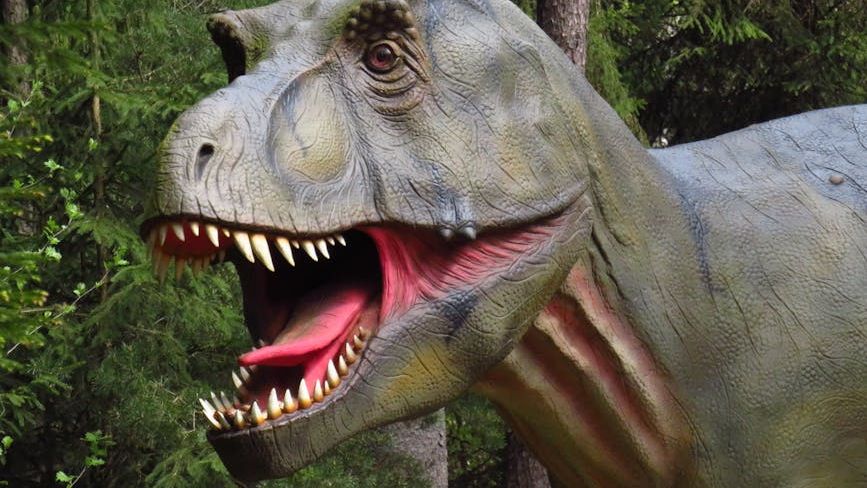
Giant Tyrannosaur Fossil Found in New Mexico – Image for illustrative purposes only (Image credits: Pexels)
A single, oversized shinbone unearthed decades ago in northwestern New Mexico has now been identified as belonging to one of the earliest known giant tyrannosaurs. The 96-centimeter-long tibia, recovered from the Hunter Wash Member of the Kirtland Formation, dates to roughly 74 million years ago and points to an animal that weighed nearly five tons. Researchers from the University of Bath, Montana State University, and the New Mexico Museum of Natural History and Science published their analysis in Scientific Reports this spring, highlighting how the find pushes back the appearance of truly massive tyrannosaurids by several million years.
Size That Defied Expectations for Its Era
The bone measures 12.8 centimeters in diameter at its widest point, reaching about 84 percent the length and 78 percent the width of the largest known Tyrannosaurus specimens. Such proportions suggest the creature stood around 35 feet long and tipped the scales at approximately 4.7 tons. Contemporary tyrannosaurs from the same period were typically much smaller, often no larger than modern humans in body mass.
This scale stands out because most large-bodied tyrannosaurids were thought to have evolved closer to the end of the Cretaceous. The New Mexico specimen instead shows that gigantism had already taken hold in southern Laramidia well before the famous T. rex appeared.
Where and When the Fossil Came to Light
University of New Mexico students collected the tibia in the 1970s while working in the remote Bisti-De-na-zin Wilderness of San Juan County. The specimen remained in museum collections for years before a fresh examination revealed its significance. The surrounding rock layers place it firmly in the late Campanian stage, a time when the region featured river floodplains and seasonal wetlands.
Paleontologists have nicknamed the animal the Hunter Wash tyrannosaur after the specific rock unit that preserved it. While no skull or additional bones have yet been linked to the same individual, the tibia alone provides enough anatomical detail to confirm its tyrannosaurid identity and impressive stature.
Implications for Tyrannosaur Evolution
The discovery supports the idea that giant tyrannosaurs first arose in the southern reaches of western North America rather than farther north. Earlier members of the group were generally smaller and more lightly built, but this specimen demonstrates that the lineage capable of reaching multi-ton sizes was already established by 74 million years ago.
Study co-author Spencer Lucas noted that the animal was “a very large tyrannosaur for its time, and much older geologically than anybody would have predicted.” Such an early appearance of gigantism may help explain how later forms like T. rex achieved their record-breaking dimensions so rapidly in the final years before the asteroid impact.
What Comes Next for the Research
Scientists are now searching museum drawers and field sites across the San Juan Basin for matching skull material that could confirm whether the Hunter Wash tyrannosaur represents a direct ancestor or a close cousin of later giants. Additional bones would also allow more precise estimates of growth rates and ecological role.
Meanwhile, the find underscores how re-examination of long-stored fossils can still yield major insights. As fieldwork continues in New Mexico’s badlands, researchers expect more surprises from the same ancient floodplains that once supported these formidable predators.