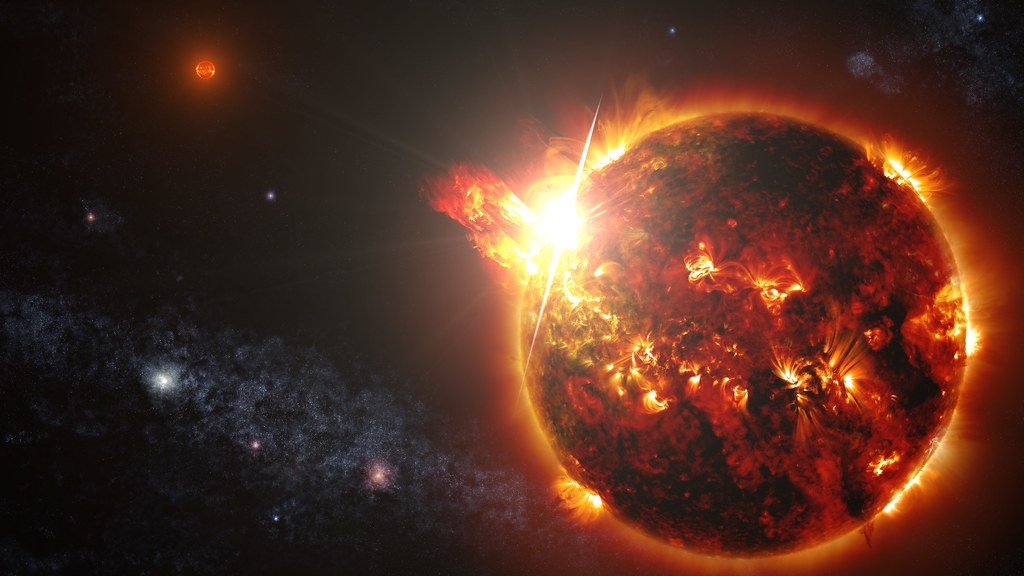
A Puzzling Deficit in the Stars (Image Credits: Flickr)
Astronomers expected binary star systems to teem with planets circling both stars, much like the fictional Tatooine from Star Wars. Yet observations reveal a stark shortfall: only 14 confirmed circumbinary exoplanets exist among more than 6,000 discovered worlds.[1][2] Recent research points to Albert Einstein’s general theory of relativity as the unexpected force driving these planets to destruction or exile.
A Puzzling Deficit in the Stars
NASA’s Kepler Space Telescope and TESS mission identified roughly 3,000 eclipsing binary stars, systems where the stars periodically eclipse each other from our view. Experts anticipated hundreds of large planets orbiting these pairs, given that about 10% of Sun-like single stars host similar worlds. Instead, astronomers confirmed just 14 circumbinary planets, with 47 candidates in total.[3]
The shortage grows more acute around tight binaries, those with orbital periods of seven days or less. None of the known circumbinary planets circle such close pairs, despite these systems dominating eclipsing binary populations. Twelve of the 14 confirmed planets hover at the edge of a so-called instability zone, hinting at a destructive barrier nearby.[1]
Precession: The Subtle Dance of Orbits
In a binary system, a circumbinary planet feels competing gravitational pulls from the two stars, which revolve around their common center on elliptical paths. This tug-of-war causes the planet’s orbit to precess, or wobble slowly like a spinning top losing stability – a purely Newtonian effect.
Meanwhile, tidal forces between the stars gradually shrink their mutual orbit over tens of millions to billions of years. As the stars draw closer, the gravitational environment shifts, altering precession dynamics for both the stars and any attendant planets.
Relativity Tips the Scales
General relativity introduces a critical twist. The theory describes gravity as the curvature of spacetime, prompting the binary stars’ orbit to precess primarily through relativistic effects. As the pair inspirals, their precession rate accelerates sharply.
The planet’s precession, by contrast, slows under Newtonian rules as the stars’ collective pull weakens at greater distances. When these rates align in resonance – a phenomenon termed apsidal resonance – the planet’s orbit stretches dramatically. Its path elongates, swinging perilously close to the stars at periastron and far away at apastron. Mohammad Farhat, a Miller Postdoctoral Fellow at UC Berkeley and lead author of the study, explained: “Two things can happen: Either the planet gets very, very close to the binary, suffering tidal disruption or being engulfed by one of the stars, or its orbit gets significantly perturbed by the binary to be eventually ejected from the system. In both cases, you get rid of the planet.”[1]
Chaos in the Instability Zone
Resonance propels the planet into the instability zone, where three-body gravitational interactions reign. Computer models show this process disrupts eight out of every 10 close-in planets around tight binaries, with 75% meeting destruction through engulfment or tidal shredding. The rest face ejection into interstellar space.[2]
Planets struggle to form near this chaotic edge, where planetesimals scatter like snowflakes in a hurricane, as Farhat described. Survivors likely originate farther out and migrate inward, but relativity ensures most do not endure. Jihad Touma, co-author and physics professor at the American University of Beirut, noted: “A planet caught in resonance finds its orbit deformed to higher and higher eccentricities, precessing faster and faster while staying in tune with the orbit of the binary, which is shrinking.”[4]
| System Type | Known Planets | Expected vs. Observed |
|---|---|---|
| Single Stars | >5,900 | Matches predictions |
| Binary Stars (All) | 14 confirmed | Hundreds expected; stark deficit |
| Tight Binaries (<7 days) | 0 | Absolute desert |
Broader Echoes Across the Cosmos
This mechanism operates swiftly within stellar lifetimes, clearing detectable close-in worlds without external interference. Distant survivors evade transit detection, as their orbits produce minimal stellar dimming. The study, published in The Astrophysical Journal Letters, suggests similar relativistic disruptions around binary pulsars or supermassive black hole pairs.
General relativity thus reveals its dual nature: stabilizing Mercury’s orbit in our solar system while dooming twin-star worlds elsewhere.
Key Takeaways
- Circumbinary planets comprise just 0.2% of known exoplanets, far below expectations.
- Relativistic resonance disrupts 80% of close-in planets around tight binaries.
- Future missions may uncover distant survivors beyond current detection limits.
Einstein’s century-old theory continues to reshape our view of planetary fates, turning a sci-fi dream into a relativistic reality check. What do you think about these vanishing worlds? Share your thoughts in the comments.