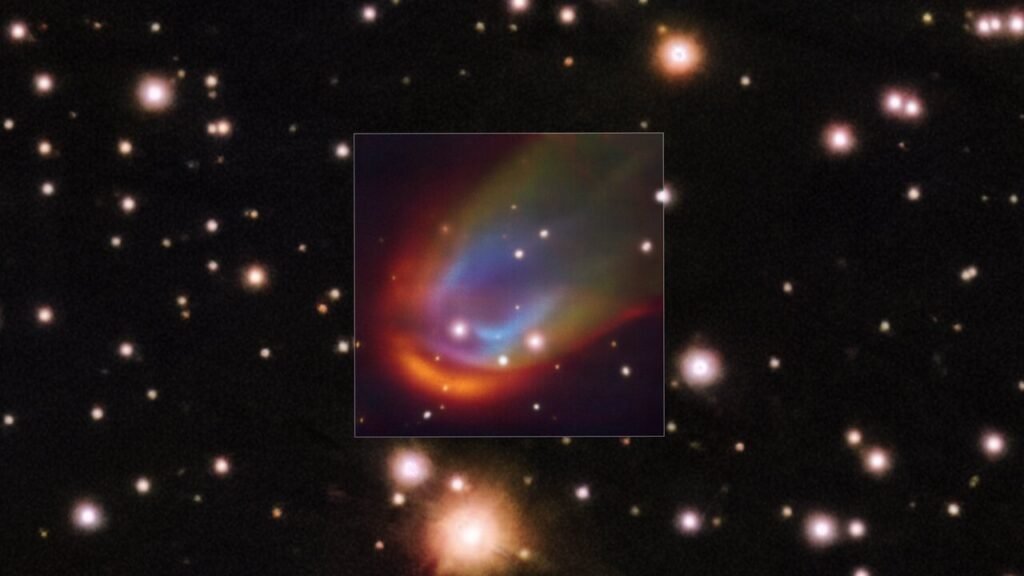

A Stunning Revelation from the Cosmos (Image Credits: Cdn.eso.org)
Astronomers have captured an unexpected cosmic spectacle: a radiant shock wave enveloping a long-extinct star, raising profound questions about the remnants of stellar life.
A Stunning Revelation from the Cosmos
The image emerged from observations conducted with the European Southern Observatory’s Very Large Telescope, revealing a delicate arc of glowing material around the white dwarf known as RXJ0528+2838. This structure, resembling a bow shock, formed as high-speed outflows of gas and dust collided with the interstellar medium. Researchers initially targeted the system to study its binary nature but stumbled upon this unforeseen feature. The discovery, detailed in a recent study published in Nature Astronomy, has sparked intrigue because such shock waves typically arise from more active stellar processes. Instead, this quiet dead star exhibited a persistent glow that defies conventional explanations.
White dwarfs, the dense cores left after stars like our Sun exhaust their fuel, usually fade into obscurity without dramatic interactions. Yet here, the evidence pointed to ongoing outflows shaping the surrounding space. The team noted the shock wave’s symmetry and intensity, captured through advanced imaging techniques that filtered specific wavelengths of light. This finding not only highlighted the VLT’s precision but also underscored gaps in current models of post-stellar dynamics.
Unpacking the Enigma of RXJ0528+2838
Located approximately 730 light-years from Earth, RXJ0528+2838 consists of a compact white dwarf orbited by a Sun-like companion star. In binary systems like this, material from the companion often accretes onto the white dwarf, forming a visible disk and driving powerful jets. However, detailed spectra from the VLT showed no trace of such a disk around this pair. Despite the absence of expected accretion, the system produced enough outflow to generate the observed shock wave, traveling at speeds that sculpted the interstellar gas into a luminous shell.
The white dwarf’s small size and low mass further complicate the puzzle, as these factors typically limit the energy available for such phenomena. Astronomers had assumed that only more massive or actively feeding white dwarfs could sustain long-term outflows. This case suggests alternative mechanisms, perhaps involving subtle magnetic interactions or episodic ejections from the companion star. The shock wave’s persistence implies a stable process at work, one that has endured without the usual triggers.
Challenging Long-Held Assumptions in Astrophysics
This observation forces a reevaluation of how dead stars influence their environments. Traditional theories emphasized accretion disks as the primary source of outflows in binary white dwarf systems, leading to predictable shock structures in cataclysmic variables. RXJ0528+2838, however, operates outside these norms, hinting at undiscovered pathways for material expulsion. The discovery broadens the catalog of white dwarf behaviors, potentially linking to rarer events like nova outbursts or even precursors to Type Ia supernovae.
Collaborators from institutions including the University of Southampton and the Institute of Space Sciences contributed to the analysis, integrating data from multiple observatories. Their work revealed the shock wave’s composition, rich in ionized gases that emit in ultraviolet and optical bands. Such insights could refine simulations of galactic evolution, where white dwarfs play a subtle yet cumulative role in dispersing elements. The finding also prompts questions about similar undetected features around other faint stellar remnants.
Key Takeaways
- The shock wave around RXJ0528+2838 marks the first imaged example of its kind without an accretion disk, challenging binary star models.
- Advanced VLT observations confirmed outflows at velocities sufficient to form the structure, despite the system’s apparent quiescence.
- This puzzle may reveal new interactions in white dwarf binaries, impacting our view of stellar death and rebirth in the universe.
As astronomers continue to probe this cosmic oddity, the shock wave around RXJ0528+2838 stands as a reminder of the universe’s capacity for surprises. It invites deeper exploration into the quiet dramas of dying stars and their lasting imprints on the void. What secrets might other dead stars hold? Share your thoughts in the comments below.