
There is a sentence that sounds simple, almost smug, and yet leaves even seasoned physicists staring at the ceiling at three in the morning: the universe is expanding, but it is not expanding into anything. On the surface, it feels like a language trick, a bit of expert hand‑waving that sweeps away a messy question instead of answering it. Underneath, though, it is a brutally honest admission about how strange reality really is when you start taking general relativity seriously.
Most people picture the universe like a balloon in a room, getting bigger inside some larger space. Cosmologists insist that picture is wrong, and then promptly offer a replacement that sounds even more unsettling: space itself is stretching, and that stretching has no outside. If that makes your brain protest, you are in good company. For more than a century, from Einstein’s first cosmological models to the latest high‑precision observations, this “not expanding into anything” idea has tugged at the nerves of people who work with it every day.
Why “Expanding Into Nothing” Sounds So Wrong to Our Brains
The most shocking part of the statement is how violently it collides with everyday experience. When you watch a balloon grow, paint spread on a canvas, or a city skyline sprawl outward, the expansion is always into something: air, blank canvas, open land. Our spatial intuition has been trained, since childhood, to think of any object as sitting inside a bigger container, and of growth as invading some pre‑existing outside. So when cosmology tells us there is no container and no outside, the mental gears grind and throw sparks.
I remember the first time I really tried to imagine it as a kid: I pictured the universe as a glowing bubble, then immediately wondered what was around the bubble, what held it, what it sat in. That instinct never really goes away; we just learn to catch it. Cosmologists do not deny that instinct – many will confess that they still secretly visualise some kind of “outside” even while knowing it is wrong. The tension between what the equations say and what the gut insists on seeing is part of why this topic keeps feeling quietly disturbing rather than settled.
What General Relativity Actually Says About Space Itself
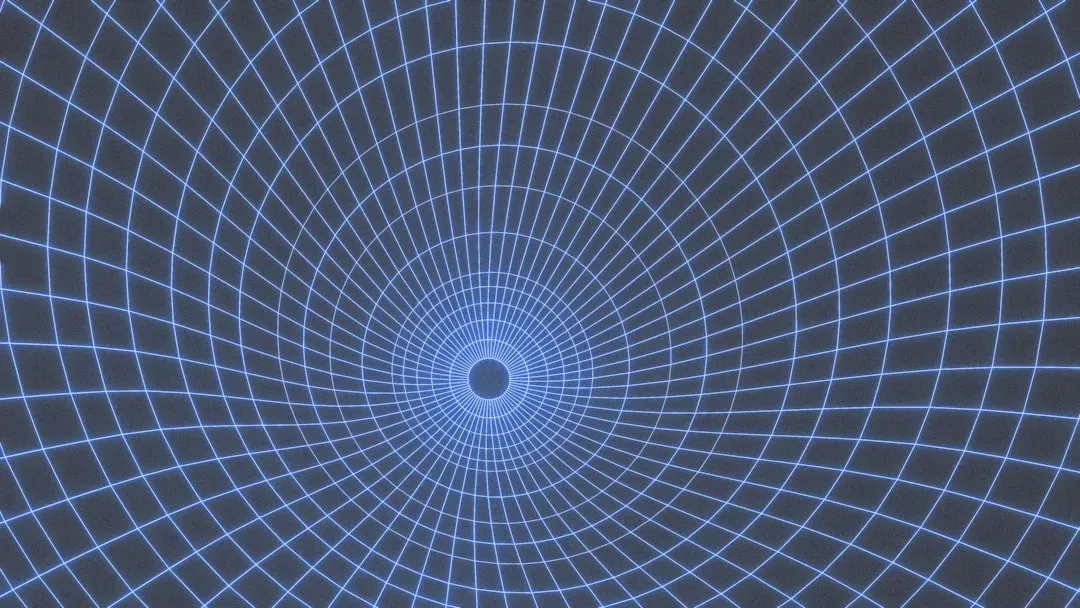
To understand why cosmologists are so stubborn about “not expanding into anything,” you have to look at what general relativity does to the idea of space. In Einstein’s theory, space and time fuse into a four‑dimensional fabric called spacetime, and that fabric is not a stage where events happen; it is part of the cast. Matter and energy tell spacetime how to curve, and spacetime tells matter how to move. Once you swallow that, the notion of an external room where spacetime sits starts to look unnecessary and even contradictory.
Cosmological models that describe an expanding universe, like the standard Friedmann–Lemaître–Robertson–Walker solutions, do not talk about a growing ball inside a bigger nothing. They describe a metric – a rule for measuring distances – that changes with time. The expansion is literally the change in how far apart two “fixed” points in the cosmic fluid become, not because they are flying through space into an outside, but because the geometry between them is stretching. In that framework, asking what spacetime is “inside” of is a bit like asking what the number line is drawn on. You can picture a sheet of paper if you want, but the math does not need or recognise it.
The Classic Balloon Analogy – And Why It Misleads as Much as It Helps
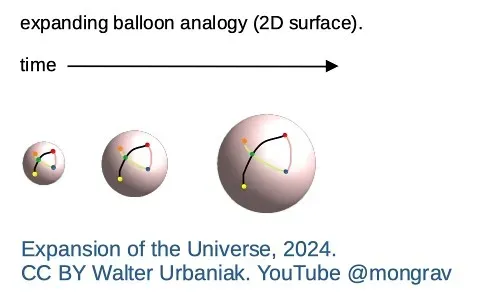
The balloon analogy is the most famous attempt to make this palatable, and like many popular explanations, it solves one confusion by creating another. Imagine tiny dots on the balloon’s surface as galaxies. As the balloon inflates, every dot sees every other dot move away, and the farther ones recede faster. Crucially, from the perspective of those dots, the surface has no edge; it is a two‑dimensional world curving back on itself. That captures one essential idea: expansion can be intrinsic to the surface, not an explosion into the room around it.
But here is the catch: in the analogy, the balloon really is inside a room filled with air, and someone is actually inflating it. Our brains latch onto the three‑dimensional view and smuggle the “outside” back in as if it were part of the physics. In the real universe, we only have the “surface” – our three‑dimensional space – and no evidence of a higher‑dimensional room it sits in. Physicists often grit their teeth using the balloon analogy because they know half the audience will walk away thinking there must be a cosmic hand on the pump somewhere. The unsettling truth is that, in our best theories, there is no pump and no room, just the surface and its own evolving geometry.
Finite but Unbounded: The Mind‑Bending Geometry of a Cosmos With No Edge
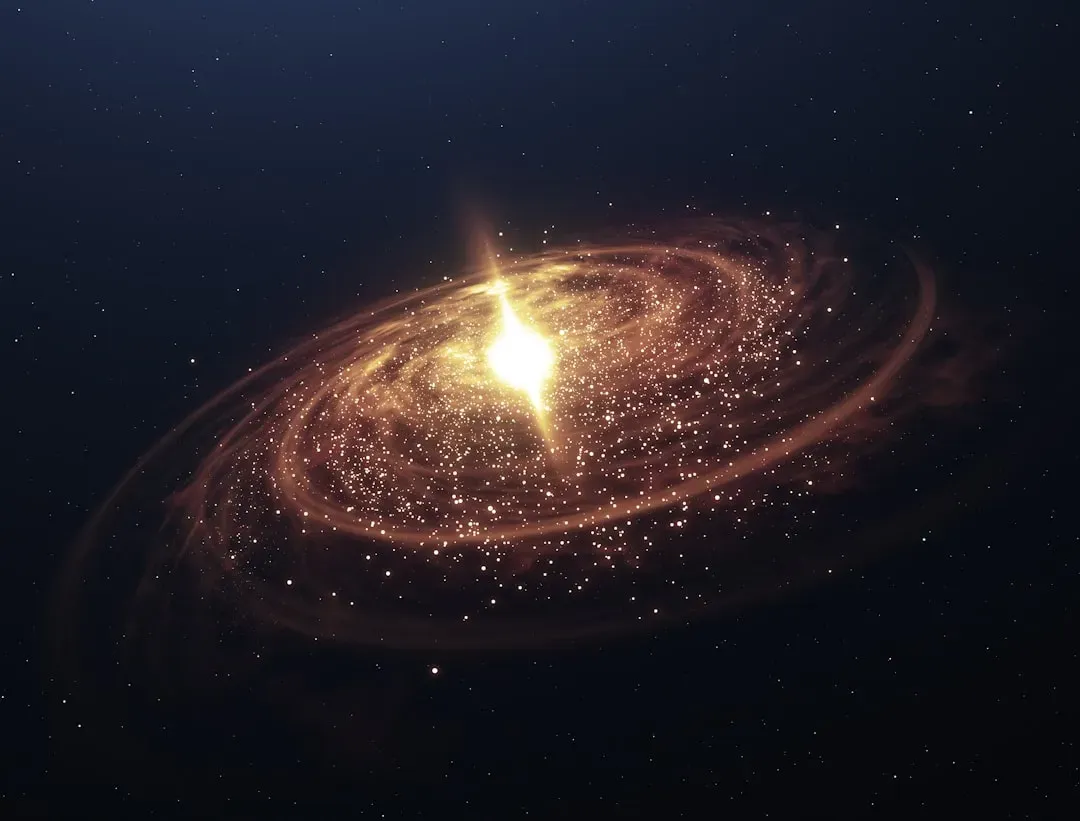
Another deeply disorienting idea tied to this is that the universe can be finite in volume yet lack any boundary or edge. A classic mathematical example is the surface of a sphere: it has a finite area, but if you keep walking in any direction, you never find a rim where the surface stops; you just keep looping around. Some cosmological models work the same way in three dimensions. Space could wrap around on itself like a giant three‑dimensional version of that surface, so you could in principle travel in a straight line long enough and eventually return to your starting point without ever encountering an “outside.”
Even in models where space is infinite, the idea of an edge does not come back. Infinite space does not need an external shell any more than an endless number line needs a final digit. The combination – finite but edgeless, or infinite but not embedded in anything – feels hostile to the way we normally picture location and size. It is no wonder that, historically, some physicists pushed hard for static or edge‑based models, not only for technical reasons but because they seemed psychologically easier to inhabit. Letting go of the craving for a cosmic wall takes more emotional work than textbooks like to admit.
The Big Bang: Not an Explosion, But the Birth of Distances Themselves
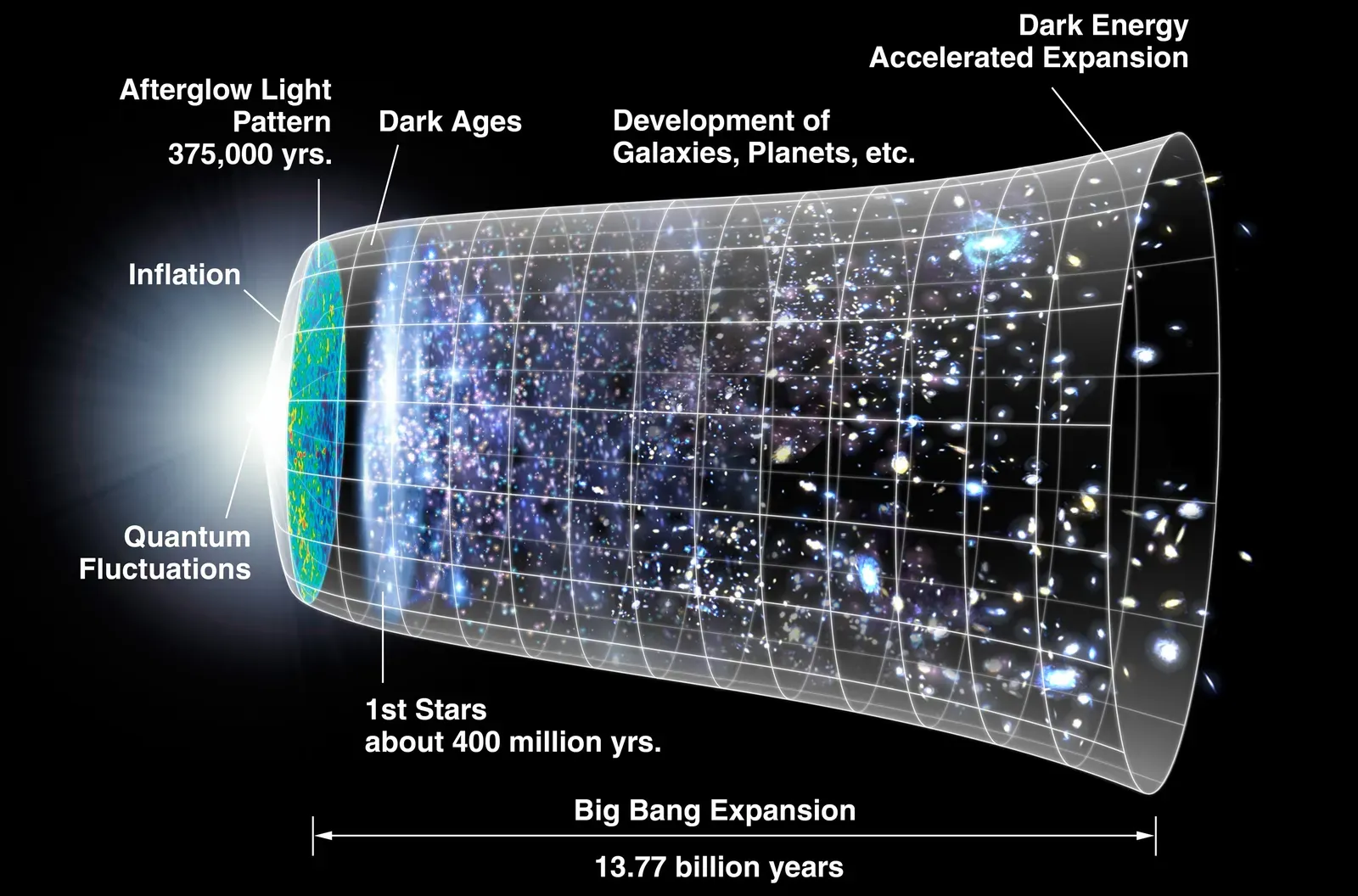
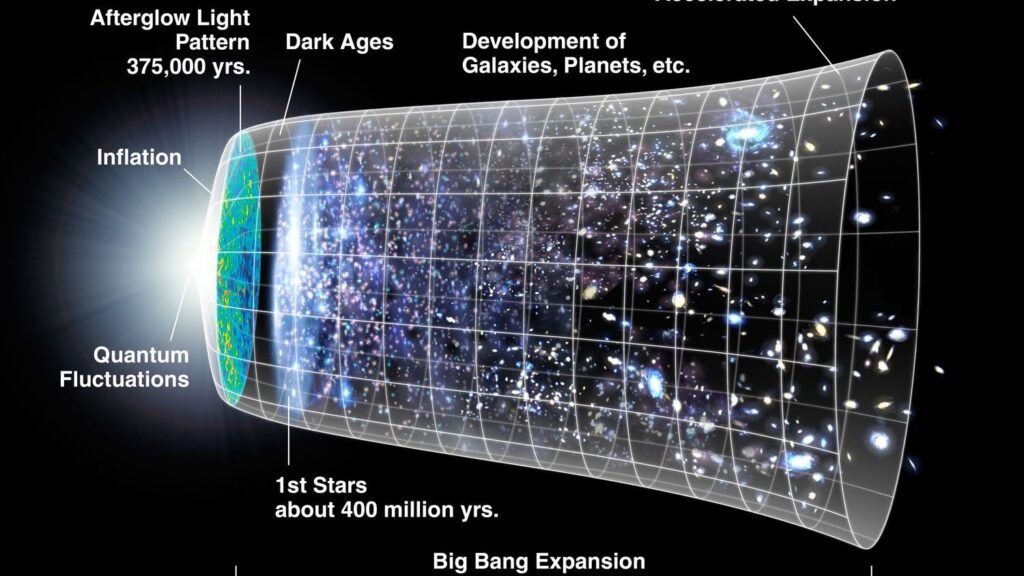
Nothing exposes the “expanding into nothing” confusion more than how people imagine the Big Bang. The popular image is a bomb going off in pre‑existing darkness, flinging matter outward into empty space. That picture is almost completely wrong in the language of modern cosmology. The Big Bang, as far as current theory goes, is not an explosion at a point in space; it is a moment when every distance between any two points in the universe was extremely small, and then began to grow. There is no privileged center where it all started, and no outer shell of debris rushing into a bigger emptiness.
In the equations, rewinding time means shrinking the scale factor – the quantity that measures the overall size of spatial slices – until it reaches a regime where our current physics breaks down. That breakdown is not a tidy, cinematic detonation; it is a sign that our description of spacetime itself stops being reliable. As unsettling as it is, the honest answer today is that we do not know what, if anything, lies “before” or “outside” this expansion. Inflating pre‑space fields, bouncing cosmologies, and multiverse scenarios are all being explored, but none are confirmed, and none turn the universe into a simple fireball expanding into a pre‑laid void. The void itself, in these models, is part of what must be explained.
Why Physicists Themselves Quietly Struggle With the Concept
It is tempting to imagine that professional cosmologists have made their peace with all this and sail through without confusion, but that is more legend than reality. Many will admit, at least off the record in a hallway or over coffee, that their intuition still wants an ambient space. They lean on the math to police that instinct rather than erase it. Learning to work with curved manifolds, dynamic metrics, and coordinate charts is one thing; genuinely feeling, in your bones, that there is no “outside” is something else entirely.
This quiet discomfort shows up in how experts talk to each other. They will say that space expands, but also talk casually about embedding diagrams, higher‑dimensional pictures, or “balloon” illustrations, fully aware these are crutches. In research, the tension reappears in debates about whether spacetime is fundamental or emergent from something deeper, like quantum entanglement or information‑theoretic structures. If spacetime is only an approximation of something more basic, then the question “what is it in?” might someday get reframed rather than simply dismissed. Until then, even physicists live with a kind of double vision: clean formalism on one side, nagging spatial intuition on the other.
What “Nothing” Really Means in Modern Cosmology
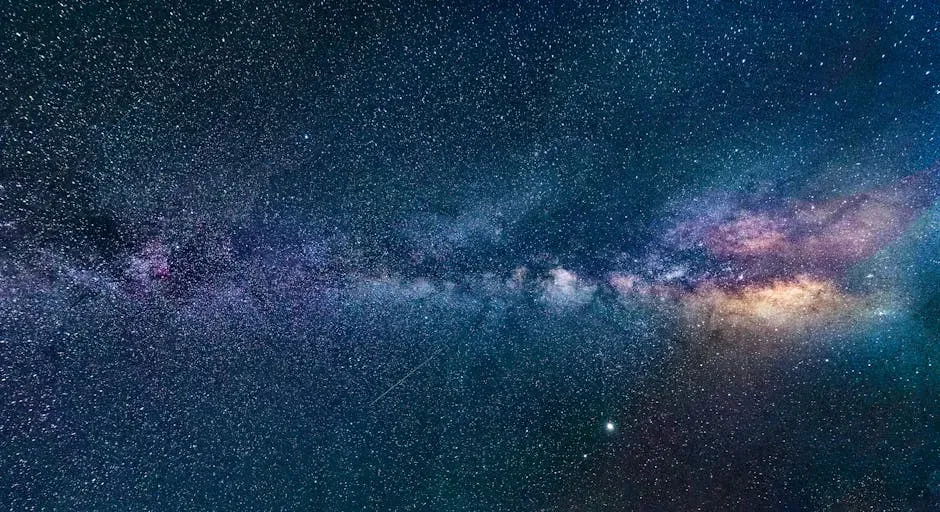
Part of the anxiety comes from how easily the word “nothing” misleads. In everyday speech, nothing means a total absence, a blank void more extreme than an empty room. In physics, though, the “nothing” outside the expanding universe is not a physical empty space waiting to be filled; it is literally the absence of a defined spacetime region. There are no coordinates there, no distances, no clocks, not even a meaningful question about what might be located “just beyond” the edge, because in the theory there is no edge to begin with.
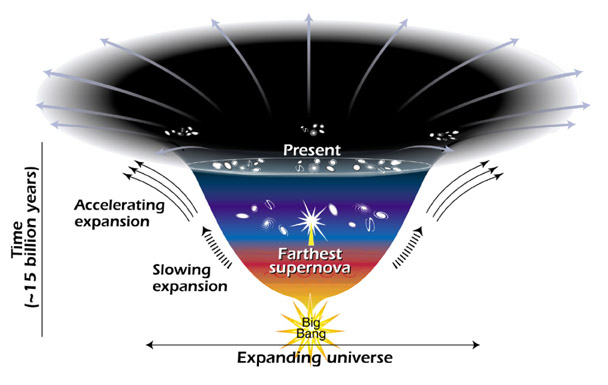
At the same time, what we call empty space inside the universe is anything but bland. Even vacuum regions are simmering with quantum fields, gravitational effects, and dark energy that appears to drive the accelerated expansion. So when cosmologists say the universe is not expanding into anything, they are not invoking some mystical nothingness around a cosmic bubble. They are making a precise point: the correct description of reality, as far as our best models go, only assigns physical meaning to the spacetime manifold itself and its contents. Asking about the outside is a bit like asking what is north of the North Pole – a perfectly grammatical question that fails because it sneaks in an assumption the geometry simply does not share.
Living With a Universe That Refuses Our Favorite Picture
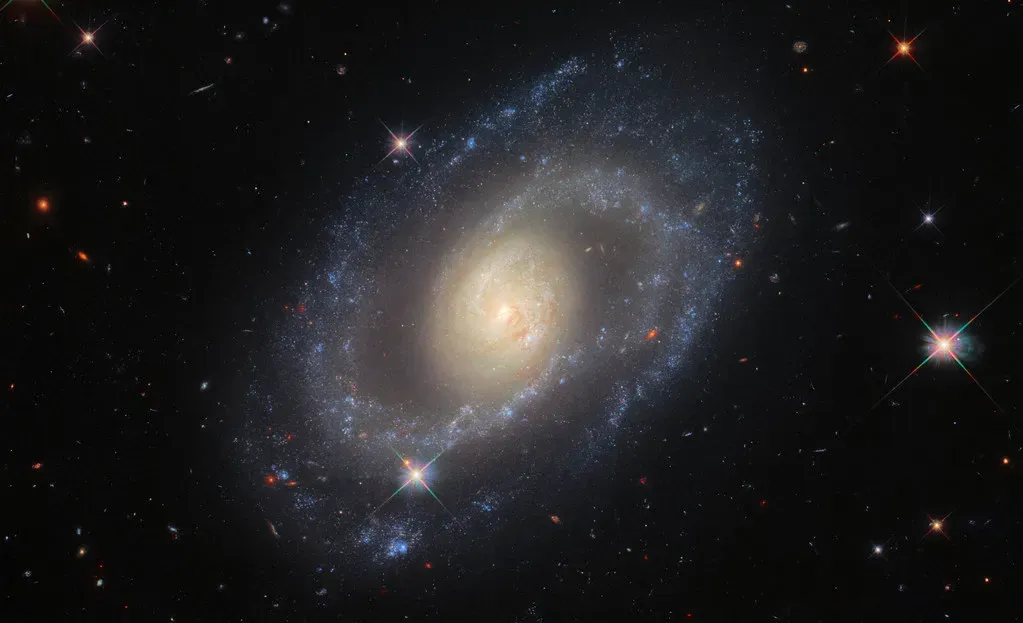
Personally, I think the most honest reaction to all of this is a mix of awe and irritation. Awe, because it is astonishing that human beings, who evolved to throw rocks and read facial expressions, managed to develop a mathematical framework that can describe cosmic expansion without needing an “outside” container. Irritation, because that same framework leaves our native imagery stranded; every time we reach for a mental picture, it betrays us by smuggling in rooms, edges, and centers that the universe stubbornly refuses to provide. There is something almost rude about a reality that works this way.
Still, I would argue that this discomfort is a feature, not a bug. It is a reminder that our intuitions are parochial, shaped by mid‑sized objects in three‑dimensional Euclidean spaces and short human lifetimes. When cosmology says the universe is not expanding into anything, it is not dodging the issue; it is inviting us to grow past those instincts and let the mathematics lead for once. You do not have to like that answer – many physicists do not, deep down – but you cannot really ignore it if you care about what the evidence and theory are telling us. Maybe the unsettling part is exactly what makes the whole idea worth sitting with: if the universe fit our first picture too neatly, would we actually be learning anything new at all?