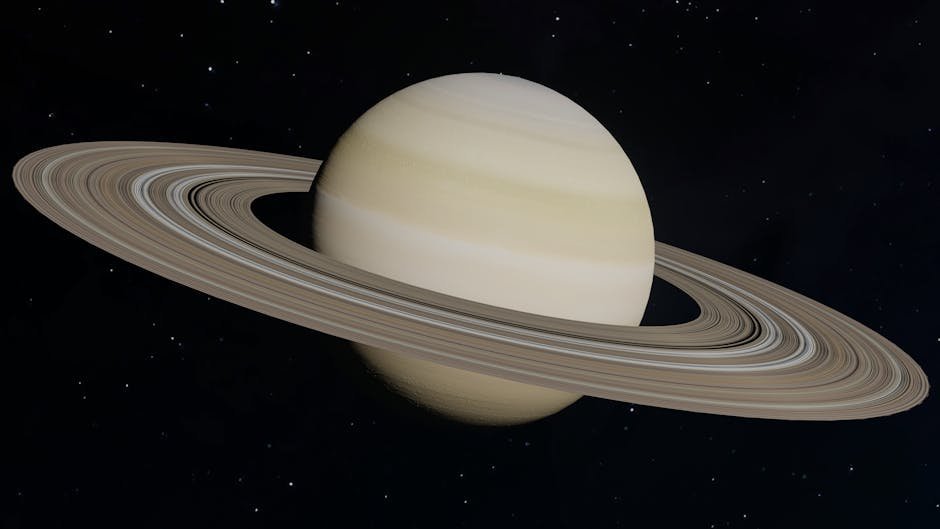
A High-Stakes Gamble Paid Off (Image Credits: Pexels)
NASA’s Cassini spacecraft spent nearly two decades unraveling the enigmas of Saturn, its rings, and moons. Yet the mission’s climax unfolded in its last five months, as the probe threaded a perilous gap between the planet’s atmosphere and innermost rings. Those daring maneuvers produced more fundamental insights than the preceding 13 years, while demonstrating that a spacecraft’s intentional demise could unlock unparalleled science.[1][2]
A High-Stakes Gamble Paid Off
Engineers faced a pivotal choice after years of orbital extensions. Cassini, launched in 1997 and arriving at Saturn in 2004, carried 12 instruments powered by radioisotope thermoelectric generators. As plutonium decay sapped power and fuel dwindled, mission planners opted against a safe drift into space. Instead, they charted a path for controlled atmospheric entry to safeguard potentially habitable moons like Enceladus and Titan from Earth microbes.
This decision crystallized over a decade. Conservative operations had preserved the spacecraft through the Equinox and Solstice mission extensions. The Grand Finale, launched April 26, 2017, discarded those margins. Over 22 orbits, Cassini plunged within 1,600 kilometers of cloud tops at 34 kilometers per second, navigating uncharted territory where ring particles posed lethal threats.[1]
Navigating the Razor-Thin Gap
Each dive demanded pinpoint accuracy. Navigation teams relied on the Deep Space Network, star trackers, and inertial measurement units to hold positions within hundreds of meters across billions of miles. The high-gain antenna served as a shield during the first pass, with instruments powered down amid fears of dust impacts larger than one millimeter.
Reality proved kinder. The Radio and Plasma Wave Science instrument detected only a handful of particles. Freed from survival constraints, other tools activated fully: the Ion and Neutral Mass Spectrometer sampled gases, the magnetometer probed fields, and radio signals tracked gravity via Doppler shifts. Data streamed at 27 kilobits per second during the final plunge, capturing the spacecraft’s fiery end on September 15, 2017, after a last Titan flyby.[1]
Revelations That Rewrote Saturn’s Story
The close passes exposed phenomena invisible from afar. Saturn’s magnetic field aligned almost perfectly with its rotational axis – to within 0.06 degrees. This near-alignment defied dynamo theories, as other planets tilt theirs by 10 to 11 degrees.
Ring dynamics shifted paradigms too. Gravity measurements pegged their age at 10 to 100 million years, far younger than Saturn’s 4.5 billion. Direct sampling confirmed “ring rain,” where water ice and organic molecules rained into the atmosphere at rates higher than models predicted. Gravity waves emerged as key to transporting energy upward, explaining why Saturn radiates 2.5 times the heat it absorbs from the sun.
- Magnetic field precision: 0.06-degree alignment challenges planetary formation models.
- Ring youth: 10-100 million years old, implying transient structures.
- Ring rain influx: Organics and ice directly measured for the first time.
- Heat mystery solved: Vertical flows via gravity waves account for excess energy.
- Gap clarity: Sparse particles enabled safe passage and sampling.
These findings compressed years of potential research into months, outpacing distant-orbit data.[1][3]
Redefining End-of-Life Operations
Cassini’s finale taught that destruction need not waste a mission. Instruments operated beyond design limits, yielding thermal and structural data that refined atmospheric entry models for future probes. No longer mere disposal, decommissioning became a science phase.
This philosophy influences successors. Missions like Europa Clipper incorporate Grand Finale-style objectives, pushing hardware to extremes for maximum yield. Rovers such as Opportunity echoed the approach, extending operations through bold risks.
| Phase | Approach | Science Yield |
|---|---|---|
| Prime Mission (2004-2008) | Conservative orbits | Broad surveys |
| Extensions (2008-2017) | Margin preservation | Steady data |
| Grand Finale (2017) | High-risk dives | Fundamental breakthroughs |
The contrast underscores how freedom from longevity fueled innovation.[1]
Key Takeaways
- Final orbits delivered disproportionate discoveries on Saturn’s core physics.
- Controlled ends protect science while maximizing data.
- Future missions now plan “finale” phases from the start.
Cassini’s legacy endures as a testament to calculated audacity in space exploration. Its plunge not only safeguarded Saturn’s moons but elevated the finale to the mission’s pinnacle. What lessons from this bold strategy will shape the next generation of deep-space voyages? Share your thoughts in the comments.