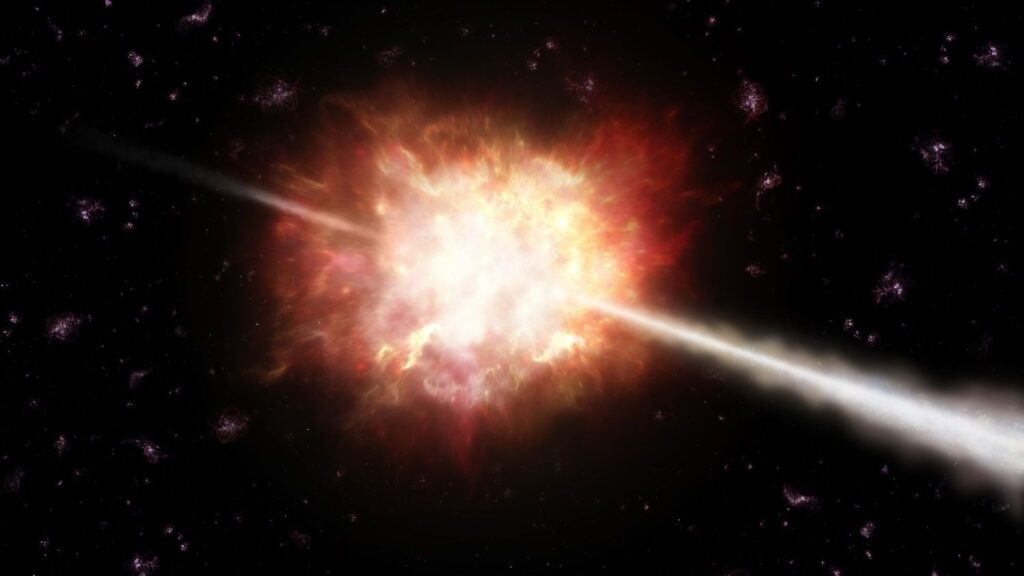

If someone told you that, in the time it takes you to blink, the universe can unleash more energy than our Sun will manage in ten billion years, it sounds like a wild exaggeration. Yet that is almost exactly what astrophysicists say happens during the most powerful gamma-ray bursts, those fleeting, terrifying flashes of high‑energy light from across the cosmos. Even more unsettling, some of these cosmic explosions have likely happened so near, on astronomical scales, that they left fingerprints in Earth’s rocks and in the chemistry of our atmosphere.
When I first learned this, it honestly felt like discovering there are cosmic sharks occasionally passing by our planetary swimming pool. Most of the time they are far away, minding their own business, but every once in a while one comes uncomfortably close. The story of gamma-ray bursts is part hard science, part detective work written in stone and isotopes, and part humbling reminder that Earth lives in a dynamic, sometimes violent galaxy. Let’s unpack what we actually know, what the evidence in our geological record suggests, and where scientists are still arguing at the edges.
What Exactly Is a Gamma-Ray Burst, and Why Is It So Extreme?
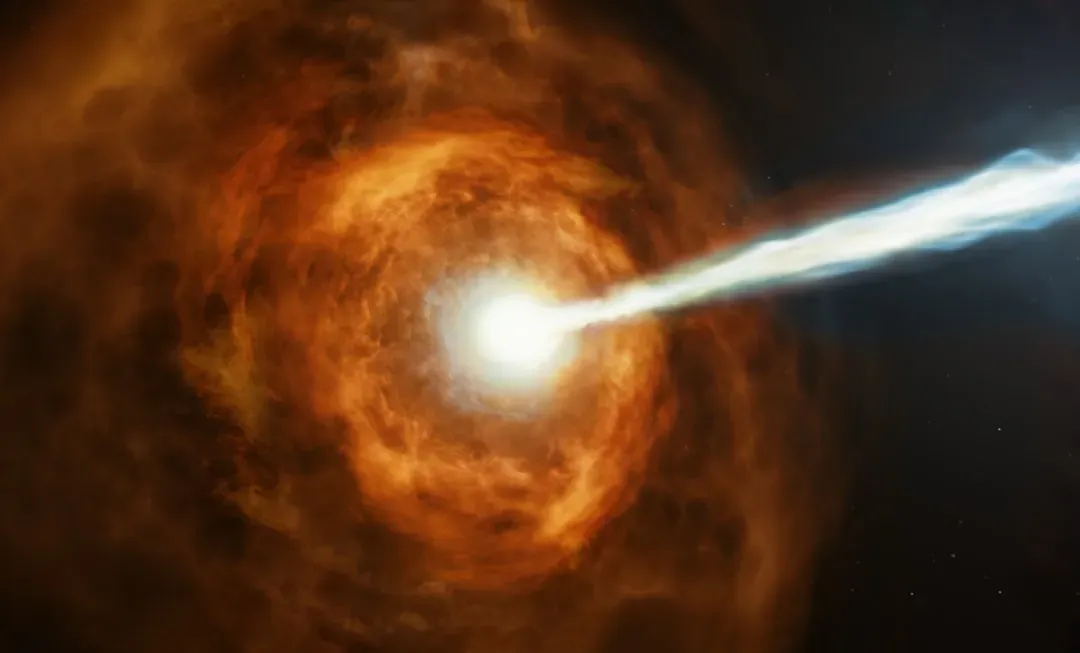
At its core, a gamma-ray burst (GRB) is a sudden, intense flash of the universe’s most energetic form of light: gamma rays. These events usually last from fractions of a second to a few minutes, yet during that tiny window they can outshine entire galaxies. Astronomers divide them into two broad families: short bursts, probably linked to mergers of neutron stars or a neutron star with a black hole, and long bursts, which are mostly tied to the catastrophic death of massive stars collapsing into black holes. Either way, we are talking about some of the most violent transitions matter can undergo.
To make sense of their power, imagine the Sun’s entire ten‑billion‑year energy budget being spent in a few seconds, focused into an extraordinarily narrow beam. GRBs do not radiate that power uniformly in all directions; instead, their energy is thought to be funneled into jets, like a pair of cosmic blowtorches. If one of those jets happens to point toward Earth, we see a burst so bright it momentarily dominates the high‑energy sky. The combination of enormous total energy and extreme beaming is what makes that comparison to the Sun’s lifetime output more than just poetic language – it’s a rough statement of actual physics.
How Can Something Lasting Seconds Outshine the Sun’s Entire Lifetime?
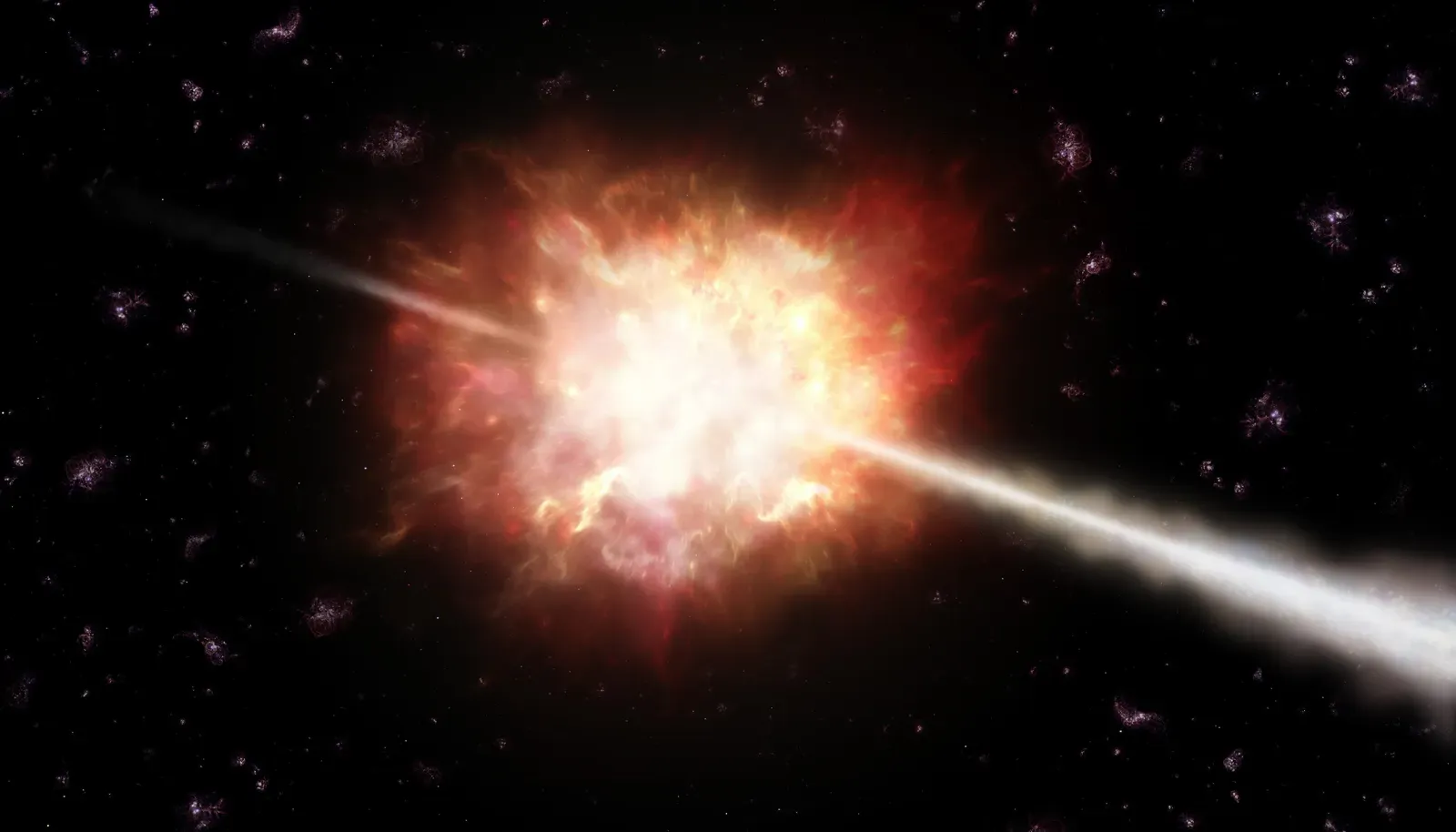
To understand how this is even possible without breaking the laws of physics, you have to think about mass, gravity, and efficiency. When a very massive star collapses or when two neutron stars merge, you suddenly concentrate enormous amounts of mass in a tiny volume, compressing and twisting spacetime itself. Under these conditions, some fraction of the available gravitational energy is converted into jets of particles moving at nearly light speed, threaded by powerful magnetic fields. That conversion can be surprisingly efficient compared with the slow, steady nuclear fusion that powers normal stars like the Sun.
The Sun is actually a very inefficient engine when it comes to turning mass into radiation, and it spreads that output leisurely over billions of years in all directions. A GRB, in contrast, is like cashing out a large chunk of that mass‑energy all at once in a focused beam. When astrophysicists account for the beaming – the fact that we see only a narrow cone rather than a full sphere of emission – the most extreme GRBs still rival or exceed the Sun’s total lifetime energy budget in their jets. In other words, the “more energy than the Sun’s entire life” comparison is not just for drama; it reflects the astonishing concentration of power when relativity, magnetism, and gravity all gang up together.
Where Do Gamma-Ray Bursts Come From in the Universe?
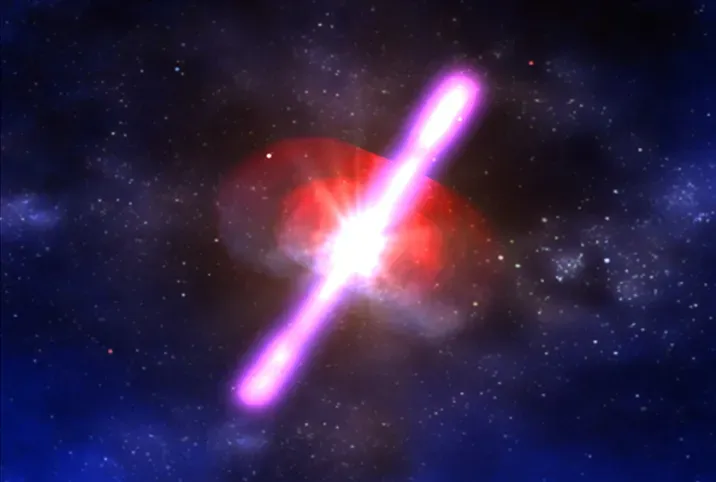
GRBs are not sprinkled randomly; they trace some of the most dramatic life and death stories of stars in the universe. Long bursts tend to appear in galaxies with active star formation, especially in regions rich in very massive, short‑lived stars. When one of those giants runs out of fuel, its core collapses and the outer layers fall inward, forming a black hole or a magnetar and launching jets that burrow through the star before erupting into space. Short bursts, by contrast, are frequently found in older stellar populations, including the outskirts of galaxies where pairs of neutron stars, born long ago, finally spiral together and smash into one another.
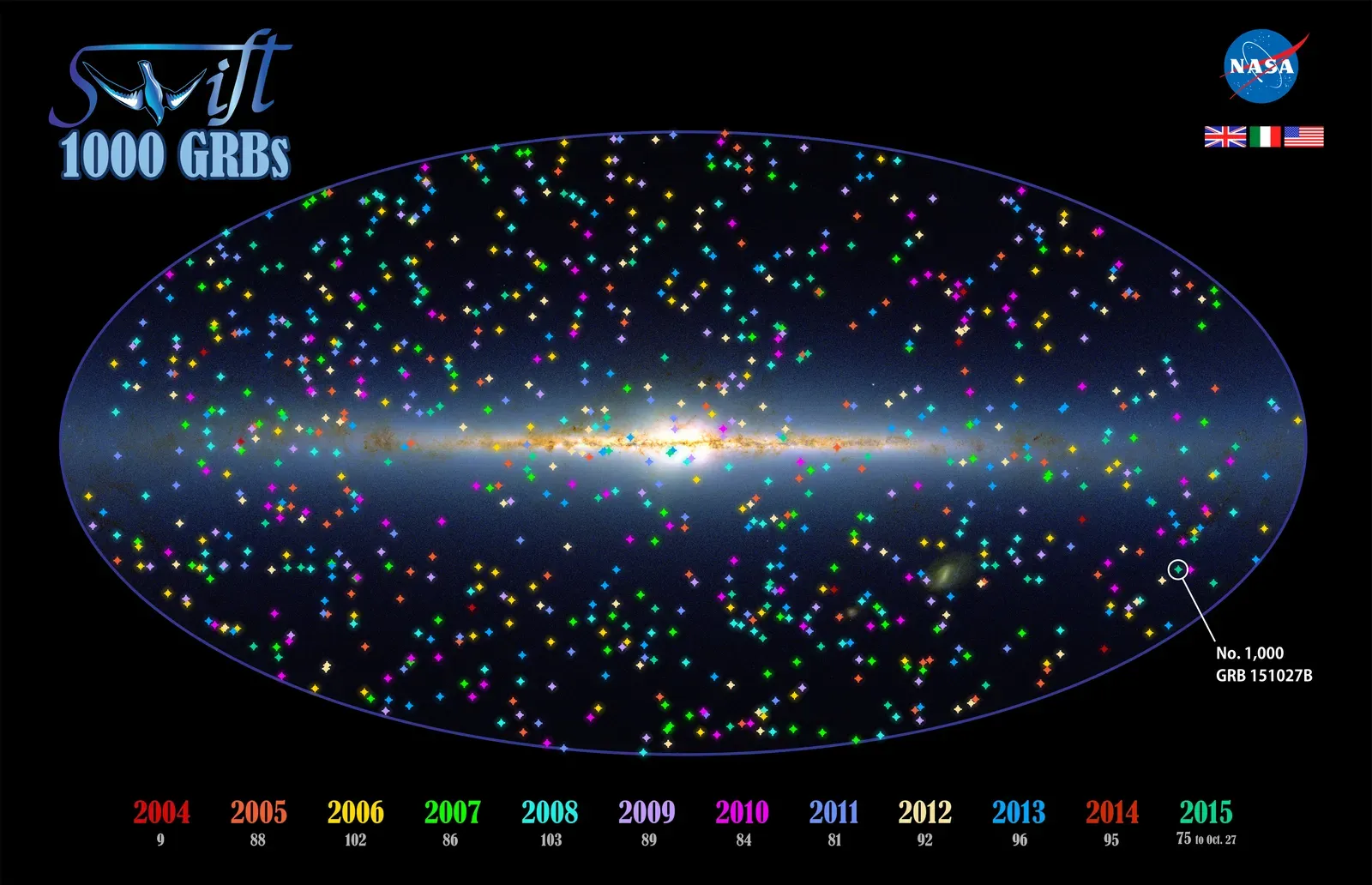
The distances involved are typically mind‑boggling. Many well‑studied GRBs come from billions of light‑years away, meaning we are seeing explosions that happened when the universe itself was much younger. Yet not every burst is so remote. We have detected some that, by cosmic standards, are in our neighborhood – in the same galaxy cluster, or even in galaxies only tens of millions of light‑years away. That still sounds far, but on a galactic canvas these are effectively close encounters, especially when we consider what a directed beam of gamma rays could do if it were aimed at Earth instead of simply passing by.
Could a Nearby Gamma-Ray Burst Actually Affect Life on Earth?
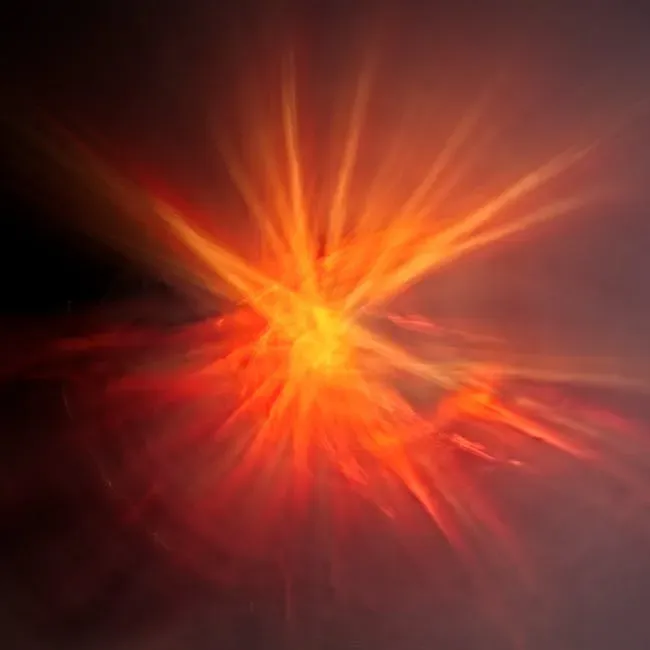
Astrophysicists have spent years exploring this uncomfortable question, and the consensus is nuanced. A GRB would have to be relatively close on a galactic scale and pointed more or less directly at Earth to do serious damage. Most estimates put the dangerous range for a truly catastrophic effect on our atmosphere at something like a few thousand to maybe tens of thousands of light‑years. That is a small fraction of the Milky Way’s size, but not so tiny that we can dismiss the possibility out of hand. There are and have been plenty of massive stars and compact binaries within that radius over the history of our planet.
The main worry is not the instant flash cooking the surface like in a science‑fiction movie; Earth’s atmosphere is actually a good shield against direct gamma rays. The real threat comes from chemistry. A strong burst could strip ozone, flood the upper atmosphere with nitrogen oxides, and alter the flow of ultraviolet light from the Sun reaching the surface for years. That kind of disruption could stress ecosystems, push some species over the edge, and change the course of evolution without necessarily leaving a neatly labeled “this was a gamma-ray burst” sign. In that sense, GRBs are less like a cinematic explosion and more like a sudden, invisible tweak of the planet’s environmental settings.
Have Gamma-Ray Bursts Really Left Traces in Earth’s Geological Record?
This is where the story gets both fascinating and controversial. Several lines of research suggest that powerful cosmic events – possibly including GRBs or close supernovae – have left chemical fingerprints in Earth’s rocks and sediments. Scientists have found unusual spikes in certain radioisotopes, such as iron and other elements produced in massive stellar explosions, in deep‑sea crusts and Antarctic snow layers. These anomalies look like brief showers of exotic material arriving from space, out of sync with what you would expect from normal cosmic rays and background processes.
Linking any particular anomaly to a gamma-ray burst, though, is tricky. GRBs can be associated with supernovae, and supernovae themselves also fling radioactive material across interstellar space. Some researchers have proposed that specific extinction or climate‑shift events in the distant past might have been triggered or amplified by a nearby burst, pointing to patterns in fossil records or abrupt changes in isotopes as circumstantial evidence. Others argue that the case is not yet strong enough and that more mundane explanations, like volcanic outbursts or slow geological cycles, can account for much of the data. The honest state of play is that we have tantalizing hints, not courtroom‑level proof, that GRBs have written themselves into our rocks.
How Do Scientists Try to Connect Cosmic Explosions to Past Extinction Events?
When researchers suspect a cosmic culprit behind a mass extinction or sudden environmental change, they follow a kind of forensic procedure. First they look for timing: does a burst of unusual isotopes or cosmic‑ray‑related chemistry line up with a known extinction boundary or major climate shift in the geological record? They also check whether the estimated energy and distance of a plausible GRB or supernova in our galactic neighborhood could realistically produce the observed effects on the atmosphere and biosphere. This involves detailed computer models of how high‑energy radiation interacts with air, oceans, and living organisms.
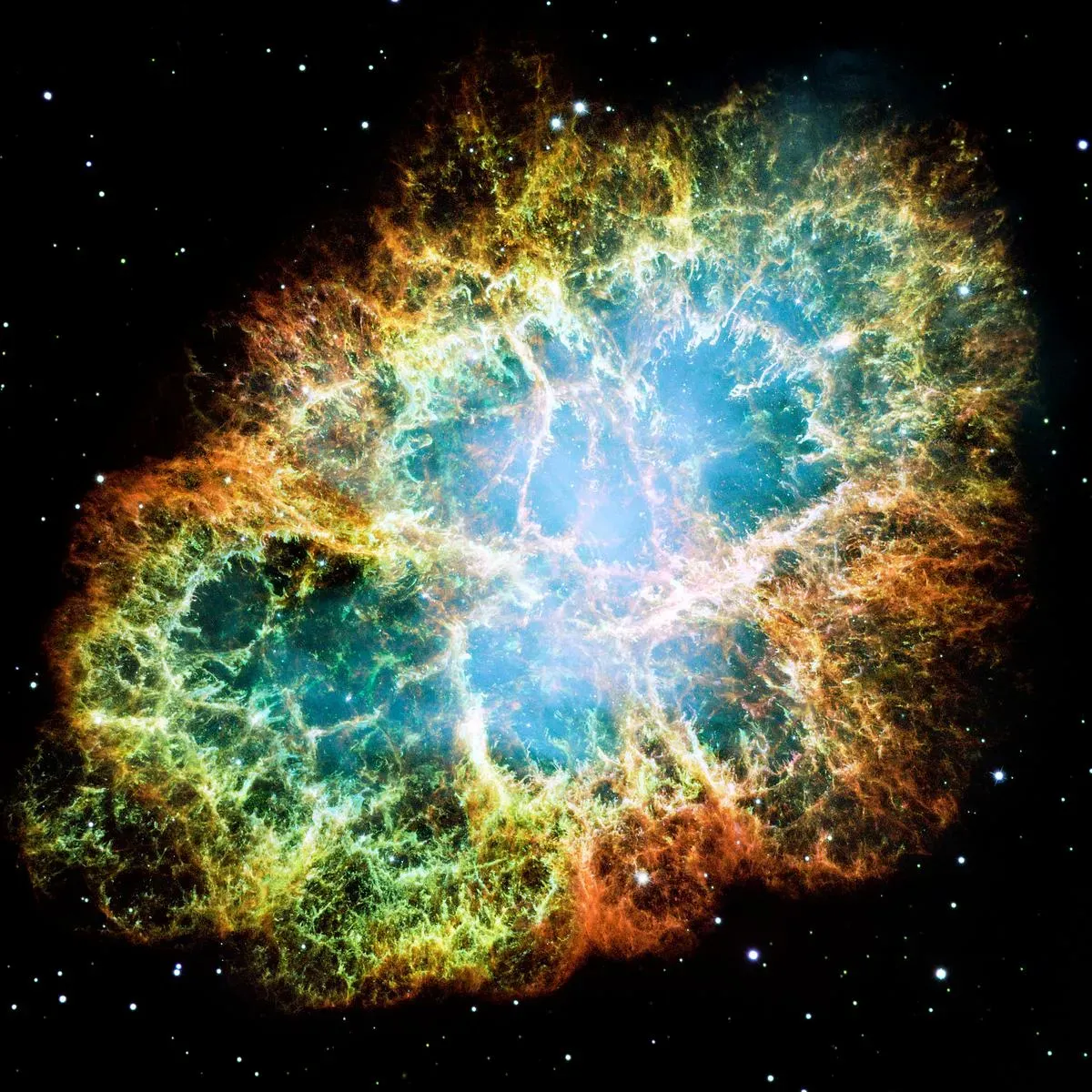
At the same time, scientists survey the sky for remnants of past explosions, like nearby supernova remnants or the locations of potential GRB progenitors such as massive stars or compact binaries. If a candidate event lines up in both time and space with an anomaly in the geological record, the case gets more compelling, though it still rarely becomes airtight. Personally, I find this cross‑disciplinary detective work one of the most inspiring parts of the story: geologists, astronomers, and climate scientists all comparing notes across millions of years and thousands of light‑years to reconstruct a single violent night that might have changed life on Earth.
What Do Gamma-Ray Bursts Tell Us About Our Place in the Universe?
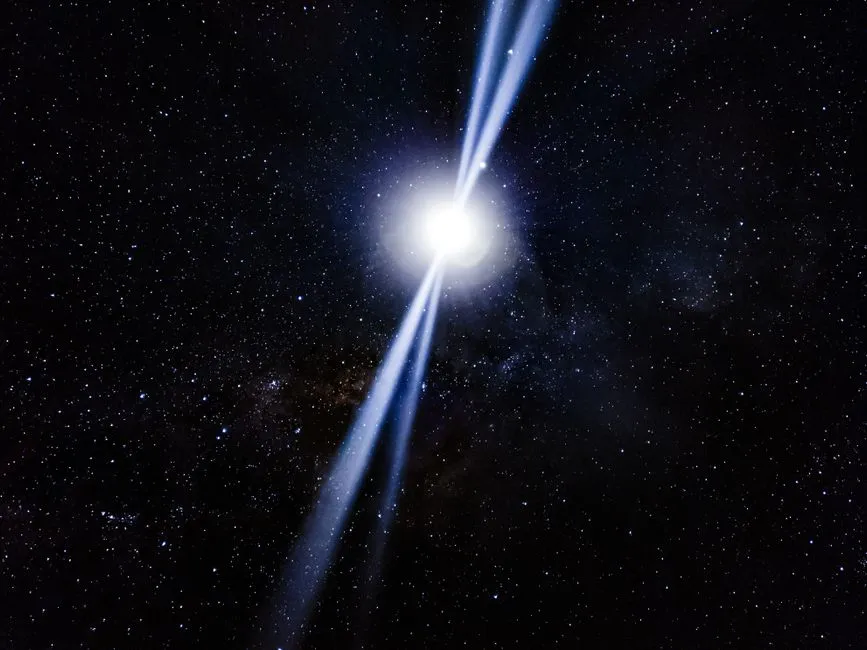
GRBs are a reminder that the universe is not a quiet, static backdrop for human stories; it is an active, sometimes explosive environment in which our planet happens to be riding along. The fact that bursts can outshine galaxies in seconds and may have nudged Earth’s history at least a few times puts our everyday worries into perspective. At the same time, our ability to detect them from billions of light‑years away, decode their origins, and even search for their signatures in geological layers says something profound about human curiosity and resilience. We are fragile, but we are not clueless.
There is also an oddly comforting side to all this. Yes, the galaxy can be dangerous, but the really lethal events are rare in both space and time, and we have made it about four and a half billion years without being completely wiped out by one. Instead of living in constant fear, it makes more sense to see GRBs as extreme test cases for our understanding of physics and as occasional background players in the grand drama of evolution. To me, they underscore a simple truth: we are part of a universe that is powerful, unpredictable, and far bigger than us, but we are also capable of reading its most dramatic chapters.
Conclusion: A Violent Universe, a Resilient Planet
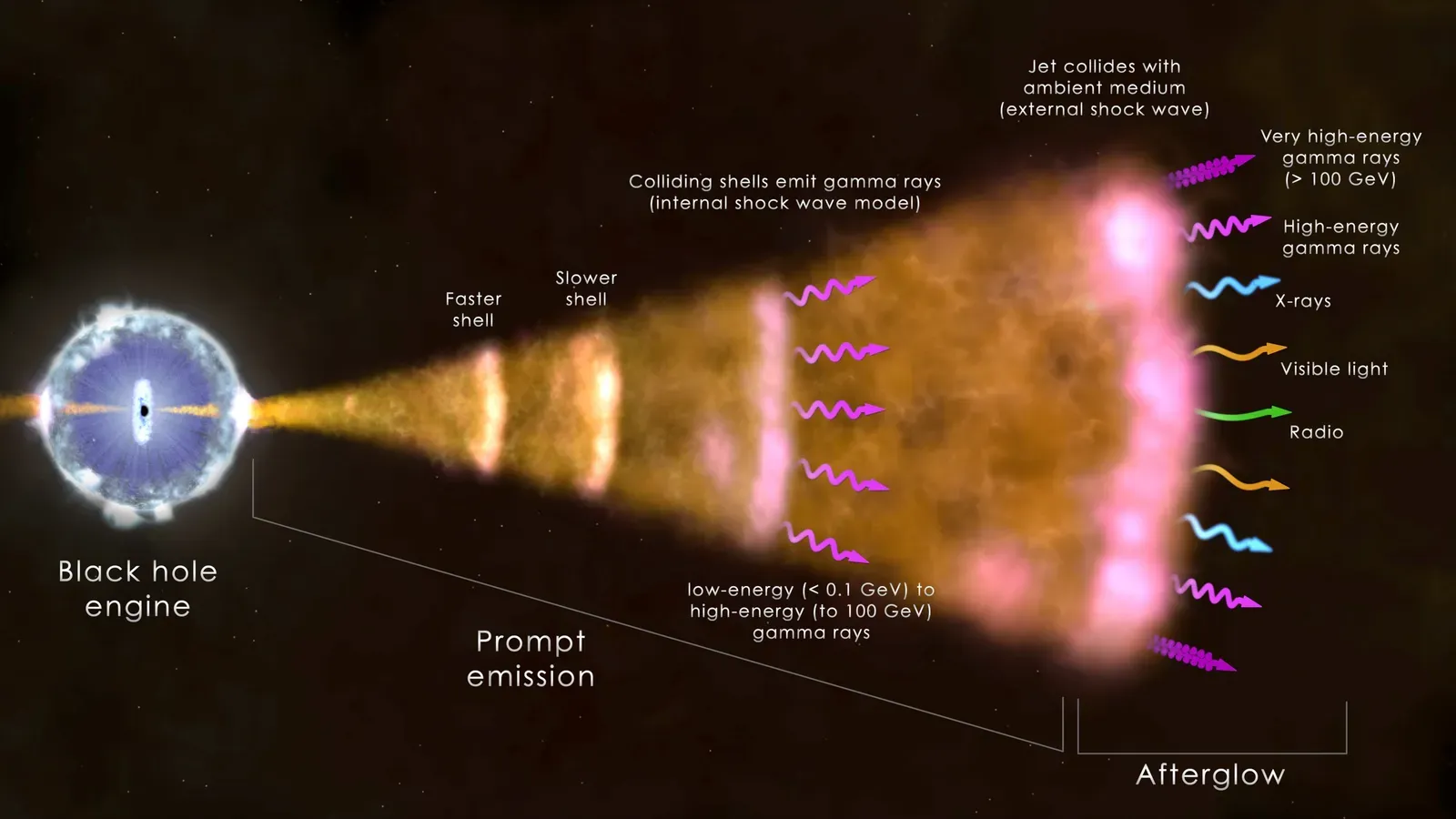
In my view, the most honest stance is to admit that gamma-ray bursts are both terrifying and awe‑inspiring, and that we should resist the urge to turn them into either pure doomsday fodder or harmless trivia. The physics behind them is solid: these events really do rival the Sun’s entire lifetime energy output in the span of seconds, funneled into narrow, relativistic jets. The idea that some have occurred close enough to leave traces in Earth’s geological record is scientifically plausible and supported by suggestive evidence, but the case is not closed and probably never will be as clean as we might like. That tension between what we know and what we can only infer is part of the story.
What I find most compelling is how GRBs connect the smallest details in a sediment core with the largest processes in the cosmos. A spike in a rare isotope in a thin layer of rock might be the footprint of a star’s final scream half a galaxy away. That kind of connection makes Earth feel less like an isolated stage and more like a participant in galactic history. If the universe can rewrite parts of our story in a few seconds of gamma‑ray fury, and yet life still finds ways to adapt and persist, maybe the real takeaway is that fragility and resilience go hand in hand. When you look up at the night sky now, do you see just pretty stars, or do you also imagine the ghosts of ancient bursts that might have brushed past us long before humans ever looked up?