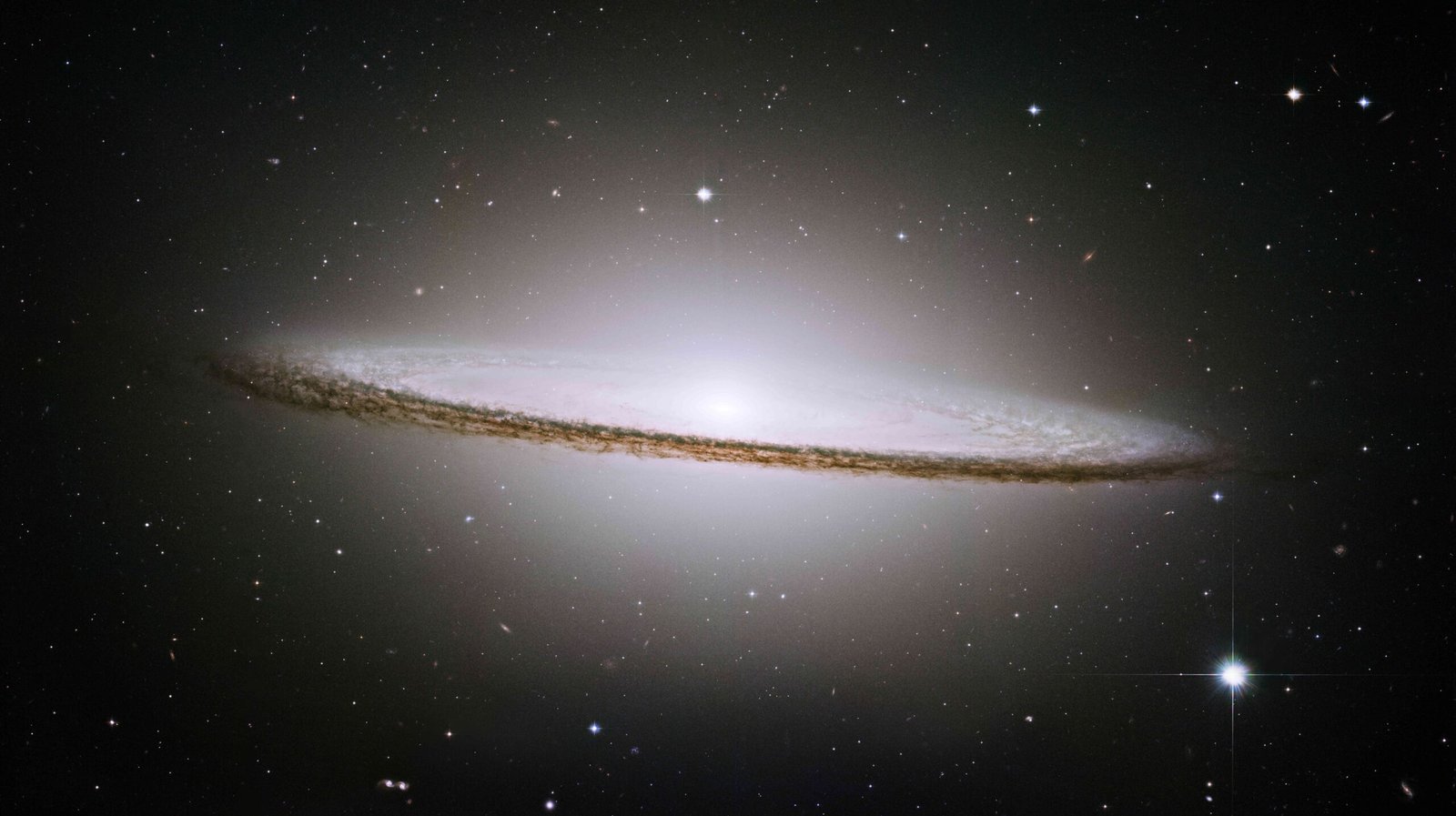
A Cosmic Phenomenon Predicted by Einstein (Image Credits: Upload.wikimedia.org)
Astronomers recently harnessed a rare gravitational lens called the Einstein Cross to probe the core of an elliptical galaxy from the universe’s formative years. This configuration, where light from a distant object splits into four distinct images around a foreground galaxy, offered magnified clarity into stellar compositions otherwise too faint to resolve. The findings challenge assumptions about star formation timelines in the early cosmos.[1]
A Cosmic Phenomenon Predicted by Einstein
Gravitational lensing occurs when massive objects bend spacetime, acting as natural telescopes to amplify distant light. The Einstein Cross represents one of the most precise alignments, producing four bright points symmetrically arranged around the lensing galaxy. Such systems remain exceptionally scarce, with only a handful documented despite extensive sky surveys.[2]
Discovered configurations like the original Einstein Cross in 1985 involved a quasar lensed by a foreground galaxy. Modern observations continue to uncover new examples, each providing unique windows into remote cosmic events. Telescopes such as Hubble and ground-based arrays have captured these crosses, revealing supernovae, quasars, and now galaxy cores.[3][4]
This particular lens enabled scientists to dissect light from an elliptical galaxy existing when the universe was young. Elliptical galaxies typically host populations dominated by older, redder stars, but detecting such maturity so early raises intriguing questions about formation processes.
Mature Stellar Core in a Youthful Cosmos
Researchers identified spectra indicating evolved stars at the galaxy’s center, defying expectations for that epoch. Typically, early galaxies brimmed with young, blue stars fueling rapid growth. Yet this elliptical harbored surprisingly aged stellar remnants, suggesting accelerated evolution or rapid assembly.[1]
“The discovery of this exceptional object has allowed us to accurately study the nature of the stars at the center of an elliptical galaxy in a remote era of the universe, when the galaxy was still young,” stated a lead researcher. Detailed analysis of the lensed images revealed chemical signatures and brightness profiles consistent with post-main-sequence stars. These observations marked a first for such precision in probing ancient galactic nuclei.
The magnification factor from the lens boosted signal strength, permitting spectral resolution unattainable otherwise. This breakthrough highlighted how rare alignments serve as cosmic microscopes for otherwise invisible details.
Mechanics of the Gravitational Lens
The foreground galaxy’s mass warps spacetime, creating multiple paths for incoming light rays. Perfect symmetry yields the cross pattern, with each arm corresponding to a parity-inverted image of the background source. In this case, the lensing galaxy aligned precisely with the distant elliptical, producing the ideal cross.[2]
- Four primary images form the cross arms, each magnified differently.
- Central regions benefit from peak amplification, ideal for core studies.
- Spectroscopy across images confirms consistent redshift and composition.
- Rarity stems from precise alignment requirements, occurring in less than 1 in 10,000 strong lens systems.
- Recent examples include systems spotted by Gaia and Hubble.[3]
Lens modeling reconstructed the unlensed source plane, verifying the galaxy’s intrinsic properties. Such techniques have evolved with computational power, now incorporating dark matter distributions for accuracy.
Challenging Models of Galaxy Formation
Standard theories posit that elliptical galaxies assembled through mergers of smaller progenitors, accumulating old stars over billions of years. Encountering a mature core so soon after the Big Bang implies either faster merging or “downsizing,” where massive galaxies quenched star formation earlier than less massive ones.
This discovery aligns with trends observed in other high-redshift lenses, where quiescent galaxies appear sooner than predicted. It prompts revisions to simulations incorporating feedback from supermassive black holes and stellar winds. Future surveys with JWST may uncover more such systems, refining our timeline of cosmic maturation.[1]
| Aspect | Typical Early Galaxy | This Einstein Cross Galaxy |
|---|---|---|
| Stellar Population | Young, blue stars | Mature, red giants dominant |
| Era | Universe ~2-3 Gyr old | Remote, young phase |
| Study Method | Direct imaging limited | Lensing magnification |
Comparative analysis underscores the anomaly, as lensing uniquely enables such contrasts.
Key Takeaways
- Rare Einstein Cross lenses magnify early universe objects by factors of 10-100x.
- Reveals old stars in young elliptical galaxy, questioning formation speed.
- Paves way for detailed spectroscopy of faint, distant cores.
This exceptional Einstein Cross not only illuminates a surprising stellar snapshot from cosmic dawn but also equips astronomers with a template for hunting similar anomalies. As detection technologies advance, more revelations await in the gravitational archives of the sky. What implications do these findings hold for our understanding of the universe’s adolescence? Share your thoughts in the comments.