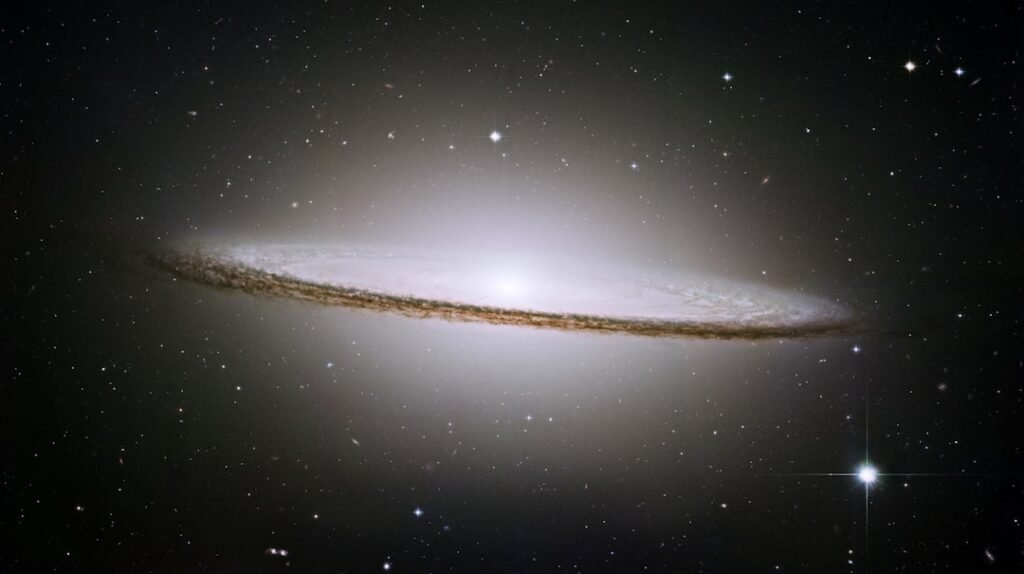

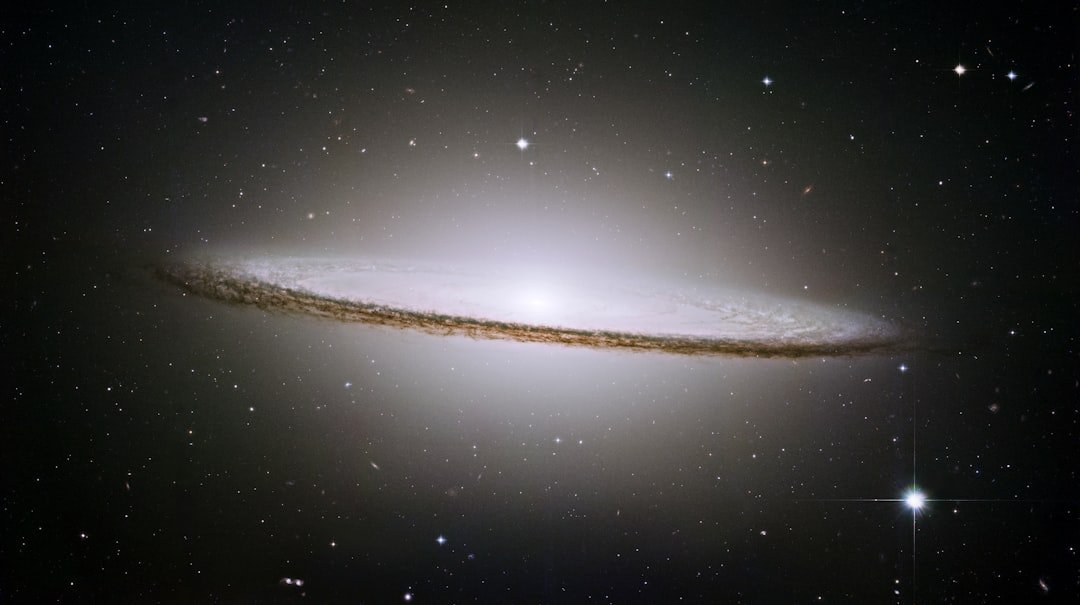
A Flat Rotation Curve Spans Vast Distances (Image Credits: Unsplash)
European astronomers turned to the Atacama Large Millimeter Array (ALMA) and the James Webb Space Telescope (JWST) to examine ADF22.1, a giant barred spiral galaxy residing in the proto-cluster SSA22 at a redshift of 3.09. This distant system, observed over 11 billion years ago, displayed structural features remarkably similar to those of nearby massive disk galaxies. The combined observations yielded precise measurements of its rotation and mass distribution, shedding light on the processes that shaped such behemoths in the young universe.[1]
A Flat Rotation Curve Spans Vast Distances
Researchers measured an outer rotation velocity of approximately 530 kilometers per second for ADF22.1, a speed that sustained a flat rotation curve from a radius of 16,000 light-years out to 49,000 light-years. This profile indicated stable dynamics across an expansive disk, with an effective radius reaching about 22,800 light-years. Such characteristics challenged expectations for galaxies at this epoch, which often appeared more chaotic.[1]
The team conducted the first rotation-curve decomposition for a galaxy of this type, breaking down contributions from stars, gas, and dark matter. ALMA provided data on cold gas distributions, while JWST captured details of stars and dust. Velocity dispersion measurements further refined models of the galaxy’s stability. These findings positioned ADF22.1 as a prime example of ordered motion in the early cosmos.[1]
Massive Components Define a Stellar Powerhouse
ADF22.1 emerged as a dusty star-forming galaxy hosting an obscured active galactic nucleus, with a stellar mass of 270 billion solar masses derived from detailed decompositions. Its dark matter halo weighed in at 7.94 trillion solar masses, while baryonic mass totaled 520 billion solar masses. These figures highlighted the galaxy’s immense scale, far exceeding typical systems at similar redshifts.[1]
The following table summarizes the key mass components:
| Component | Mass (Solar Masses) |
|---|---|
| Stellar | 270 billion |
| Baryonic | 520 billion |
| Dark Matter Halo | 7.94 trillion |
Stellar-to-halo mass ratio stood at 0.2, and baryon-to-halo mass ratio at 0.4 relative to the cosmological baryon fraction. Specific angular momentum ratios for stellar and baryonic components matched local values at 0.9 and 1.0, respectively. These proportions suggested efficient angular momentum transfer during assembly.[1]
Cold Gas Fuels Rapid Disk Growth
Formation models for ADF22.1 invoked cold gas condensing from the hot circumgalactic medium, either through spontaneous processes or a fountain cycle powered by supernova or active galactic nucleus feedback. This mechanism allowed the disk to grow massive and extended without significant hindrance. Insufficient gas expulsion in early phases preserved the high angular momentum needed for its flat structure.[1]
“We exploit ALMA and JWST observations to characterize its dynamics, compare it to local counterparts, and use this information to understand its formation and subsequent evolution,” the researchers stated in their study.[1] Led by Francesca Rizzo of the University of Groningen, the team published their analysis as a preprint on arXiv.[1] The galaxy’s starburst nature contrasted with expectations for high-mass systems, which typically transitioned to quiescent, bulge-dominated forms earlier.
- Structurally akin to local giant disks despite its youth.
- Hosts a bright, obscured AGN amid dusty star formation.
- Demonstrates high rotation speeds indicative of dark matter dominance.
- Exhibits angular momentum efficiency matching present-day galaxies.
- Resides in dense proto-cluster environment of SSA22.
From Starburst to Stellar Relic
High-mass disk galaxies like ADF22.1 typically evolved into quiescent ellipticals, yet this one’s properties hinted at a divergent path. It could transform into an extreme early-type galaxy retaining unusually high angular momentum or persist as one of the most massive and extended disks observed locally today. The proto-cluster setting amplified opportunities for mergers and feedback, influencing its trajectory.[1]
These observations served as a laboratory for mass accumulation in early galaxies and supermassive black holes. Comparisons to local counterparts underscored the continuity in disk stability across cosmic time. Future studies may refine these models with additional high-redshift data.
Key Takeaways:
- ADF22.1’s flat rotation curve reveals mature dynamics at redshift 3.09.
- Mass ratios align closely with local galaxies, defying simplistic evolution models.
- Cold gas inflows drove its massive disk without excessive disruption.
The study of ADF22.1 underscores how advanced telescopes like ALMA and JWST bridge the gap between the early universe and our own Milky Way’s ancestors. As researchers continue to map these ancient structures, they refine theories on galaxy assembly. What implications do these findings hold for our understanding of cosmic evolution? Share your thoughts in the comments.