Somewhere beneath the ice of the Canadian Arctic, a spot on the map that used to matter to every sailor, pilot, and Boy Scout with a compass has quietly packed up and left. It didn’t announce itself with a headline or a tremor you could feel. It just kept sliding, year after year, the way it always has, only faster than anyone expected. What’s driving that slide sits nearly two thousand miles beneath your feet, and understanding it means thinking about the planet not as a solid ball but as something closer to a slow, churning ocean of metal.
A pole that refuses to sit still
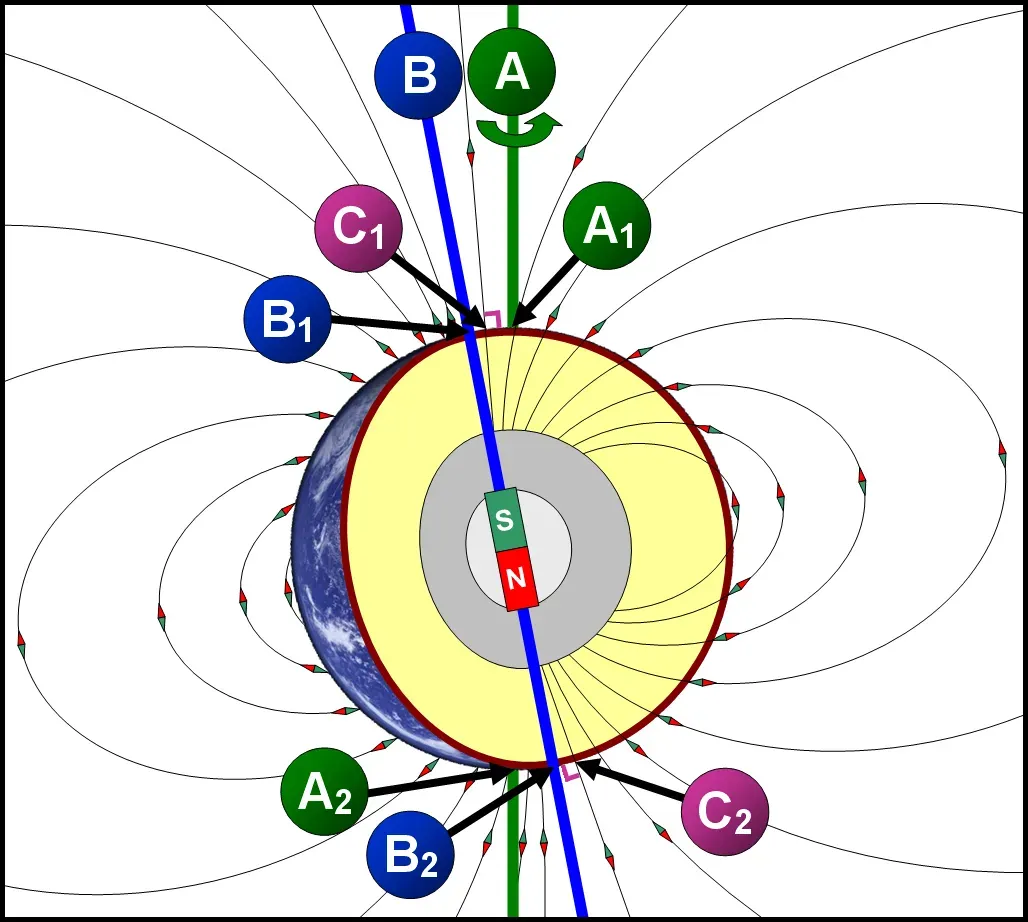
The magnetic north pole was first pinned down in 1831 by the British polar explorer James Clark Ross, who found it sitting on the Boothia Peninsula in what is now Canada’s Nunavut territory. Since that discovery, the magnetic north pole has moved about 25 miles a year in a northwest direction, a pace that sounds modest until you add it up over nearly two centuries.
That slow northwest crawl has now added up to something genuinely historic. The pole is no longer closest to Canada, and it now sits officially closer to northern Russia, completing a drift that began more than 190 years ago in the high Canadian Arctic. Geophysicists tracking the shift note that the north magnetic pole is sliding about 35 miles closer to Russia each year, which means the compass in your phone is chasing a target that has essentially left the continent it called home for two centuries.
The dynamo hiding in the outer core
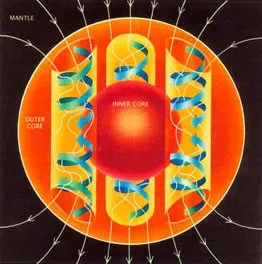
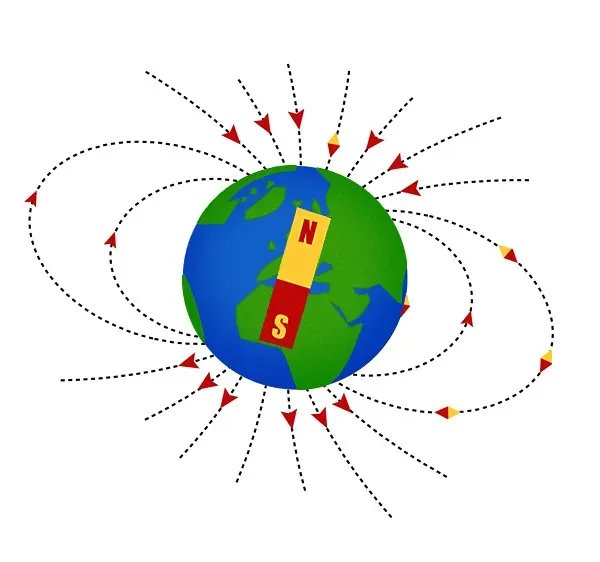
To understand why the pole moves at all, you have to go looking for the actual source of Earth’s magnetism, and it isn’t at the surface. Earth’s magnetic field is generated by the geodynamo, a process driven by the churning, electrically conductive molten iron in Earth’s outer core, and as the fluid moves, it creates electric currents that generate magnetic fields, which then reinforce one another.
The European Space Agency has described this in a way that’s easy to picture: our magnetic field exists because of an ocean of superheated, swirling liquid iron that makes up the outer core, and like a spinning conductor in a bicycle dynamo, this moving iron creates electrical currents, which in turn generate our continuously changing magnetic field. It’s a genuinely strange thing to sit with. The stability we take for granted every time a compass needle settles is actually the byproduct of something violently dynamic happening thousands of miles down.
Why the core never holds still
The outer core doesn’t churn randomly. It moves because of heat, and heat has to go somewhere. The ongoing slow cooling of the liquid iron and nickel core drives circular currents of liquid material in the outer core known as convection currents, while the Earth’s rotation deflects these currents, causing them to flow in a particular pattern.
Add the planet’s spin into that mix and things get even more organized, in a strange, swirling sort of way. Because the Earth is rotating, the convection currents in the molten iron are influenced by the Coriolis effect, which causes the motion of fluids to be deflected to the right in the Northern Hemisphere and to the left in the Southern Hemisphere, and this causes the swirling convection currents to align in cylindrical patterns, which is important for generating the magnetic field. Those shifting cylinders of moving iron are, in effect, the reason the magnetic pole never sits in exactly the same place for long. Change the flow pattern even slightly, and the surface expression of that field, the point your compass chases, shifts with it.
The 1990s sprint, and the recent slowdown
For most of the twentieth century, magnetic north ambled along at a pace you could almost ignore. Then something changed. In 1990, its northern drift accelerated, increasing from 9.3 miles per year to 34.2 miles per year, according to NOAA scientist Arnaud Chulliat. That’s nearly a fourfold jump, and it caught researchers off guard.
What’s been happening more recently is arguably stranger still. Unlike the geographic North Pole, which marks a fixed location, the magnetic north pole’s position is determined by Earth’s magnetic field, which is in constant motion, and over the past few decades its movement has been unprecedented, dramatically speeding up, then in a more recent twist rapidly slowing, though scientists can’t fully explain the underlying cause. Researchers studying satellite data have traced part of the acceleration to specific changes deep in the core. Research is showing that changes in the pattern of core flow between 1970 and 1999 elongated the Canadian lobe, significantly weakening its signature on Earth’s surface, causing the pole to accelerate towards Siberia.
Watching an invisible ocean from orbit
You can’t exactly send a submarine into the outer core, so scientists have had to get clever about tracking it. The European Space Agency’s Swarm mission, a trio of satellites launched specifically to monitor Earth’s magnetic field, has become one of the main tools for this work. Swarm mission data are being used to measure and untangle the different magnetic fields that stem from Earth’s core, mantle, crust, oceans, ionosphere and magnetosphere, giving researchers an indirect but remarkably detailed window into a place no instrument can physically reach.
That satellite data feeds directly into the models the world actually relies on. Early in 2026, NOAA confirmed that WMM2025 and its high-resolution version had proven accurate during their first year of operation, after comparing the models with fresh data from the European Space Agency’s Swarm satellites. It’s an unglamorous but essential feedback loop: satellites watch the field from above, the field reflects what the liquid iron is doing below, and modelers translate all of it into numbers that keep navigation systems honest.
Why an invisible drift costs real money
It’s tempting to file all of this under abstract science, but the pole’s wandering has concrete consequences. For industries reliant on magnetic fields, such as aviation, shipping and navigation, this movement is no small matter, since GPS systems, planes and military equipment track the magnetic field and rely on accurate models of magnetic north to function properly. When the field shifts and the models lag behind, small errors creep in that can eventually become significant ones.
The stakes get sharper the closer you get to the poles. Without regular updates to the magnetic model, navigation errors would accumulate quietly, and a few degrees of uncorrected declination can throw off flight paths, shipping lanes, and military targeting systems. That’s why agencies treat the five-year World Magnetic Model update as a serious infrastructure task rather than a scientific curiosity, and why an emergency update was once issued in 2019 when the pole moved faster than the existing model could handle.
The bigger, slower question of a flip

Wandering poles naturally raise a bigger question: could the whole field flip? It’s happened before, many times, over the planet’s history. Scientists have estimated that this polar flip, which can take thousands of years to complete, happens about once every million years, though the time between flips has varied greatly, from 5,000 years to as much as 50 million years. The last one occurred roughly 780,000 years ago, so by geological standards we are overdue, though “overdue” on that timescale could still mean tens of thousands of years away.
There’s also the matter of a field that’s been quietly losing strength. Over the last two centuries, the field has weakened by about 9 percent, which has fed decades of speculation about reversal, even though the U.S. Geological Survey says there is no evidence that mass extinctions correlate with magnetic pole reversals. The honest answer, repeated by NOAA researchers themselves, is that it could change its rate, or even speed up again, and nobody currently has a reliable way to say which.
Final thoughts

What strikes me most about this story isn’t the drift itself, it’s how comfortable we’ve become pretending the ground beneath us is static. It isn’t. There’s a molten ocean of iron down there doing its own restless thing, and the compass in your pocket is just a distant, delayed readout of that churn. I think that’s worth sitting with for a second, not as a source of anxiety but as a genuinely humbling fact about the planet we live on. The pole will keep moving, the models will keep chasing it, and honestly, that ongoing chase between fixed instruments and a restless planet is one of the more quietly fascinating collaborations in modern science.