Most people assume every flash of colour in the animal kingdom comes from pigment – a chemical dye sitting quietly in skin, scales, or feathers. They’re wrong, and the truth is stranger than fiction. Some of nature’s most dazzling creatures are, biologically speaking, colourless.
Their blues, greens, and shimmering golds are optical illusions built from microscopic architecture – tiny structures that bend, scatter, and refract light itself. Scientists call it “structural colouration,” and once you understand it, you’ll never look at a peacock, a butterfly, or even a blue jay feather the same way again. Here’s what researchers actually say about the animals faking their colours with physics instead of chemistry.
#1 – The Blue Morpho Butterfly Is Secretly Brown
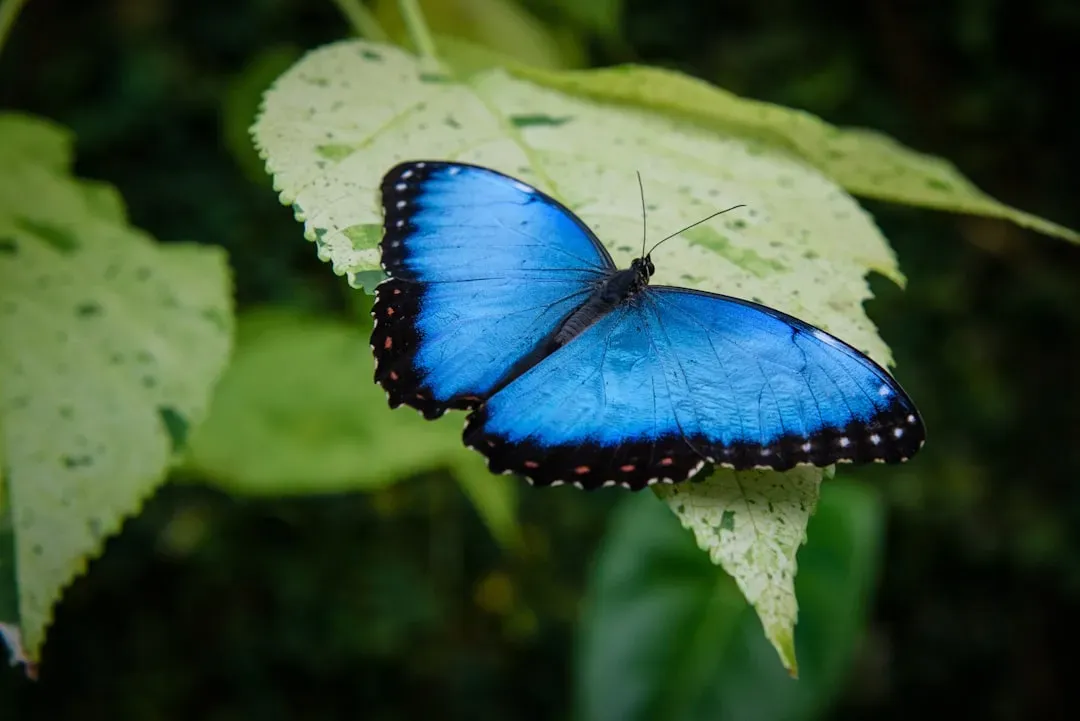
The Blue Morpho is one of the most photographed butterflies on Earth, but here’s the twist: it doesn’t actually have any blue pigment at all. Researchers have confirmed that the wings of a Morpho butterfly are some of the most brilliant structures in nature, yet they contain no blue pigment – they harness the physics of light at the nanoscale.
If you flip the wing over or look at it from a different angle, the illusion collapses entirely. The pigmented colour of the wings is actually brown, and since the top of the wing appears brown when illuminated from behind, the brilliant blue seen by the eye must come from the structure of the wing, not from pigment. Tree-shaped ridges arranged in precise rows act like a diffraction grating, turning each wing into a living prism. But that’s nothing compared to what we found about #2.
Fast Facts
- Morpho butterflies live in the rainforests of Central and South America, with some species reaching wingspans of nearly 8 inches.
- Their scales contain microscopic, “Christmas tree” shaped ridges that split incoming light like a tiny prism.
- The wing’s true pigment is a dull brown, visible only when light hits it from behind rather than in front.
- Because the blue is structural rather than chemical, it never fades with age the way dyed or pigmented colour would.
#2 – The Peacock’s Feathers Are Actually Brown Underneath
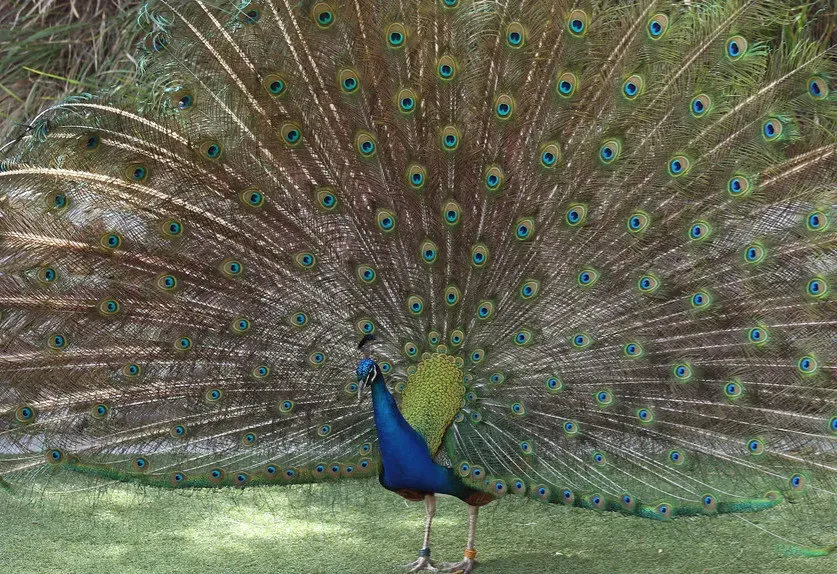
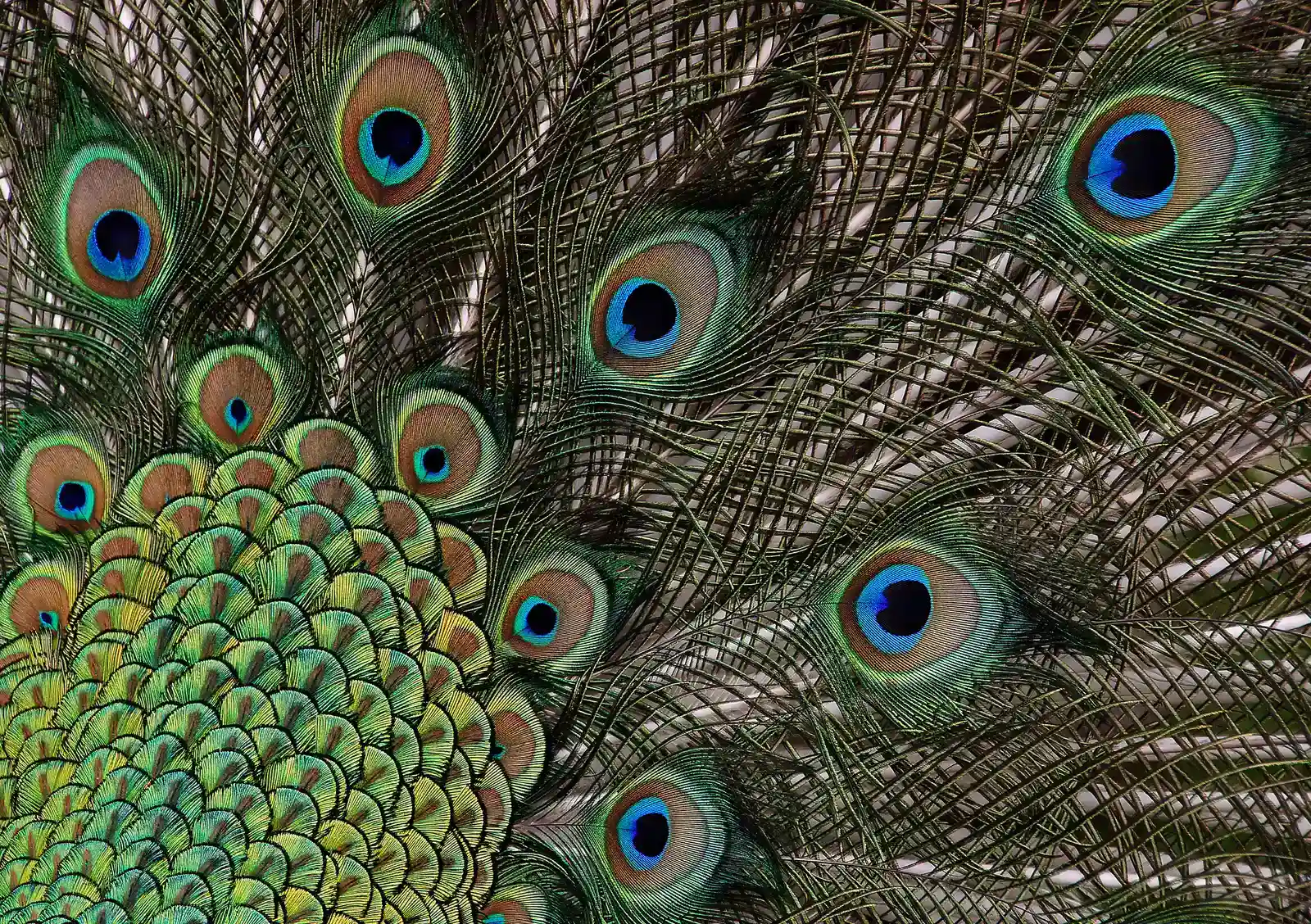
Here’s a fact that stops most people mid-scroll: peacock feathers are pigmented brown, not blue or green. Scientists at Harvard confirmed that a peacock’s brilliant teal and blue feathers aren’t the result of pigment at all, but of nanoscale networks that reflect specific wavelengths of light.
The proof is almost embarrassingly simple to witness – when the feathers get wet, they turn brown, a dead giveaway that the colour was never pigment-based. Under a microscope it gets even stranger: the barbules contain photonic lattices made of melanin cylinders spaced roughly 150 nanometers apart in the green regions. Even wilder, albino peacocks that can’t produce melanin lose the entire microstructure and turn ghost-white, because without the structure there’s simply nothing left to reflect. But #3 takes this trick to a whole new level of shape-shifting.
#3 – Panther Chameleons Don’t Change Colour With Pigment Either
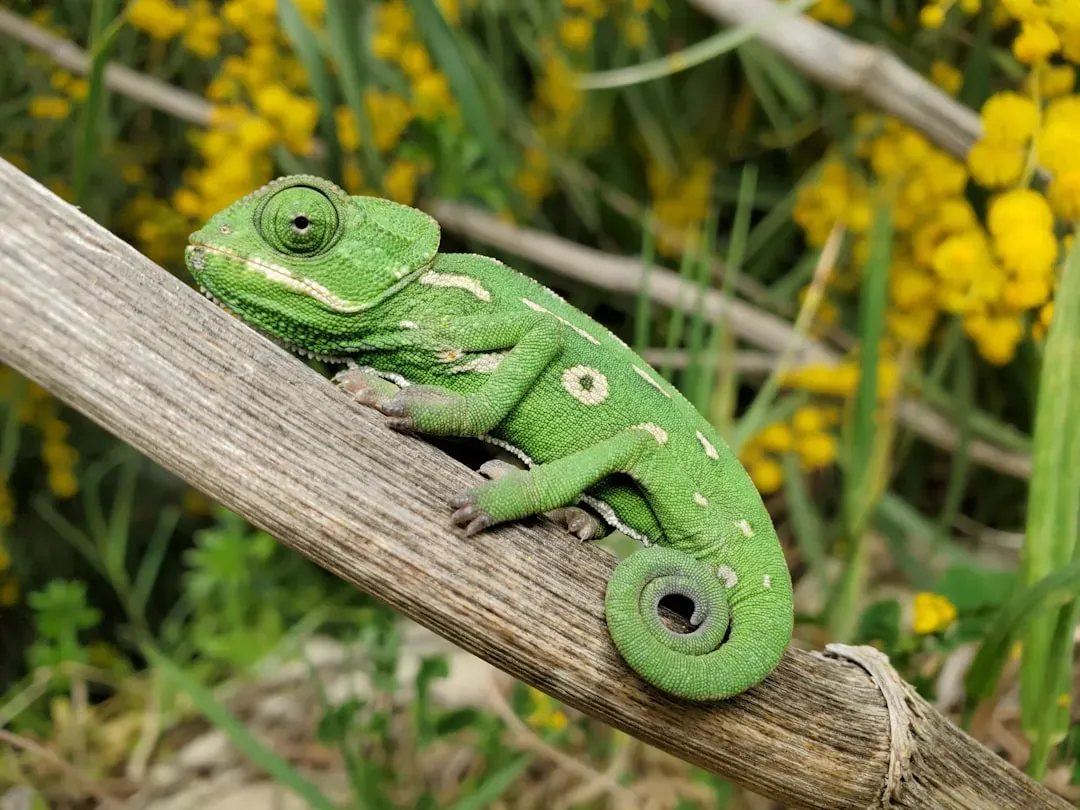
For decades, everyone assumed chameleons changed colour by shuffling pigment granules around inside their skin cells. A 2015 study out of the University of Geneva proved that assumption dead wrong, showing the changes happen through active tuning of a lattice of nanocrystals inside a layer of dermal cells called iridophores.
Here’s the part that should blow your mind: the chameleon is physically stretching its own skin to rearrange crystals, not mixing paint. When calm, the crystals sit in a dense network that reflects blue wavelengths; when the animal gets excited, it loosens the lattice and other colours like yellow or red bounce back instead. There’s even a second, deeper layer of cells doing something completely different – reflecting infrared light like a built-in heat shield. Wait until you see what hummingbirds are doing with the exact same nanocrystal trick.
#4 – Hummingbird Throats Flash Like a Light Switch
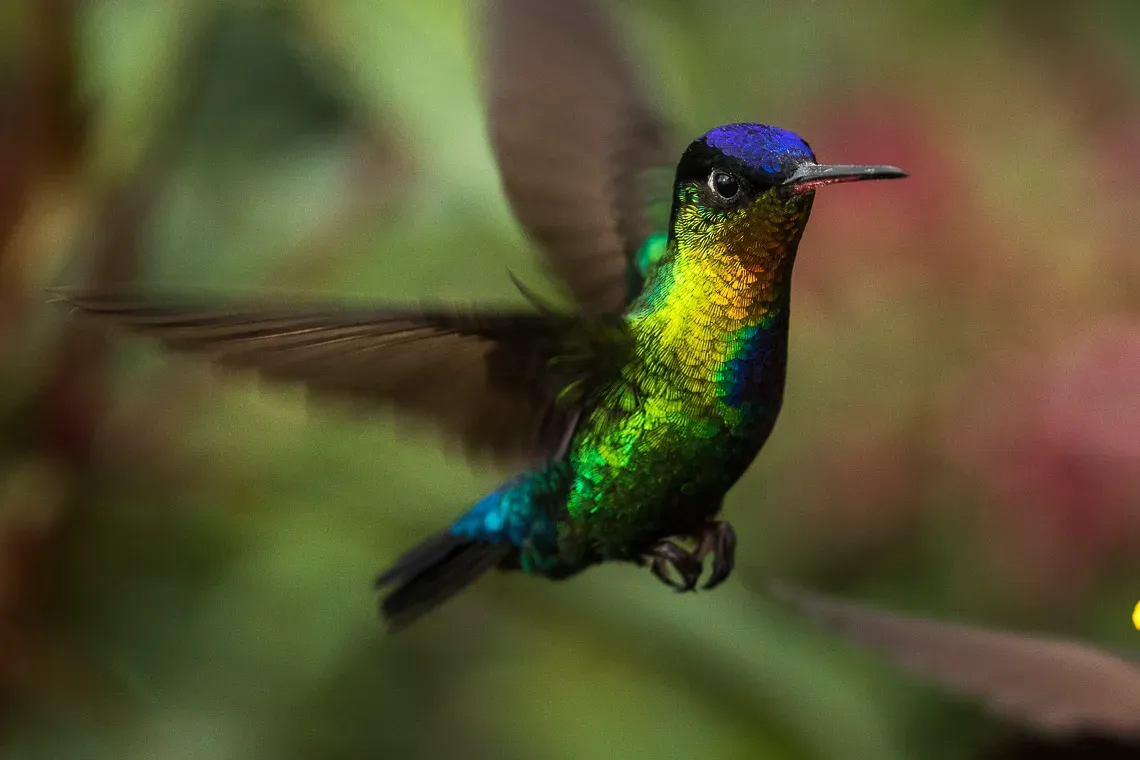
Watch a hummingbird’s throat feathers in direct sun and they can look fire-engine red, then black, then metallic gold within a single second of head movement. That’s not a trick of your eyes – it’s the same photonic-crystal architecture found in peacocks and chameleons, layered into microscopic platelets inside each feather barbule.
The colour isn’t fixed – it’s angle-dependent, which is why the same bird can look completely different depending on where you’re standing. Pigment-based colour, like a cardinal’s red, looks identical from every direction; structural colour shifts, flashes, and can even vanish when light hits it from behind. It’s biological engineering that human display technology still struggles to replicate cheaply. Songbirds pull off an even simpler version of this same illusion, and #5 is the textbook example.
#5 – The Indigo Bunting Is Never Actually Blue
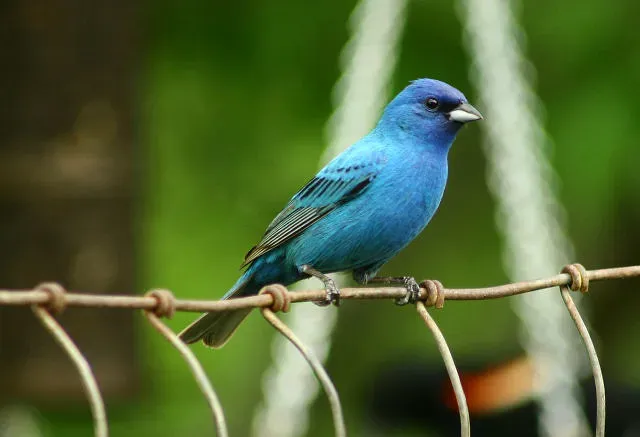
The indigo bunting might be the single best “gotcha” species on this list, because up close its own feathers are dark and dull. Bird experts note that the male demands attention with a striking blue colour that isn’t truly blue at all – like nearly every blue bird, it lacks blue pigment entirely, which is remarkably rare in nature.
You can test this yourself with a single feather. Hold it facing the sun and you’ll see the dull brown of melanin; let the sun come from behind instead, and microscopic structures refract that unmistakable cerulean back toward you. The exact same feather can look brown or brilliant blue depending purely on lighting direction – no chemistry involved. #6 is the backyard bird almost everyone assumes is genuinely blue.
#6 – Blue Jays Are Wearing an Optical Illusion
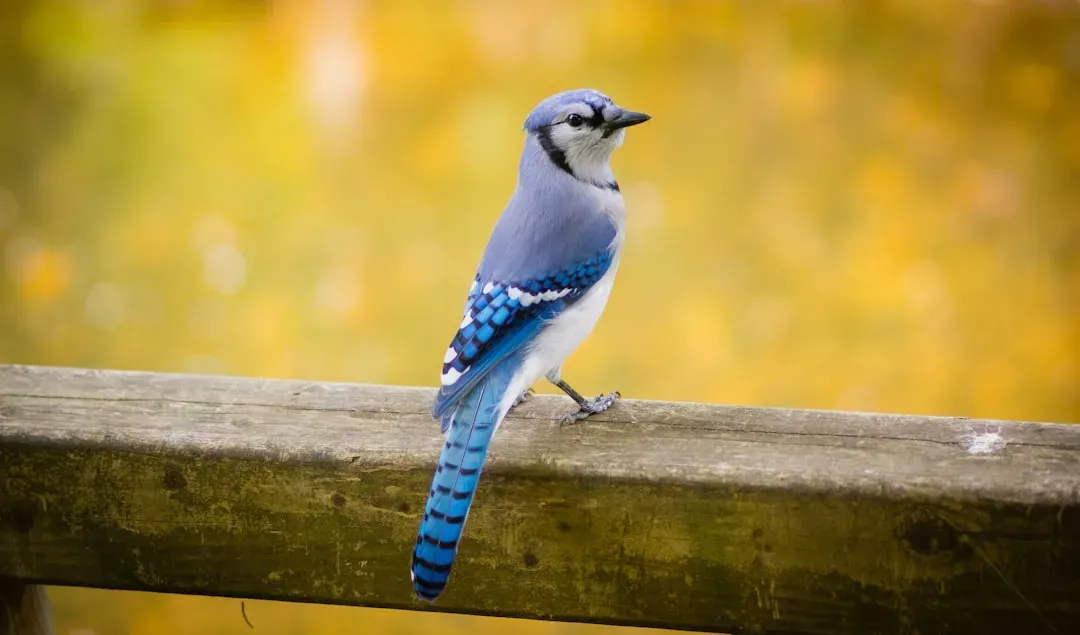
Blue pigment barely exists in the animal kingdom, and blue jays are living proof. Wildlife experts explain plainly that blue jays don’t have a trace of blue pigment – the pigment that is present, melanin, is brown and nowhere close to blue.
We perceive the feathers as blue because of light scattering: tiny pockets of air and keratin absorb every wavelength except blue, which bounces back to our eyes. Ornithologists have proven this with a party trick – soaking a blue jay feather in different solvents changes its refractive index and literally switches the blue off, turning it sea-green or colourless, something impossible with true pigment. If a feather can be “unplugged” like a light bulb, is it fair to even call it a colour at all? #7 takes this same illusion into the insect world, with a twist that makes it even stranger.
Quick Compare
- Pigment colour: Looks the same from every angle, comes from chemical compounds, and can fade with age or sun exposure.
- Structural colour: Shifts or disappears depending on viewing angle and lighting, and rarely fades since there’s no dye to break down.
- The giveaway: Wetting feathers, crushing scales, or backlighting a wing can “switch off” structural colour almost instantly – true pigment never behaves that way.
#7 – The Golden Tortoise Beetle Can Turn Off Its Own Gold
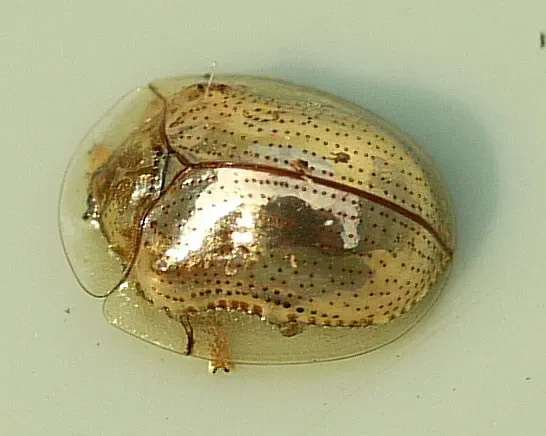
Most beetles get their metallic sheen from fixed nanostructures that never change. The golden tortoise beetle is different – it can actively dial its brilliant, mirror-like gold colour up or down almost like a dimmer switch, and the mechanism has nothing to do with pigment.
The beetle’s shell contains microscopic layers filled with fluid. When the fluid is present, those layers act like a tiny multi-layered mirror, producing an intense metallic gold, almost like liquid metal poured over its back. When the beetle is disturbed or drying out, the fluid drains, the reflective effect collapses, and the shell shifts to a dull, reddish-orange almost instantly. It’s essentially a living, adjustable mirror on six legs. But arachnids do something even more startling with the exact same optical principle, and #8 might be the most vivid blue in the entire animal kingdom.
#8 – The Gooty Sapphire Tarantula’s Blue Has Nothing to Do With Pigment
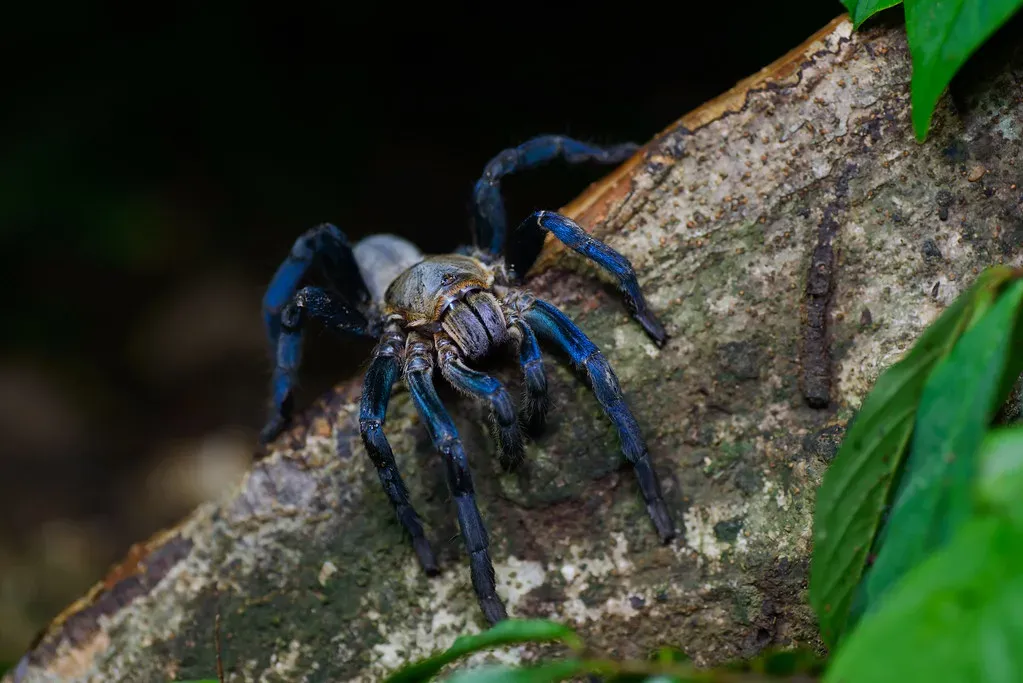
Deep-blue tarantulas look almost unnaturally vivid, like something out of a video game, and that’s because their colour is built the same way as a peacock’s feather rather than through skin pigment. Physicists studying these spiders confirmed that the intense blue doesn’t come from pigment at all, but from nanostructures that cause reflected light waves to overlap.
This overlapping-wave effect is what makes structural blue so intensely saturated compared to dyed or pigmented blue. Engineers have tried for years to replicate it industrially, but structural colours are strongly iridescent, meaning the shade shifts depending on viewing angle – a tradeoff nature solved millions of years before humans tried to copy it. Some tarantula species have evolved nanostructures precise enough to stay blue from nearly every angle, a genuine engineering marvel materials scientists are still reverse-engineering. #9 proves that even tiny jumping spiders are playing this same game – with moves to match.
#9 – Peacock Spiders Turn Structural Colour Into a Dance Move
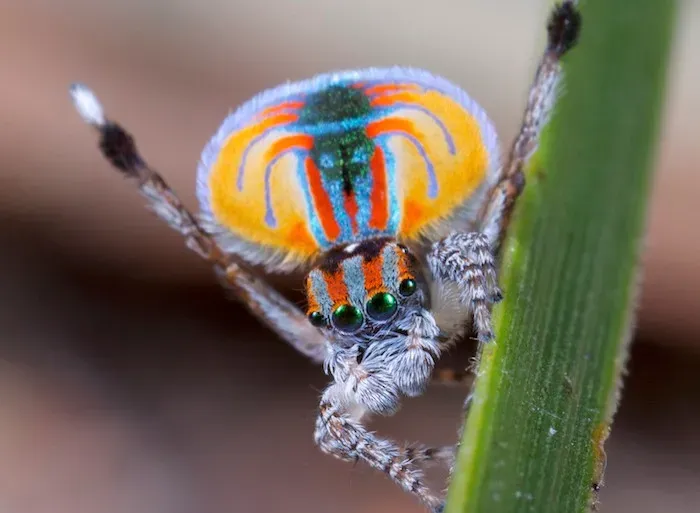
Peacock spiders are barely the size of a grain of rice, yet males display fan-like abdominal flaps covered in blazing blues, reds, and iridescent patterns during elaborate courtship dances. Unlike most spiders, which rely on dull pigmented browns and greys for camouflage, these males evolved microscopic scales specifically to weaponize structural colour for mating displays.
The flashiest males don’t just have the brightest colours – they combine colour with a literal dance routine, vibrating their abdomens to make the iridescent patterns pulse and shift in real time for a watching female. Because the effect is angle- and light-dependent, males must position themselves precisely relative to the sun to maximize it, meaning performance may matter as much as colour in mate selection. Many biologists now argue that colour and courtship movement in these species should be studied as a single evolved trait, not two separate ones. #10 shows the same nanoscale tricks working underwater on a much larger, more dangerous canvas.
Why It Stands Out
- Peacock spiders are among the only arachnids known to pair structural colour with rhythmic, dance-like courtship movement.
- Displays only reach full brilliance when the male positions himself at precisely the right angle to the sun.
- Unlike most spiders, which rely on camouflage, males evolved these iridescent scales purely to win visual competitions during mating season.
#10 – Rainbow Boas Shimmer Without a Single Iridescent Pigment
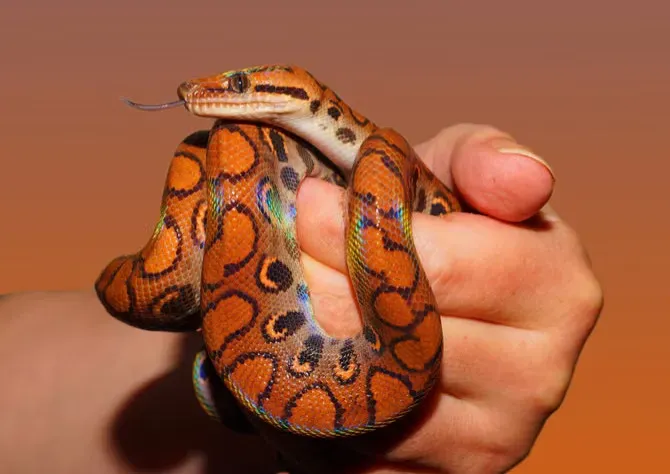
Rainbow boas are famous for the way their scales ripple with an oily, prismatic sheen in direct sunlight, cycling through violet, green, and gold as the snake moves. That shimmer isn’t caused by any pigment cell in the skin – it’s produced by microscopic ridges on each scale that split incoming light the way a diffraction grating does.
The snake’s actual base pigmentation is a fairly ordinary brown, and in flat, diffuse lighting the rainbow effect nearly disappears. That’s a useful reminder that structural colour, unlike pigment, genuinely depends on the light environment – a rainbow boa in a dim enclosure looks far less spectacular than the same snake basking in direct sun. Herpetologists often use rainbow boas as an accessible example of iridescence because, unlike butterfly wings or beetle shells, the effect is visible at full-body scale with the naked eye. #11 shrinks this concept back down to something you could easily miss if you weren’t looking closely.
#11 – The Diamond Weevil Has Scales Like Tiny Crystal Facets
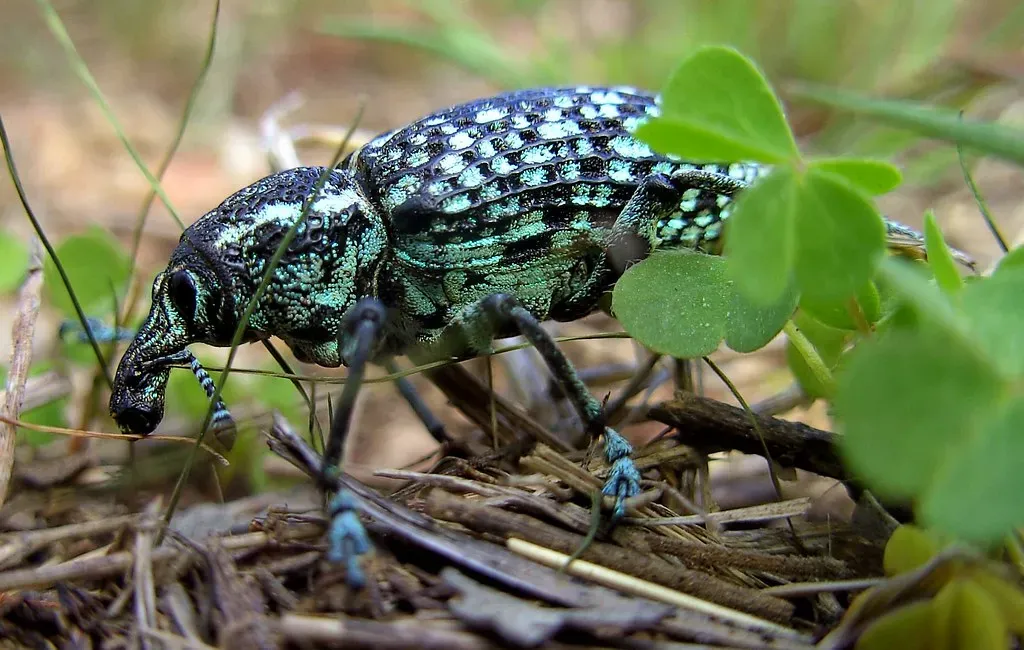
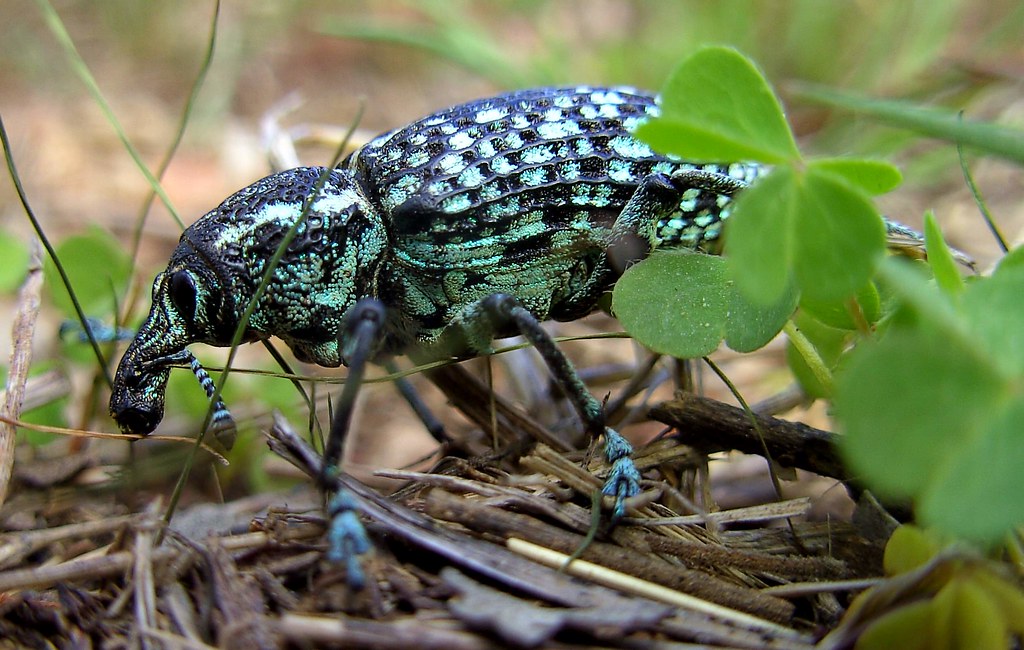
The diamond weevil, found in the forests of Brazil, looks like it’s been dipped in glitter – its exoskeleton is covered in a dense mosaic of tiny, faceted scales that sparkle green, gold, and black depending on the angle of light. Entomologists consider it one of the most visually striking examples of structural colour in the insect world precisely because the effect looks almost too geometric to be biological.
Each individual scale acts like a microscopic photonic crystal, similar in principle to the nanostructures in butterfly wings and peacock feathers, scattering light into discrete, jewel-like flashes instead of one smooth hue. The faceted surface creates a mosaic effect, like hundreds of tiny mirrors angled slightly differently across its body. Collectors have prized the diamond weevil for over a century specifically because, unlike pigmented insects, its colouring never fades, chips, or dulls with age. #12 takes this same permanence and applies it to a creature that can also kill you.
#12 – The Blue-Ringed Octopus Uses Structure to Broadcast a Warning
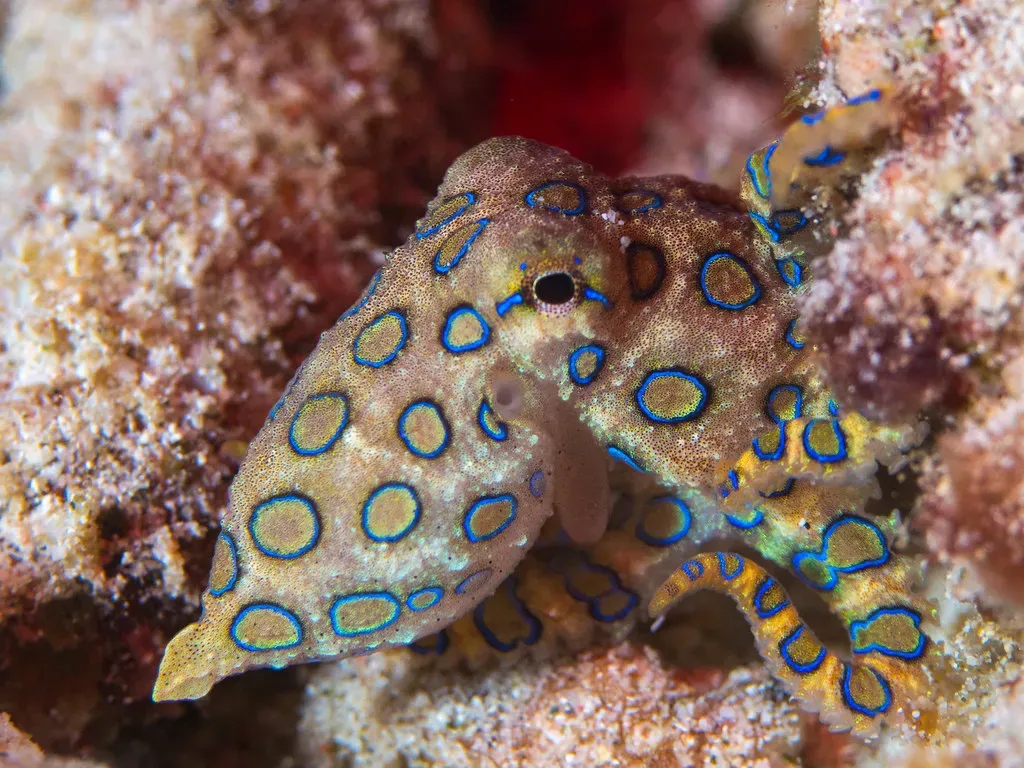
The blue-ringed octopus is one of the most venomous marine animals on Earth, and its trademark electric-blue rings aren’t decoration – they’re a warning label, built from structural colour rather than pigment. The rings sit inside specialized skin cells called iridophores, the same general cell type responsible for iridescent colour in chameleons and many fish.
The octopus can actually control the intensity of the rings, making them pulse or flash brighter when it feels threatened, by adjusting muscles around the iridophore cells to change how light reflects off the internal nanostructures. This is functionally different from a chameleon shifting its whole body for camouflage – here, the structural colour exists almost exclusively as an active threat display, while the rest of the octopus’s skin can still shift into duller camouflage tones using separate pigment-based chromatophores. It’s a striking example of an animal running two completely different colour systems side by side: one chemical, for blending in, and one purely structural, for standing out when it matters most. #13 brings this entire list back to something almost every coastal town has seen glinting in a fishing net.
Worth Knowing
- Iridophores – the cells behind the octopus’s warning rings – are also found in chameleons, many fish, and several other cephalopods.
- These cells contain stacked crystal plates that can be actively adjusted using surrounding muscle tissue.
- The blue-ringed octopus is one of the few animals known to use structural colour purely as a threat display rather than camouflage.
#13 – Silvery Fish Scales Are Built From Microscopic Mirrors
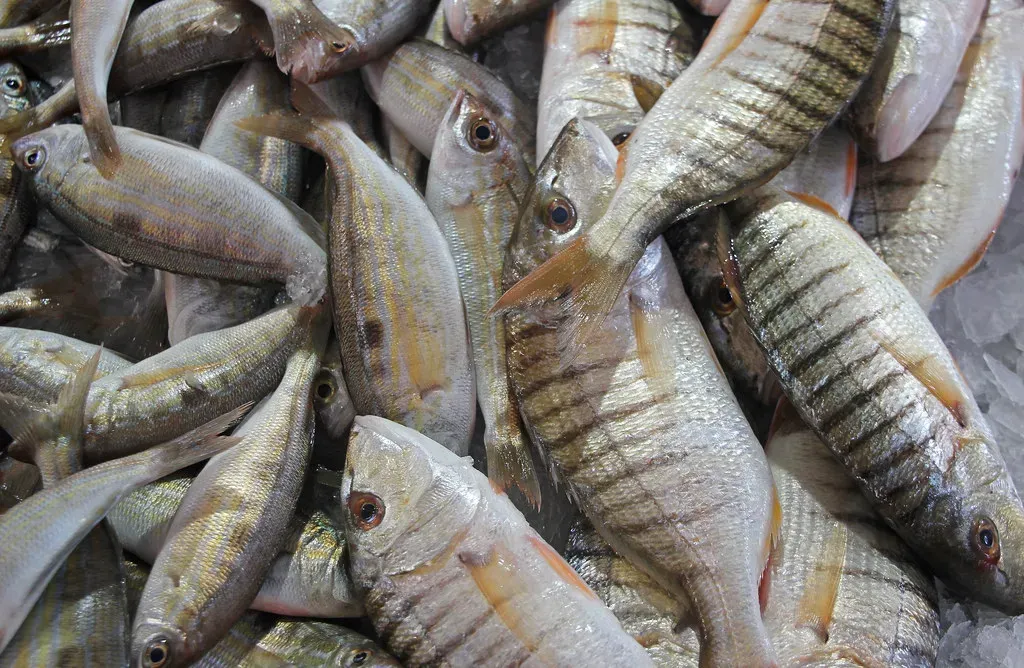
Herring, sardines, and dozens of other schooling fish share a dazzling silver sheen that has nothing to do with actual silver-coloured pigment. Their scales contain stacked layers of a crystalline substance called guanine, arranged in thin platelets that behave like microscopic mirrors, reflecting nearly all visible light back at once rather than absorbing specific wavelengths the way pigment does.
That mirror effect is a survival tool, not just decoration – in open water, a school of silvery fish reflecting light in every direction makes it far harder for predators to lock onto a single individual, effectively camouflaging thousands of fish in plain sight. The precision of the guanine platelet spacing determines exactly how reflective and “flat” silver a fish appears, which is part of why some schooling species look mirror-polished while others have a duller, pearlescent shine. Unlike the blues and golds seen elsewhere on this list, this is one of the few examples where structural colour produces something closer to a true reflective surface than a single vivid hue – proof the same physics scales from a butterfly’s wing all the way up to an entire ocean ecosystem’s worth of shimmering fish.
The Bottom Line
Once you see it, you can’t unsee it: an enormous share of nature’s most jaw-dropping colours are optical illusions, not pigments at all. Peacocks are brown. Blue jays are brown. Morpho butterflies are brown. The blue, green, and gold you’re actually seeing is light bouncing off nanoscale architecture that evolution perfected long before humans understood the physics well enough to explain it.
Frankly, it makes pigment-based colour – a cardinal’s red, a flamingo’s pink – look almost lazy by comparison. Structural colour is engineering; pigment is just chemistry. Which of these 13 animals surprised you the most, and did we miss one that deserves a spot on this list?