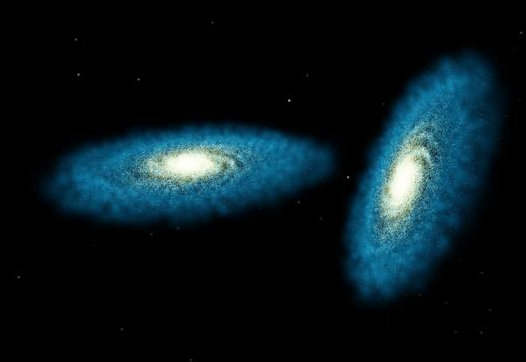
Picture two enormous cities, each home to hundreds of billions of residents, driving straight through one another at highway speed and somehow never touching a single car. That is roughly what happens when galaxies collide, and it sounds like it should be impossible. Yet it is one of the more reliable predictions in modern astrophysics, backed by decades of observation and simulation, and it says something quietly strange about how much of the universe, even the parts we think of as solid, is actually nothing at all.
The illusion of a crowded universe
Galaxies look dense in photographs, swirling disks packed with light from edge to edge. That impression is mostly an artifact of how our eyes and telescopes gather photons over long exposures, stacking faint light until the image glows. In reality, the volume of space occupied by stars inside a galaxy is a tiny fraction of the total volume the galaxy takes up.
The volume contained by a galaxy is mostly empty space, which makes the chance for stars to collide extremely rare even though galaxies themselves may collide. Astronomers describing what happens during these mergers often reach for a specific image: even during such galactic encounters, the stars within them, spaced out by incredible distances, rarely come into direct contact, passing by each other like “smoke passing through a screen door.” It is a strange kind of violence, one that reshapes everything without a single direct impact between stars.
How far apart stars really are
Numbers alone rarely convey scale the way a physical model does, so astronomers like to build one. The distance between neighboring stars, at our position in the Milky Way Galaxy, is approximately equal to 10 million times the diameter of a star. That ratio is difficult to picture until you shrink it down to something familiar.
If the Sun were a grapefruit in New York City, the nearest star would be another grapefruit in San Francisco. Scale the Sun down further to something the size of a ping pong ball, and Proxima Centauri would be a pea about 1,100 km (680 mi) away, and the Milky Way would be about 30 million km (19 million mi) wide. Stretched across that kind of emptiness, the odds of two stars actually meeting during a galactic pass through are closer to a rounding error than a real possibility.
Why galaxies collide so much more easily than stars
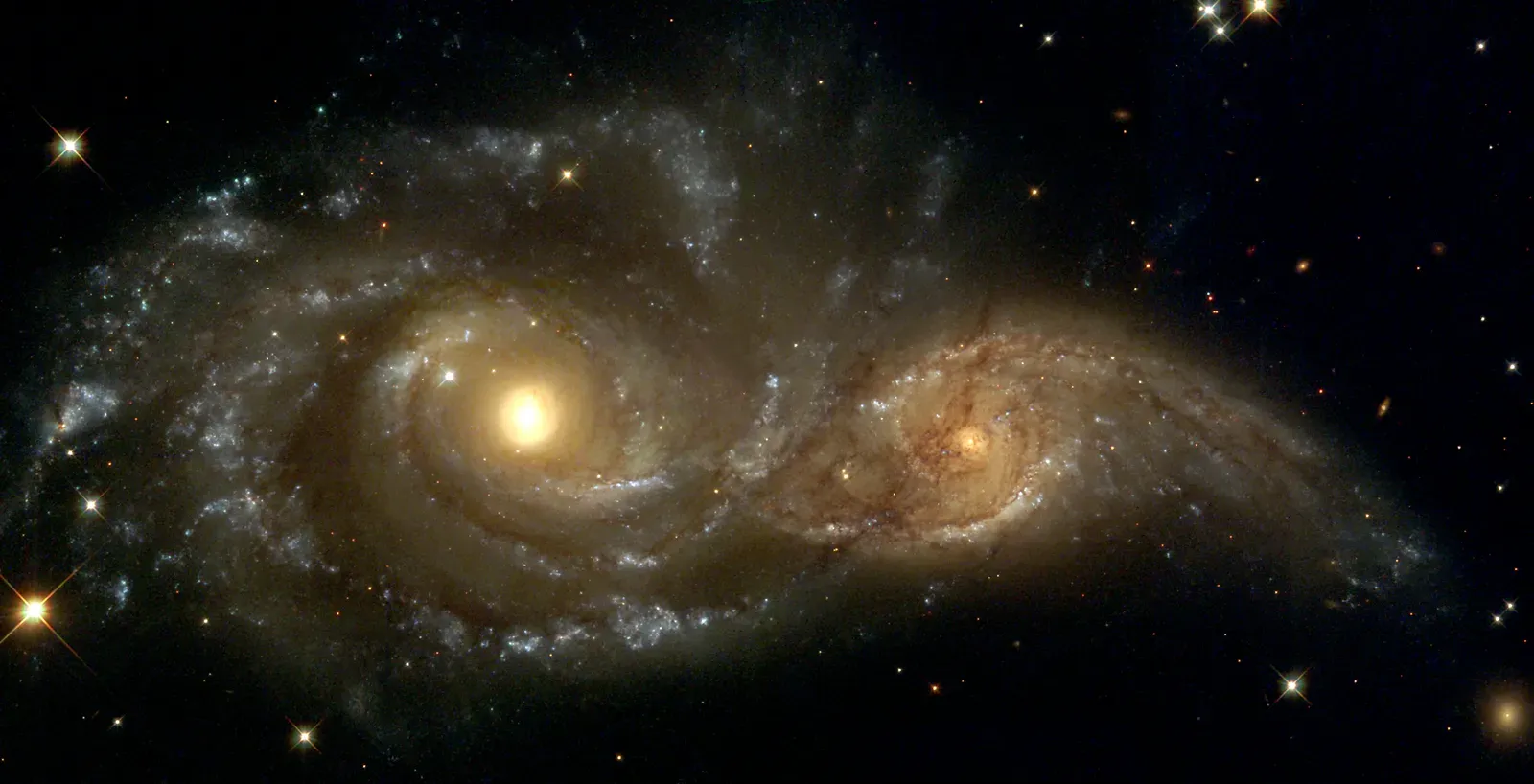
If stars are separated by such staggering gaps, why do galaxies bump into each other constantly on cosmic timescales? The answer comes down to a simple ratio of size to spacing, and galaxies fail that test in the opposite direction that stars do. By contrast, galaxies collide with each other quite frequently, since the distance between neighboring galaxies is approximately equal to 20 times the diameter of a galaxy.
Compare that with stars, where the gap runs into the millions of stellar diameters, and the contrast becomes obvious. Galaxies are, relatively speaking, packed close together in a way individual stars simply are not. That single geometric fact, size versus spacing, is really the entire explanation physicists reach for when asked why stars almost never touch while galaxies merge all the time.
The Milky Way’s own collision course
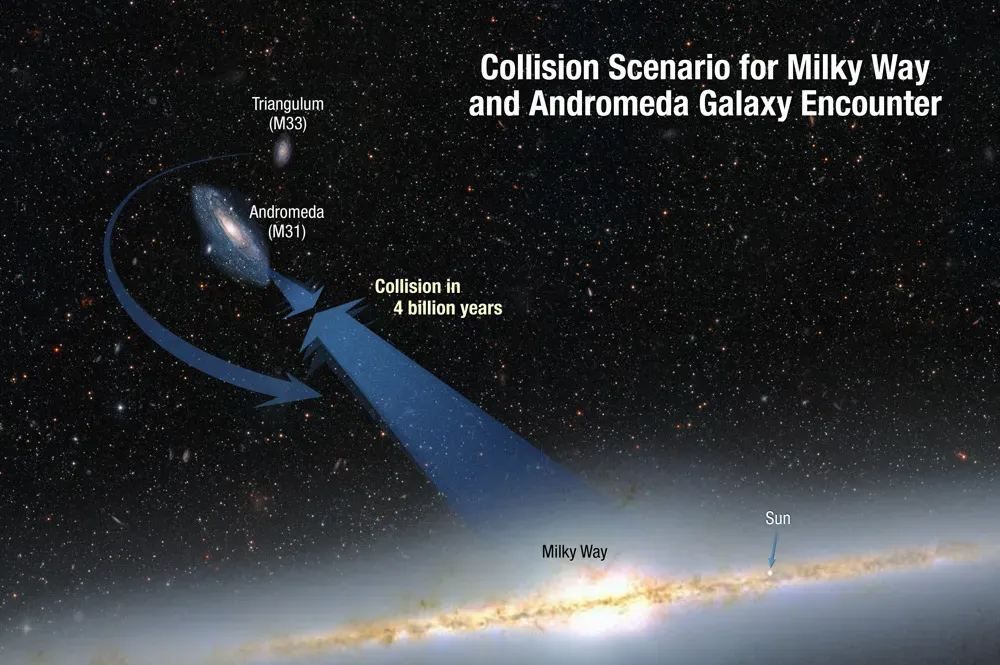
This is not just an abstract exercise. Our own galaxy has a long predicted date with its neighbor, the Andromeda Galaxy, and the star count involved makes the emptiness argument especially vivid. While the Andromeda Galaxy contains about 1 trillion stars and the Milky Way about 300 billion, the chance of even two stars colliding is negligible because of the huge distances between the stars.
Even in the busiest, most star packed regions near each galaxy’s core, the spacing barely changes the outcome. The average distance between stars is still 160 billion km, roughly 100 billion miles, which is analogous to one ping pong ball every 3.2 kilometers. Multiply that emptiness across a collision involving well over a trillion stars combined, and the expected number of direct stellar impacts still rounds down to essentially zero.
What a galactic collision actually destroys and creates
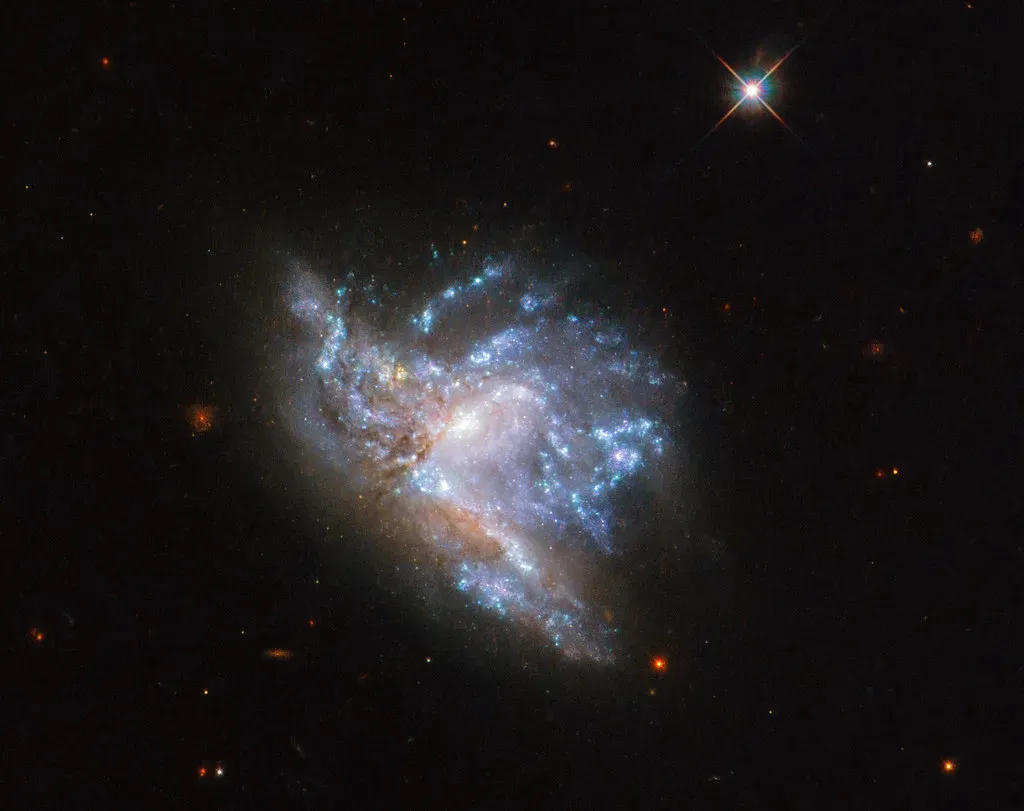
None of this means a galactic merger is a gentle, uneventful affair. Gravity does real work here, and gas does what stars do not. Although stars don’t collide when two galaxies merge, the much larger gas clouds do, slamming into each other violently.
Those collisions between gas clouds trigger dramatic consequences that stars themselves never experience directly. Shock waves from the collision run through the clouds and trigger the collapse of dark nebulae to form stars, so if the two colliding galaxies are rich in gas, their merger will be accompanied by a burst of star formation. Meanwhile gravity reshuffles stellar orbits wholesale, stretching galaxies into new shapes even though the stars inside them never physically touch anything.
The tidal tails and famous wrecks in the sky
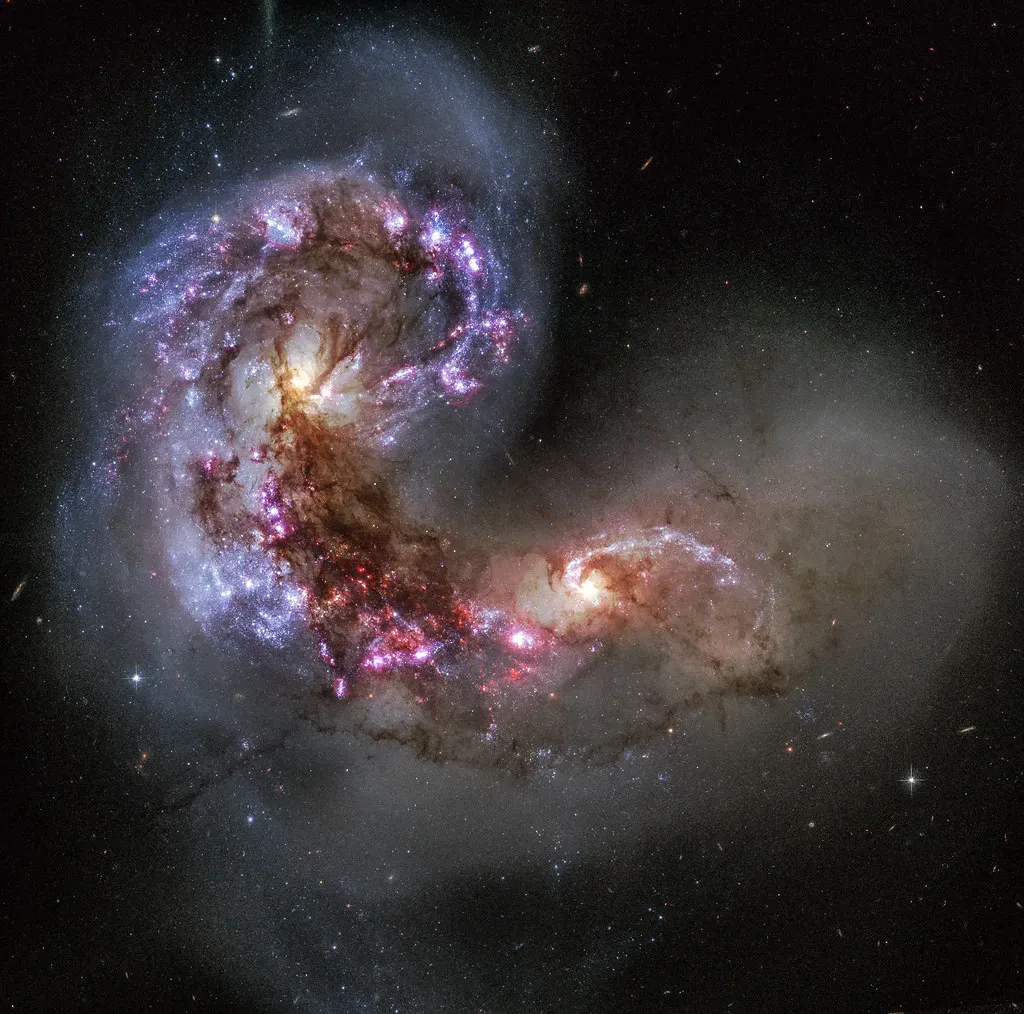
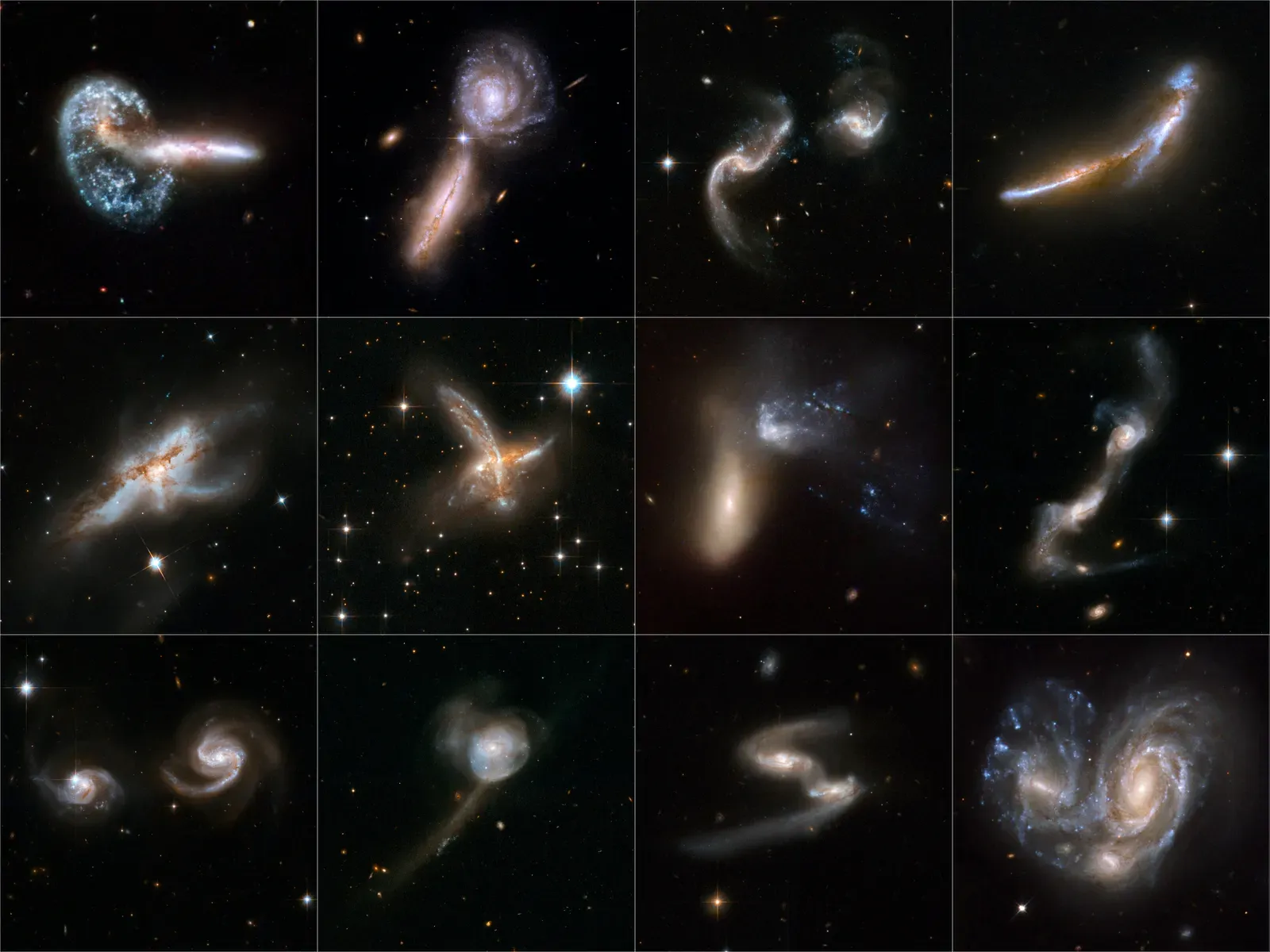
Some of the most striking images in astronomy are galaxies caught mid collision, their shapes stretched into long glowing streamers. Researchers eventually figured out why these shapes form, and the explanation reads almost like fluid dynamics rather than a car crash. When two galaxies merge, the gravitational interactions raise tidal tails of gas and stars, long thin ropes of material flung outward from the tight embrace of the spiral arms over the course of the merger event.
Simulations built to test that idea produced a striking match to reality. These simulated tails looked almost exactly like pictures of intriguing objects such as the Antennae galaxies. The Mice galaxies, another well photographed pair caught by Hubble, show the same signature of gravity pulling long streams of stars and gas outward as the two systems pass through one another, proof that these events are shaping tools rather than demolition tools.
The one thing that eventually does meet in the middle
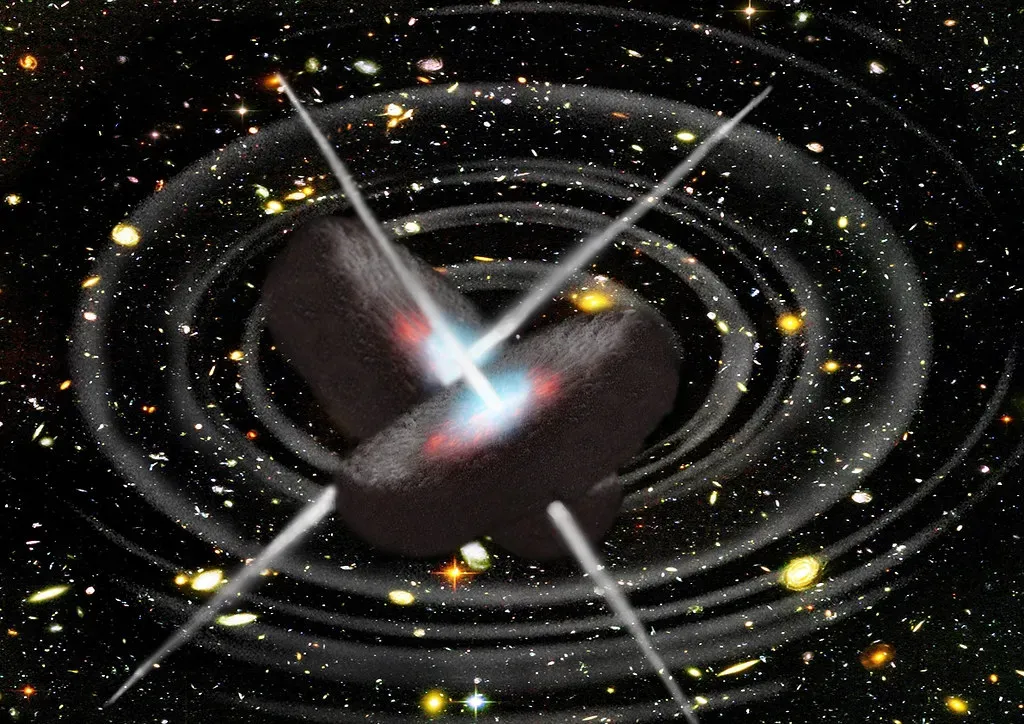
There is an exception to the no contact rule, and it sits at the very center of every large galaxy. Supermassive black holes do not have the luxury of vast empty space working in their favor, because gravity slowly drags them toward each other over immense timescales. The Milky Way and Andromeda each contain a central supermassive black hole, and these black holes will eventually spiral into one another and converge near the center of the newly formed galaxy over a period that may take millions of years.
That slow spiral is driven by dynamical friction, a drag effect produced as a black hole’s gravity stirs up the surrounding stars and dark matter, bleeding off orbital energy bit by bit. It is worth noting, though, that even the timing and certainty of the broader Milky Way and Andromeda merger has recently been questioned. A 2025 study using data from Hubble and Gaia found that the long held prediction of a Milky Way, Andromeda collision is far less inevitable than astronomers had previously suspected, according to Till Sawala, the study’s lead author. Whether the two galaxies eventually merge, drift apart, or spend billions of years circling each other, the underlying physics of stars slipping past stars without touching remains the same.
A quiet truth about the universe
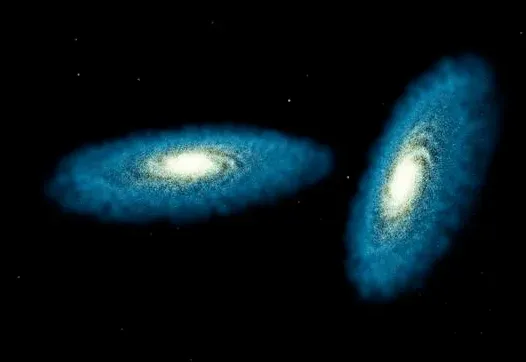
The part of this story I find genuinely humbling is not the collision itself but what it reveals about matter in general. We tend to think of stars, planets, and galaxies as solid things bumping around in a crowded universe, when the truth is closer to the opposite. Almost everything we call “stuff” is separated by distances so extreme that two entire galaxies, each carrying hundreds of billions of stars, can pass directly through one another and statistically expect zero direct hits.
That is not a loophole or a technicality. It is the honest architecture of the cosmos, and it should recalibrate how we picture space in general, not just galaxies millions of light years away. The next time someone describes a galactic collision as a cosmic car crash, it is worth remembering that the real story is closer to two ghosts walking through each other, changed by the encounter, but never actually touching at all.