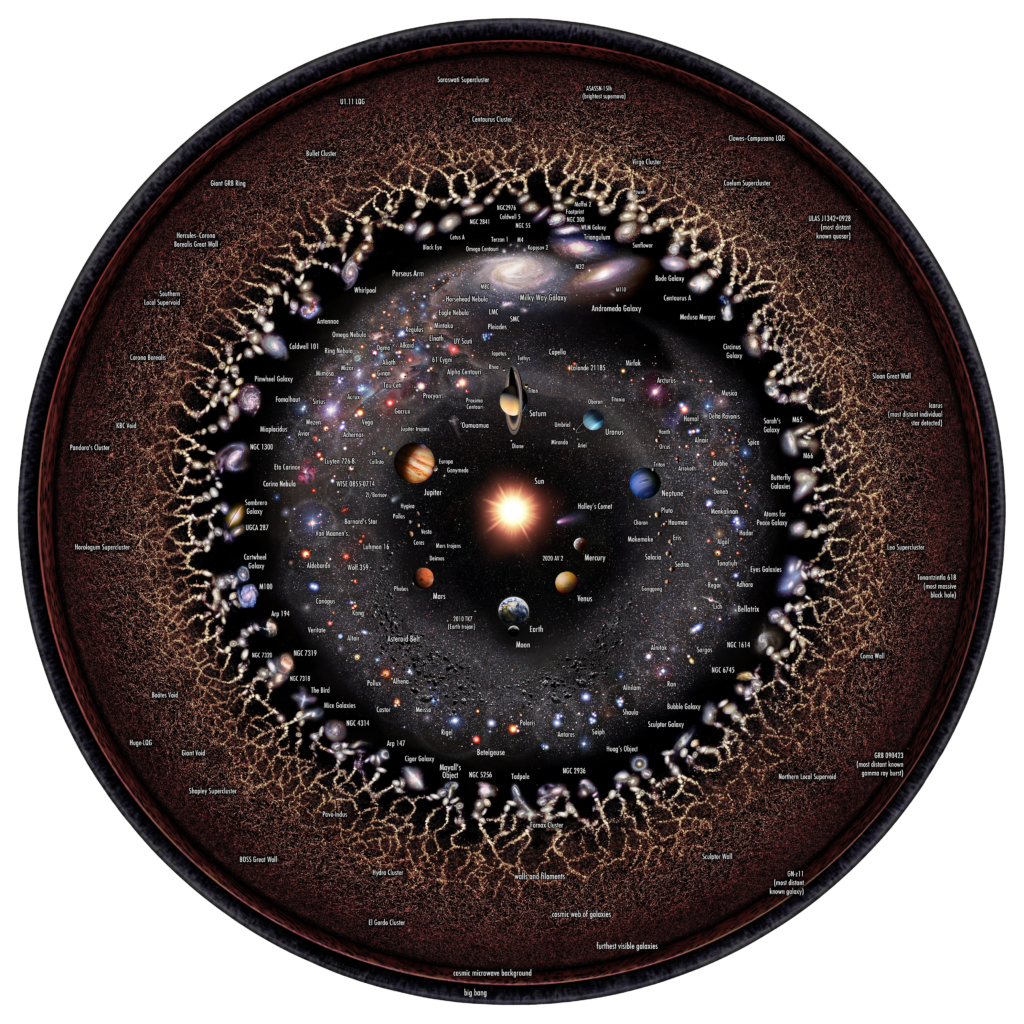

You live inside a cosmic keyhole. Everything you’ve ever seen through a telescope, every galaxy image that’s ever blown your mind, every map of the cosmos you’ve been shown in documentaries – that’s just the observable universe, not the whole thing. It feels complete because that’s all you can access, but cosmology keeps whispering a slightly unsettling truth: what you see is only a finite patch of something that is almost certainly far bigger, and possibly unimaginably stranger.
Once you really let that sink in, the questions start to bite. If your observable universe is just a bubble in a much grander reality, what is outside that bubble? Do the same laws of physics hold there, or would you be stepping into a region where your deepest “rules of nature” simply fail? Modern cosmology does not give you all the answers, but it does give you enough clues to realize you’re living on a tiny, lit stage surrounded by darkness whose script you do not yet know.
Why the Observable Universe Is Just Your Cosmic Horizon
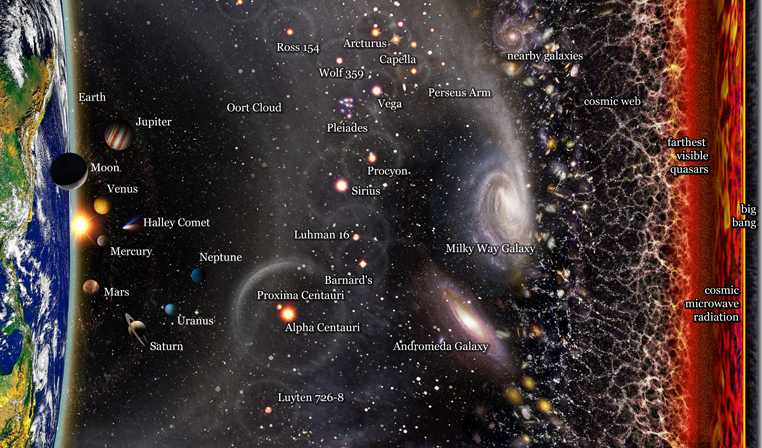
When you hear the phrase “observable universe,” it sounds like a dramatic way to say “everything that exists,” but that’s not what it means. It literally just marks the region from which light has had time to reach you since the Big Bang, given a finite cosmic age and a finite speed of light. You are not seeing an edge of space; you are seeing the limits of what light can currently report back to you. If the universe has been around for roughly 13.8 billion years, light from farther than a certain distance simply has not had enough time to arrive.
Because space itself has stretched over time, this “horizon distance” is much larger than 13.8 billion light-years; the radius of your observable universe today is on the order of many tens of billions of light-years. Beyond that, there may be more of the same cosmic web of galaxies, or something completely different. The key point is that “observable” is not a metaphysical boundary; it’s an information boundary. You’re not seeing an end to reality, you’re hitting the limit of what causally connects to you right now.
The Big Bang Did Not Start at a Single Point in Space
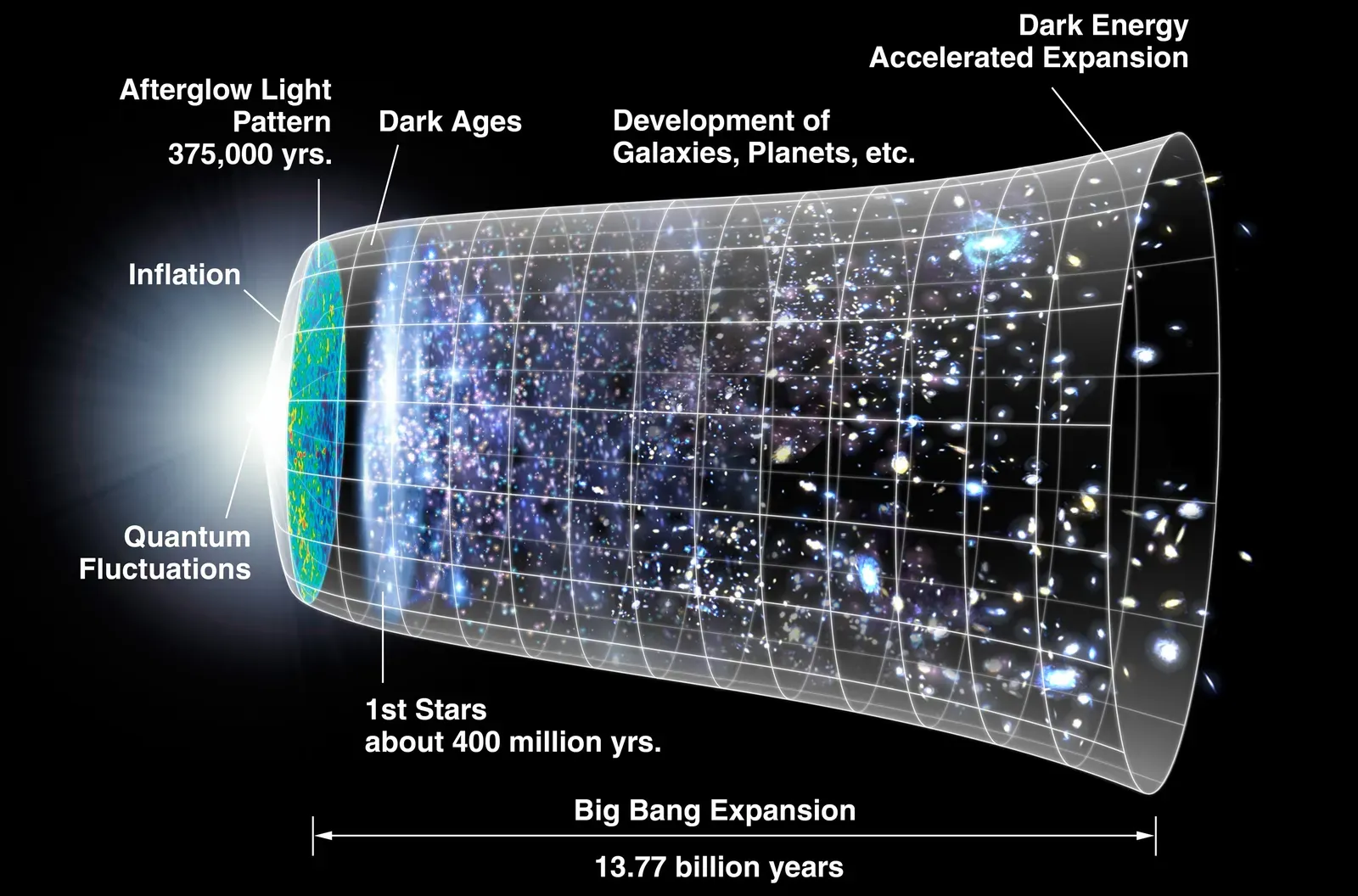
It’s tempting to picture the Big Bang as an explosion from a central point, flinging galaxies outward into preexisting emptiness. If you think that way, you’ll naturally ask, “Where did it explode from, and what is beyond the blast?” Cosmology pushes you to a different image: the Big Bang was an event everywhere at once, a hot, dense state filling all of space, not a fireball expanding into a pre-made void. Space itself has been expanding, carrying galaxies along like dots on an inflating balloon.
From your viewpoint, every distant galaxy seems to be receding from you, so it’s easy to feel like you’re at the center. But if you were sitting in a galaxy billions of light-years away, you’d see pretty much the same pattern: everything moving away, the same cosmic microwave background, the same large-scale structure. That’s why cosmologists say the universe is homogeneous and isotropic on very large scales. In that picture, your observable universe is just one spherical region centered on you, carved out of a much larger expanding space that never had a “middle” in the way your explosion intuition suggests.
Cosmic Inflation and the Case for a Much Bigger Cosmos
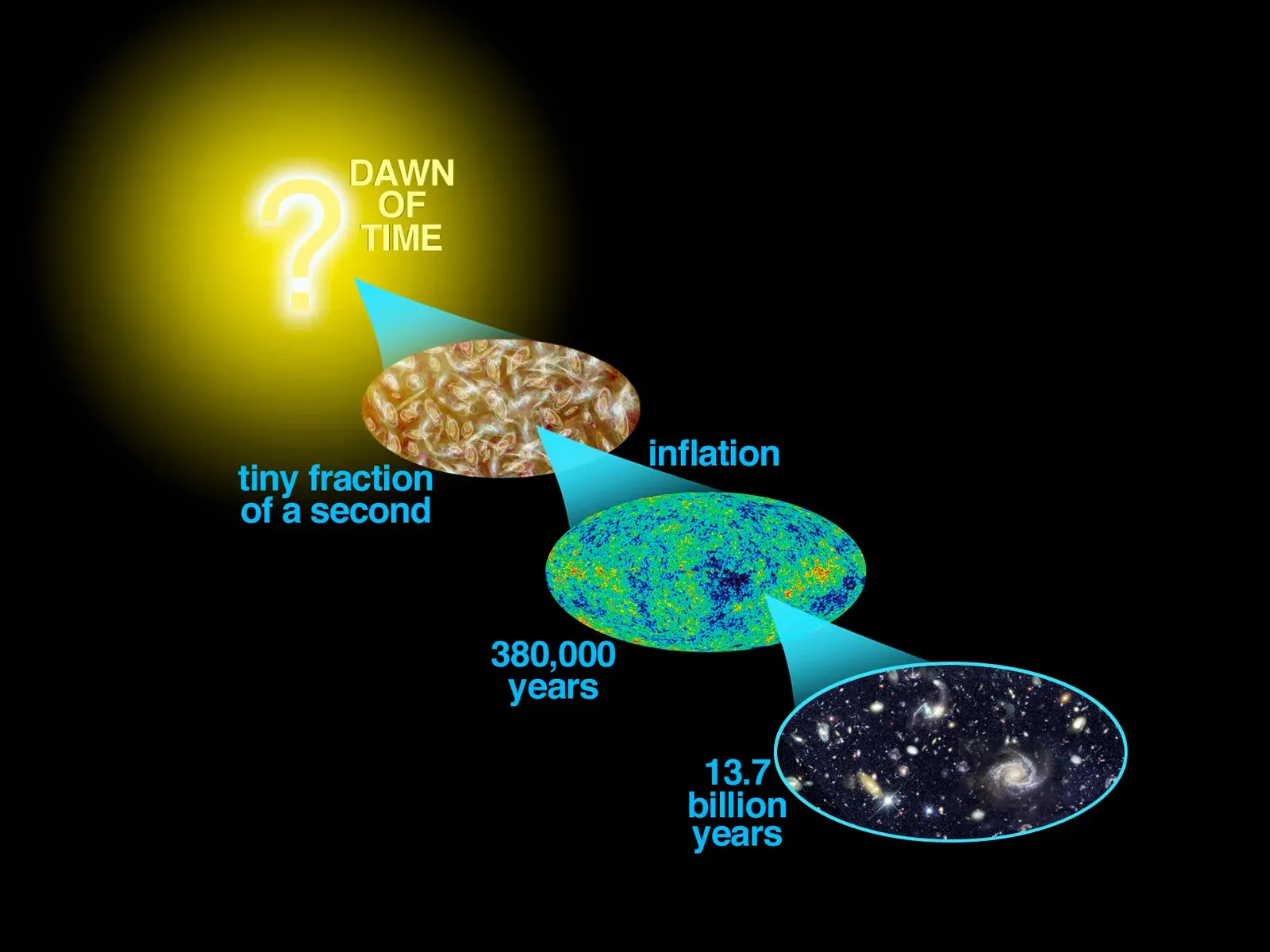
One of the main reasons you have strong evidence for a universe larger than what you can see is a concept called cosmic inflation. According to this idea, in a tiny fraction of a second after the Big Bang, space went through a brief but furious growth spurt, doubling in size again and again in a staggeringly short time. If that really happened, then the part of space you now observe is just a microscopic patch of what inflation actually created. Your observable bubble would be like a single tile on an arena-sized mosaic.
Inflation also helps explain why the universe you see looks so uniform on very large scales, and why the tiny density ripples that seeded galaxies have just the pattern you measure in the cosmic microwave background. Those successes are why cosmologists take it seriously as more than a wild story. But inflation almost automatically predicts that space beyond your horizon keeps going, perhaps endlessly. You cannot see that extension directly, and maybe you never will, but your best-fitting models of early-universe physics strongly hint that you are not living in a small, cozy, finite box.
What It Really Means for Physics Laws to Be “Different” Elsewhere
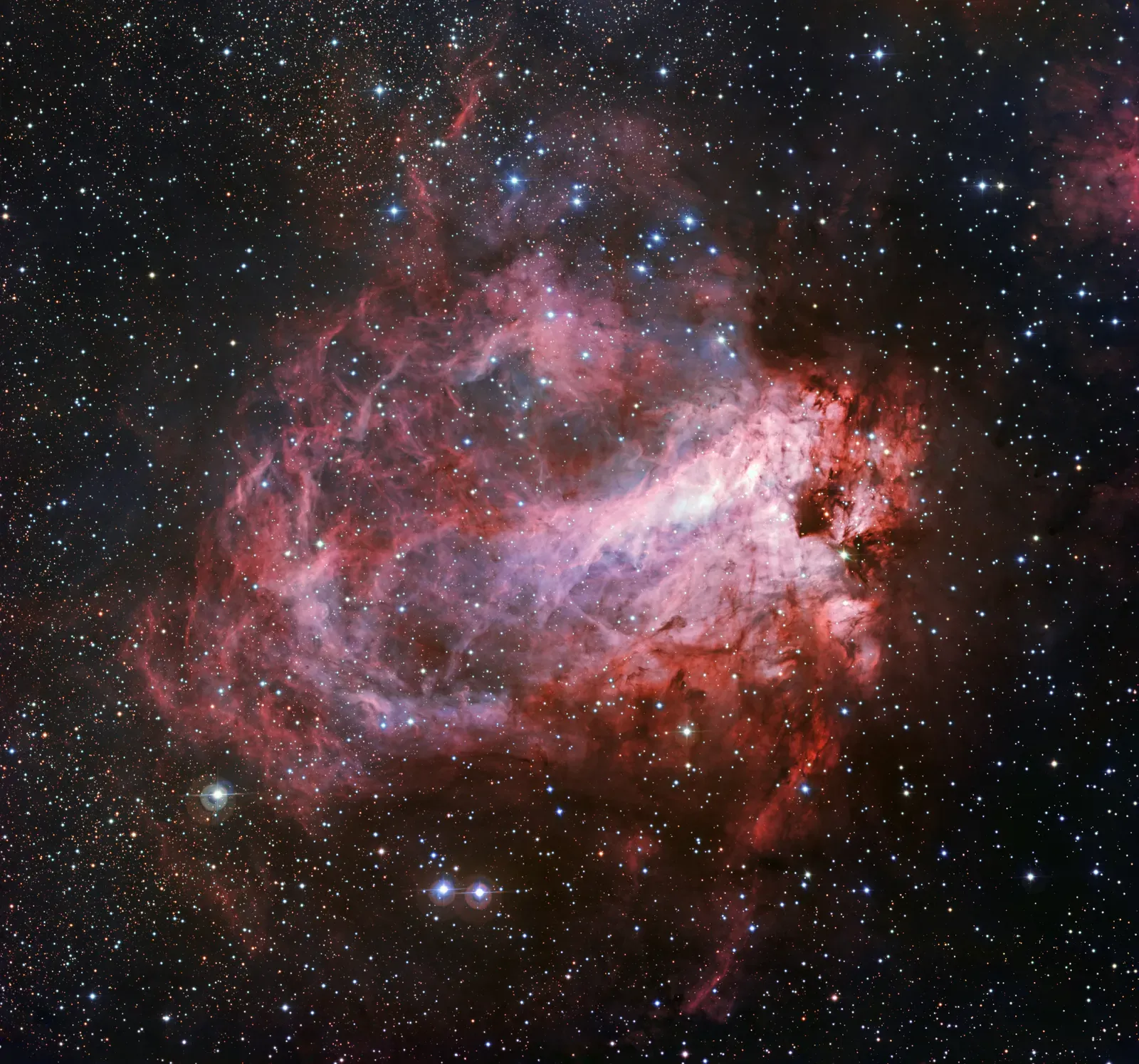
When you hear that the laws of physics might not be the same beyond your observable patch, it can sound as if other regions would casually break energy conservation or let objects fall upward for no reason. That’s not quite what cosmologists mean. In many theories, the underlying framework – things like quantum fields and general relativity – remains the same everywhere, but specific details can vary. Numbers you treat as fixed, like the strength of certain forces or the value of the cosmological constant, might be different in other regions, much like different settings in a simulation.
In some models of inflation, for example, fields can “settle” into different stable configurations in different patches of the universe. Each configuration gives you a different set of effective physical constants and particle properties, which means stars, chemistry, and even space-time behavior could shift from what you know. From your standpoint inside one patch, your laws feel absolute and universal. From a larger cosmic perspective, they might be more like local dialects of a deeper language. You are only just starting to test how much of that is fantasy and how much is consistent with the data you have.
The Multiverse: Serious Idea or Just a Fancy Story?
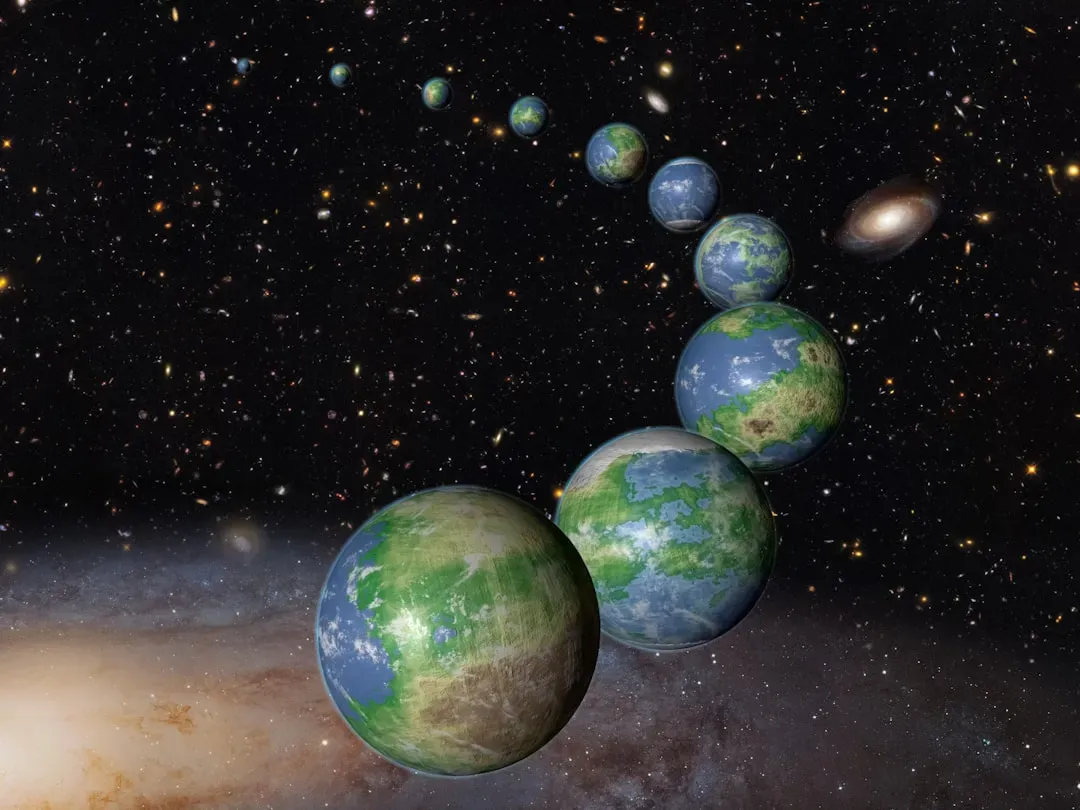
The word “multiverse” easily gets wrapped in hype, but when cosmologists bring it up, they’re usually not talking about comic-book portals. Instead, they’re working through the logical consequences of theories like inflation or certain interpretations of quantum mechanics. In many versions of inflation, the explosive expansion does not stop everywhere at once. It fizzles out in some regions but continues in others, creating a patchwork of “bubble universes,” each with potentially different local physics. You live in one such bubble – the only one you can see from here.
You should know, though, that while the multiverse is a serious idea for many researchers, it’s also controversial. It is notoriously hard to test directly, because by design other bubbles are beyond your horizon. Some scientists argue that if a concept cannot, even in principle, be checked against observations, it does not belong in physics. Others respond that certain multiverse models make statistical predictions about what you should expect to see in your own patch, such as the range of possible values for dark energy, and that those can be tested indirectly. For you as a curious observer, it’s a reminder that the line between bold insight and speculation is thin, and you need to walk it carefully.
Anthropic Reasoning: Why Your Patch Seems “Just Right”
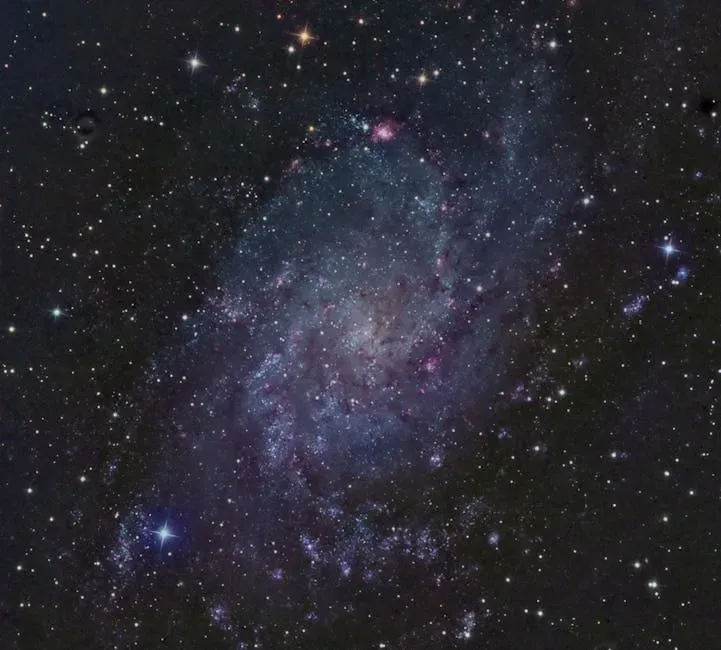
If you start to seriously consider that other regions of the universe might have different physical parameters, you quickly run into an unsettling question: why do you live in a region where the laws are so friendly to life? The strengths of forces, the masses of particles, the tiny but nonzero value of dark energy – many of these numbers seem to fall in narrow ranges that allow stars, planets, and complex chemistry to form. Change them slightly, and you might end up with a universe where nothing like you could ever emerge. This is where anthropic reasoning comes in.
The anthropic idea is simple but subtle: you naturally find yourself in a region where conditions permit your existence, because you could not be asking questions from anywhere else. If many different patches or universes exist with different physical parameters, most of them might be sterile, but you only ever observe the rare life-friendly ones. On its own, this does not explain everything, and it makes some people uneasy because it feels circular. Still, it gives you a way to understand why your observable universe looks so finely tuned without assuming it was designed specifically with you in mind.
What Lies Beyond Your Cosmic Horizon – and How You Might Glimpse It
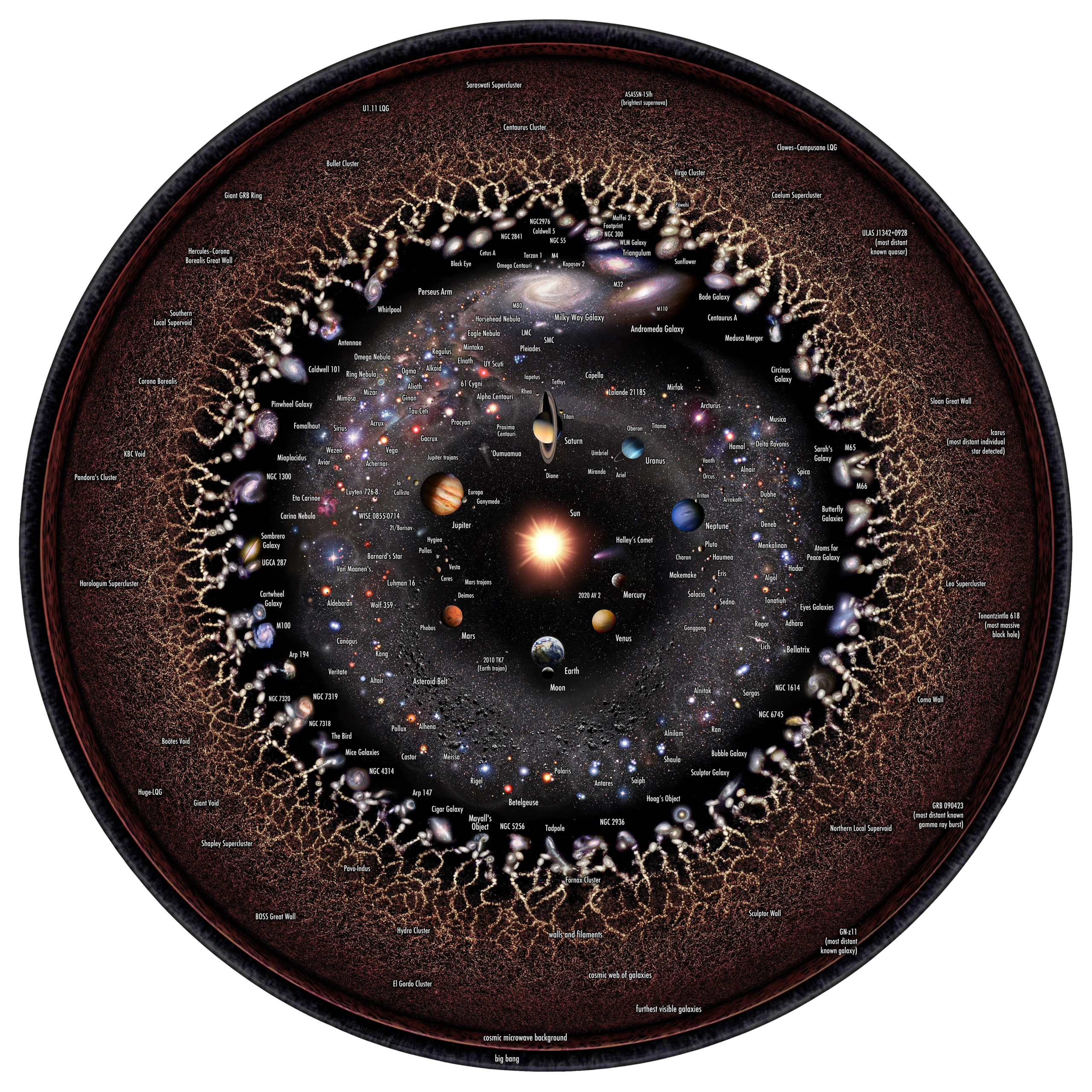
So what actually lies beyond the edge of your observable universe? The most conservative answer is: more of the same cosmic web you already see – galaxies, clusters, and voids, stretching out with roughly the same statistics for a tremendous distance. That alone is profound, because it means you are embedded in an enormous, perhaps infinite, structure you will never fully map. More speculative ideas layer on top of that picture: regions where inflation ended differently, patches where dark energy behaves in other ways, or even domains where no familiar atoms can exist.
Even if you can never directly see beyond your horizon, you are not completely helpless. Cosmologists look for subtle fingerprints of physics outside your patch, such as unusual patterns in the cosmic microwave background that might hint at past collisions with other “bubbles,” or inconsistencies in large-scale structure that could point to variations in fundamental parameters. So far, nothing has clearly broken the standard picture, but the mere act of looking forces you to treat your observable universe as a sample, not the whole story. You are, in a sense, trying to understand the shape of an entire ocean from the surface patterns in one small bay.
Living with Cosmic Ignorance: Why Not Knowing Is Its Own Kind of Wonder
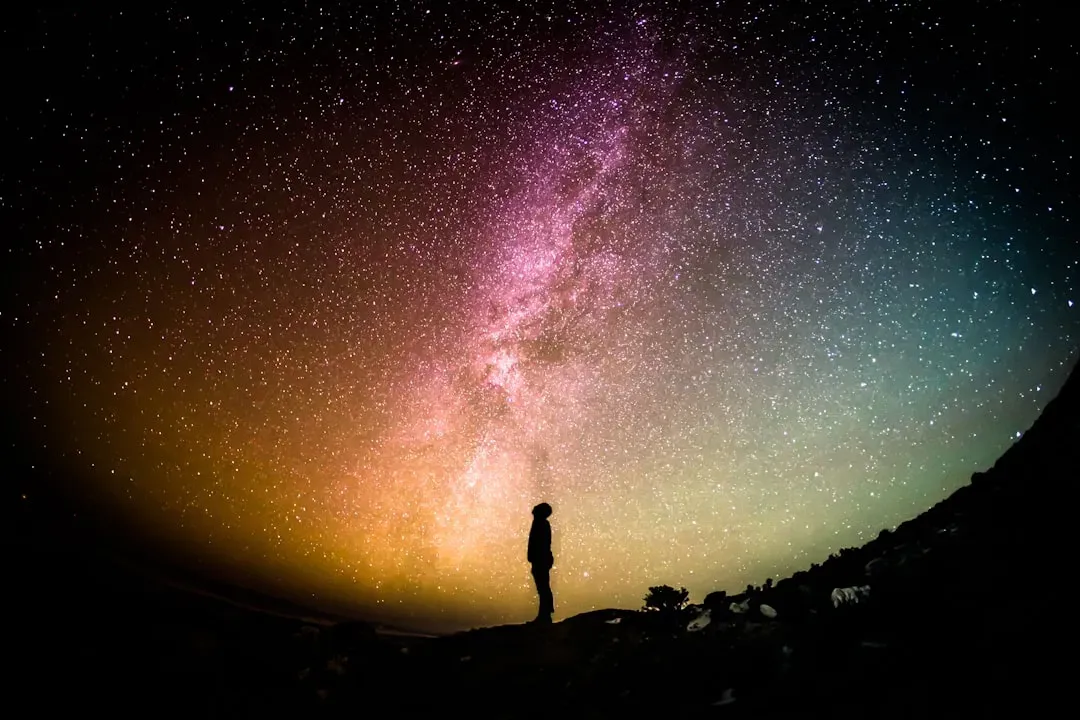
There is a strange comfort in thinking that the universe you see is all there is: a tidy, closed system with fixed rules and clear edges. Cosmology refuses to give you that comfort. Instead, it hands you a universe that is larger than your imagination can comfortably hold, possibly populated with regions where your cherished laws of physics look like special cases rather than ultimate truths. That can feel destabilizing, especially if you like answers that are crisp and final. But it also hands you a different kind of awe – one rooted in humility.
When you accept that your observable universe is a tiny, time-limited window into something vastly bigger, your place in reality changes. You are no longer living at the center of everything; you are floating inside a finite bubble in an unknown sea. Yet that bubble is where stars forged the atoms in your body, where planets cooled, where minds evolved that can ask questions about what lies beyond. The fact that you can even pose these questions from this little patch of cosmos might be the strangest law of all. If the curtain were lifted on what lies past your horizon, what kind of universe do you think you’d find?