
If someone told you that two tiny particles could mirror each other instantly, no matter how far apart you pull them, you’d probably think it sounds like science fiction. Yet that’s exactly what quantum entanglement forces you to confront: a world where your everyday ideas about distance, cause, and effect quietly fall apart. You’re left with a strange question that feels almost uncomfortable: if nothing can travel faster than light, how on earth do entangled particles stay perfectly in sync?
As you explore this topic, you’re not just learning another science concept; you’re walking straight into one of the deepest puzzles humans have ever faced about reality itself. Entanglement doesn’t just challenge your intuition, it dares you to rethink what “separate” even means. By the end, you might not see space, time, or even information in quite the same way again.
The Weird Core of Quantum Entanglement
You can think of quantum entanglement as a kind of invisible connection that ties two or more particles together so tightly that their states are no longer independent. When you measure one, you instantly know something about the other, even if it’s at the opposite side of the planet. Before you measure them, each particle doesn’t have a definite state in the way you’re used to; instead, the pair shares a joint quantum state that only makes full sense when you think of them as one combined system.
What really twists your mind is that this connection does not fade with distance and doesn’t behave like any signal you’re used to. You’re tempted to imagine a hidden message zipping between them, but experiments show that no ordinary, slower-than-light process can explain what you see. You’re forced into a choice: either accept that the world is nonlocal in a subtle way, or insist that the particles carried some pre-agreed secret instructions all along – a view that modern tests have essentially ruled out. Either way, your classical picture of independent objects living in separate places starts to crumble.
Why It Does Not Really Break Einstein’s Speed Limit
At first glance, entanglement looks like it flat-out violates Einstein’s rule that nothing can travel faster than light. You measure one particle, and the other “knows” instantly what result it must give if measured in the same way. It’s incredibly tempting to conclude that you’ve discovered faster-than-light communication and that you could use it to send instant messages across the galaxy.
But when you look closer, you realize that the universe is sneakier than that. Even though the correlations appear instantly, you can’t control the exact outcome of any single measurement on your side, so you can’t encode a message in it. The other person with the partner particle just sees random results until you later compare notes using an ordinary, slower-than-light channel. The spooky part is real, but it doesn’t let you cheat relativity or build a cosmic texting service that outruns light.
Bell’s Theorem: How You Know It’s Not Just Hidden Tricks
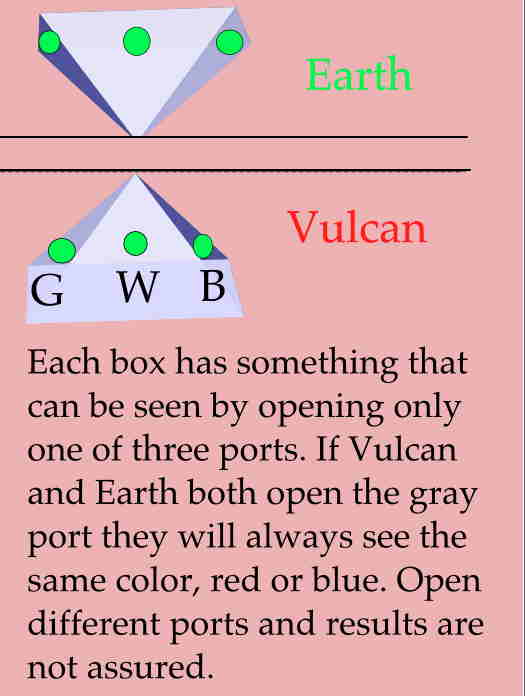
If you’re skeptical, you might wonder whether entangled particles simply share some hidden plan in advance, like two students secretly agreeing on answers before a test. For a long time, that idea – called a local hidden variable theory – seemed like a reasonable way to save your everyday picture of reality. Then came a profound result known as Bell’s theorem, which turned this comforting story upside down.
Bell showed that if the world really were governed by those local hidden rules, certain statistical patterns could never appear – but entangled particles do show those patterns when you test them carefully. Experiments have repeated and refined these tests over decades, closing loopholes and tightening the screws on alternative explanations. When you see the data, you’re pushed to accept that no ordinary “pre-agreed plan” can fully explain quantum correlations. You live in a universe where either locality, realism, or both, fail in the way you intuitively expect.
What “Faster Than Light” Really Means Here

When you say that entangled particles seem to communicate faster than light, you’re using everyday language to describe something more subtle. What is really happening is that the joint quantum state enforces relationships between outcomes that show up immediately once measurements happen on each side. The puzzling part is not that a signal crosses space faster than light, but that space itself does not fully separate the entangled system into independent pieces in the way you normally assume.
So instead of picturing a message outracing a photon, it can help to imagine a single object that has been stretched across distance, like a pair of gloves separated into two boxes. When you open one box and see the left glove, you instantly know the other box holds the right glove. The twist is that, unlike ordinary gloves, quantum particles do not “decide” left or right until measurement, and yet the correlations still come out perfectly. The sense of “faster than light” here is really your intuition bumping into a deeper, non-classical kind of connectedness.
How Entanglement Powers Quantum Technologies

You might be surprised to learn that this bizarre phenomenon is not just an abstract puzzle; you’re already living in a world where entanglement is being harnessed in labs and early-stage technologies. Quantum cryptography uses entangled particles to let two parties generate shared secret keys, with the crucial feature that any eavesdropping attempt disturbs the system in a detectable way. You’re no longer just trusting math; you’re using the laws of physics themselves to protect information.
In quantum computing, entanglement acts as a kind of fuel that lets qubits explore many possibilities at once and correlate their outcomes in ways classical bits never could. When a well-designed quantum algorithm runs, you are effectively choreographing a dance of entangled states that amplifies useful answers and suppresses wrong ones. It’s still early days, and building large, stable quantum machines is brutally hard, but without entanglement, the promised leaps in factoring, optimization, and simulation would collapse back into classical limits.
Entanglement, Teleportation, and Quantum Networks
When you hear about quantum teleportation, it sounds like something ripped straight out of a science fiction movie, but the real process is subtler and more grounded. What you are actually teleporting is not the particle itself but its quantum state – its full set of probabilistic properties – from one location to another. Entanglement is the backbone of this trick: you share an entangled pair between the sender and receiver, perform a special joint measurement on your side, and then use ordinary communication to complete the transfer.
From your perspective, this is like copying a unique pattern of quantum information from one system onto another, while the original pattern is destroyed in the process. There’s no physical object racing ahead of light, and you still need a classical channel, but the ability to faithfully move quantum states opens the door to quantum repeaters and future quantum networks. In such a network, entanglement links distant nodes so that you can share secure keys, coordinate distributed quantum computations, and probe correlations on scales that once seemed impossible.
What This Says About Reality and Your Intuition
The more you sit with entanglement, the more it nudges you to question what you mean by reality in the first place. You’re used to thinking that objects have definite properties whether or not you look at them, and that space cleanly separates one thing from another. Entanglement calmly tells you that, at the quantum level, those comforting assumptions simply do not hold in the way you expect.
Different interpretations of quantum mechanics offer you different ways to live with this discomfort – some give up on locality, others soften your idea of objective properties, and some multiply worlds in which every outcome happens. Whichever view you lean toward, you’re forced to admit that your everyday intuition was built for slow, heavy objects, not for delicate quantum systems. Instead of treating this as a threat, you can see it as an invitation: your mind is being stretched to match a universe that is richer and stranger than it first appears.
How You Can Actually Picture Entanglement Without Giving Up

If your brain feels like it is rebelling a bit, that is completely normal; you are trying to picture something that does not fit neatly into your familiar mental boxes. One helpful move is to stop insisting on classical images for everything and instead lean on patterns and relationships. When you think of an entangled system, you can picture it as a shared rulebook that only fully makes sense when you look at the whole, not at each part in isolation.
Simple metaphors can still help you build intuition, even if they are imperfect. You can imagine a pair of perfectly rigged coins that always give correlated results once flipped, no matter how far apart they are, except that quantum coins do not have heads or tails until the flipping happens. You might not get a movie-like mental picture of what is “really going on,” but you can get comfortable working with the rules, the statistics, and the practical consequences. Over time, the shock wears off, and you start to accept that your role is not to tame the universe into your expectations but to expand your expectations to fit the universe.
In the end, quantum entanglement shows you that the universe is far more interconnected than your everyday senses suggest. You learn that distance does not always mean separation, that information and reality can be woven together in subtle, nonlocal patterns. Even though you cannot use entanglement to send faster-than-light messages, you can use it to build new technologies and to stretch your understanding of what “communication” and “connection” really mean.
As you walk away from this topic, you might still feel puzzled, but that puzzlement is a sign you are brushing up against the limits of current knowledge and your own intuition. The real question is not whether entangled particles are strange, but how you choose to live with a universe that refuses to shrink itself down to your comfort zone. So now that you’ve peeked behind the curtain of quantum reality, what part of your old picture of the world will you question first?