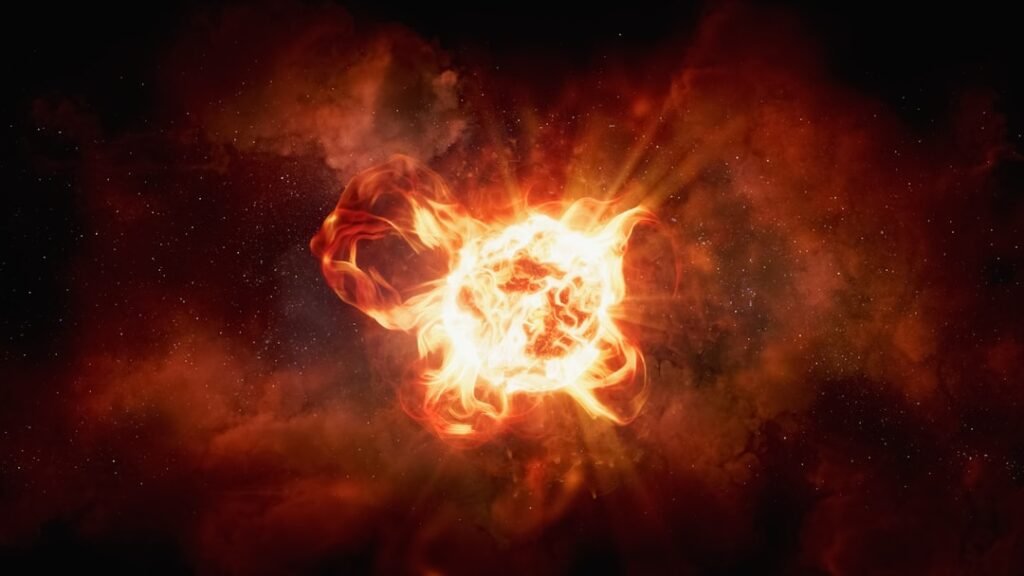

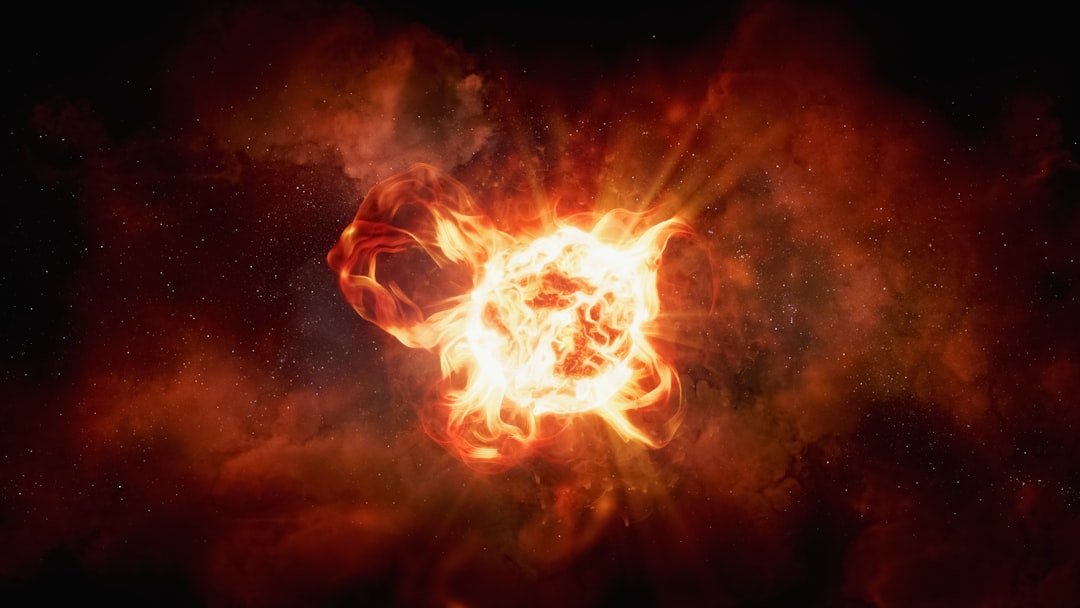
The Predictable Slowdown Across a Star’s Lifetime (Image Credits: Unsplash)
Stars begin their lives rotating rapidly, but over billions of years, they typically slow dramatically, often by factors of 100 to 1,000 compared to their initial speeds.[1] This process, known as spin-down, results from the loss of angular momentum as material escapes via stellar winds, much like the Sun has shed some of its own rotation through the solar wind. Recent advanced simulations, however, indicate that in the closing chapters of massive stars’ lives, rotation rates can defy this trend and even increase under specific conditions.
The Predictable Slowdown Across a Star’s Lifetime
Astronomers have long observed that stars lose rotational energy steadily from formation through much of their main-sequence phase. Magnetic fields generated within the star couple with ionized particles in outflows, effectively braking the rotation much as a skater pulls in their arms in reverse.[1] For our Sun, this has meant a gradual decline in total angular momentum over its 4.6-billion-year history.
These changes prove crucial for understanding stellar structure and evolution. Slower rotation influences convection patterns, chemical mixing, and even the eventual fates of stars, from white dwarfs to supernovae. Traditional one-dimensional models captured the broad trend effectively but struggled with finer details, particularly near the end.
Late-Stage Anomalies Challenge Old Assumptions
In the final phases of massive stars, as they burn heavier elements like oxygen and silicon in their cores, unexpected rotational shifts emerge. Observations hinted at inconsistencies: some stars appeared to rotate faster than expected just before core collapse, while others decelerated sharply. These discrepancies puzzled researchers, as core contraction alone would predict acceleration via conservation of angular momentum.
New evidence suggests external factors intervene. The cores of these stars can contract under certain conditions, prompting faster spins relative to outer layers. Yet, transport mechanisms within the star often counteract or amplify this, leading to varied outcomes.[2]
3D Simulations Uncover the Driving Forces
A team at Kyoto University developed sophisticated three-dimensional simulations to probe these dynamics during advanced nuclear burning stages. Their work focused on the interplay of convection, rotation, and magnetic fields in the oxygen-burning regions deep inside massive stars.[3] Over short timescales, convective motions – updrafts and downdrafts of hot plasma – interact with the star’s rotation and tangled magnetic fields.
The speed and direction of these flows shift under magnetic influences, redistributing angular momentum radially. In many cases, this drags the core’s rotation down alongside the envelope. Surprisingly, particular magnetic field geometries reverse the effect, transporting momentum inward and accelerating the core.[4] “We were surprised to discover that some configurations of the magnetic fields actually spin the core up, suggesting that the final spin rate will be unique to the star’s properties,” noted co-author Lucy McNeill. She added, “Slow rotation might even be forbidden in some classes of massive stars.”[3]
This finding emerged from detailed modeling published in The Astrophysical Journal.Study DOI The simulations highlighted how convection properties in the oxygen layer, combined with field strength and shape, dictate whether spin-up or spin-down dominates.
Key Factors Shaping Terminal Spins
Several elements emerge as pivotal in determining a star’s final rotation:
- Magnetic field geometry: Twisted or aligned fields alter momentum transport direction.
- Convection vigor: Stronger flows in oxygen-burning zones amplify effects.
- Rotation baseline: Initial core-envelope differentials set the stage for changes.
- Stellar mass: Though focused on massive stars, patterns may extend broadly.
These interactions occur rapidly, on scales of days to years, far quicker than earlier models assumed. The result challenges uniform predictions, implying diverse spin states at death.[5]
What This Means for Stellar Deaths and Beyond
Final rotation rates influence supernova explosions, neutron star births, and black hole formation. Faster-spinning cores could drive more asymmetric blasts or leave rapidly rotating remnants with unique pulsar behaviors. The Kyoto team’s work bridges gaps between solar-type star theories and massive star evolution, hinting at a universal framework for magnetic angular momentum transport.
Researchers plan expanded simulations across stellar masses to test generality. As computational power grows, these models promise sharper insights into the cosmos’s most violent endings. Ultimately, unraveling these spins deepens our grasp of how stars shape galaxies – and perhaps even the elements forging new worlds.