
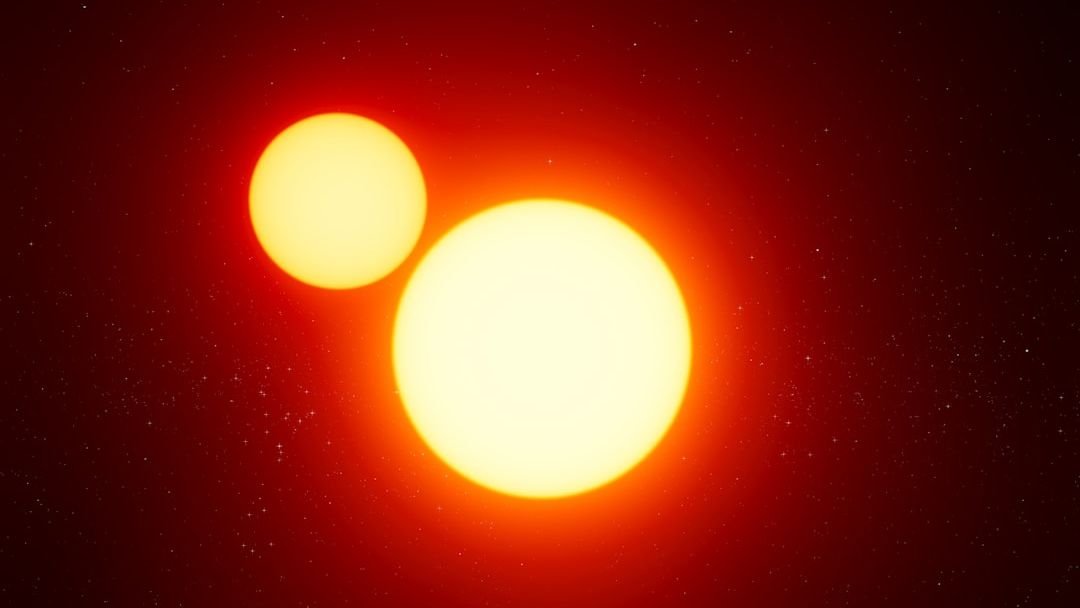
Gravitational Dynamics in Dual-Star Environments (Image Credits: Unsplash)
Stars rarely travel alone in the galaxy; roughly half exist in binary systems where two stars orbit a common center. A recent investigation by scientists at the University of Central Lancashire has uncovered evidence that these paired stars create conditions ripe for planet formation. Gravitational instabilities within the protoplanetary disks around binaries appear to drive more effective planet-building processes than those around solitary stars.
Gravitational Dynamics in Dual-Star Environments
Protoplanetary disks, vast rings of gas and dust encircling young stars, serve as the birthplaces of planets. In binary systems, the mutual gravitational pull of the two stars introduces complexities that researchers previously viewed as disruptive. The University of Central Lancashire study, however, demonstrates that these interactions trigger instabilities that clump material more rapidly.
Such clumping accelerates the aggregation of dust particles into larger bodies, a critical early step in planet formation. This mechanism contrasts with the steadier, slower evolution seen in disks around single stars.
Efficiency Gains Over Single-Star Disks
Simulations and models from the research highlight a key advantage: binary disks exhibit heightened gravitational instability. This leads to denser concentrations of material, fostering quicker transitions from dust to planetesimals. Single-star disks, by comparison, rely on gentler processes that proceed at a more measured pace.
The findings suggest that planets orbiting both stars – known as circumbinary planets – emerge under these favorable conditions. Observational data has already confirmed such worlds exist, but their formation pathways remained puzzling until now. The study provides a clearer picture of why they might form despite the orbital chaos.
Broader Implications for the Galaxy
Binary stars dominate the stellar population, numbering in the tens of billions across the Milky Way. If planet formation proves more efficient around them, circumbinary planets could outnumber those in single-star systems. This shift challenges earlier assumptions that binaries hinder planetary development.
Astronomers anticipate refined surveys to test these predictions. Telescopes like the James Webb Space Telescope continue to spot candidates, offering potential validation. The research opens doors to rethinking the distribution of habitable zones in dual-star setups, where stable orbits might support life-friendly worlds.
Still, uncertainties linger. Not all binaries behave identically; factors like separation distance and mass ratios influence disk stability. The study emphasizes these variables, urging further modeling to map the full range of outcomes.
Pathways Forward in Exoplanet Research
The University of Central Lancashire team’s work builds on growing evidence from exoplanet hunts. Past discoveries, such as those around Kepler-16, illustrated circumbinary planets’ resilience. This new analysis explains their origins through gravitational mechanisms rather than rare coincidences.
Future studies will likely incorporate advanced hydrodynamical simulations to probe edge cases. Observatories targeting young binaries could yield direct images of forming disks, bridging theory and observation. For now, the research underscores the galaxy’s diversity, where two stars together yield planetary abundance.
These insights remind us that cosmic companionship fosters creation on grand scales. As detection technologies advance, the true extent of circumbinary worlds may soon come into sharper focus, reshaping our view of the universe’s planetary tapestry. For more details, see the full report on Phys.org.