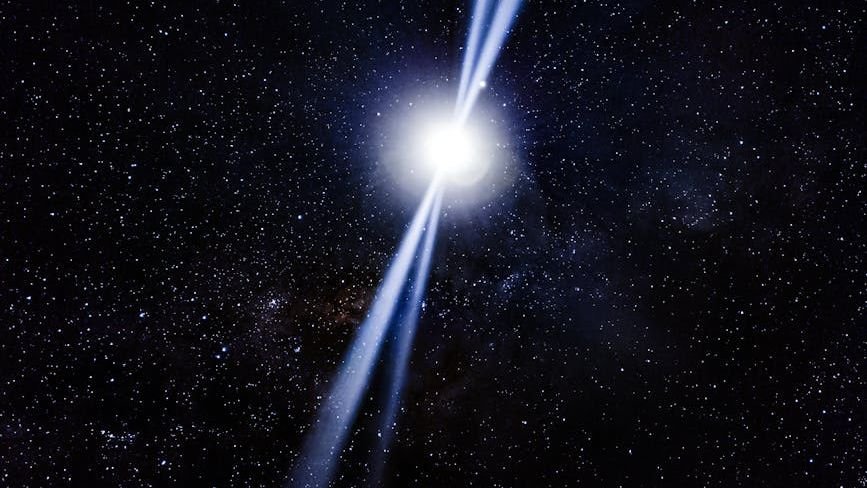
Unveiling the Quasar Pair (Image Credits: Pexels)
Discoveries like this one reshape how astronomers view the birth of massive galaxies, offering direct evidence of violent mergers that fueled the early cosmos. The Atacama Large Millimeter/submillimeter Array (ALMA) recently confirmed a close pair of quasars, designated J2037–4537, situated in merging galaxies just a billion years after the Big Bang. Observations detected a bridge of ionized carbon emission and dust linking the two, signaling an active collision that promises insights into supermassive black hole growth.
Unveiling the Quasar Pair
Astronomers targeted J2037–4537 after initial hints from other telescopes suggested something unusual. Quasars represent the brightest objects in the early universe, powered by supermassive black holes devouring surrounding gas at ferocious rates. This pair stands out for its proximity – far closer than typical quasar companions – within galaxies that appear to be slamming together.
The confirmation came through ALMA’s sensitive eyes, which excel at mapping cool gas and dust invisible to optical instruments. Such close encounters remain exceedingly rare, especially so soon after the universe’s dawn. Researchers noted the system’s redshift places it firmly in the first billion years, a period when the cosmos transitioned from smooth fog to structured webs of matter.
The Telltale Bridge of Gas and Dust
Central to the discovery, ALMA imaged a distinct bridge of [CII] emission – singly ionized carbon atoms glowing from interstellar regions – and accompanying dust between the quasars. This [CII] line serves as a key tracer for molecular gas, the raw material for star formation and black hole feeding. The bridge’s presence strongly indicates dynamical interaction, as tidal forces during the merger stripped material from each galaxy.
Dust in the bridge absorbs and re-emits light, further confirming the connection. Without this gaseous link, the pair might have appeared as isolated beacons. Instead, the structure paints a picture of chaos: galaxies distorting shapes, gas funneled toward central black holes, and stars likely bursting into life along the bridge.
Implications for Early Galaxy Evolution
This merger illuminates a critical phase when the universe’s largest structures assembled. Quasar pairs like J2037–4537 suggest that dual supermassive black holes co-evolved with their host galaxies, eventually coalescing into even more massive ones observed today. Mergers accelerated this process, injecting energy that cleared gas and quenched star formation in mature galaxies.
Previous surveys hinted at such systems, but firm evidence proved elusive until ALMA’s resolution. The finding aligns with simulations predicting frequent mergers in the dense early universe. Still, questions linger: How did these black holes grow so quickly? What role did the bridge play in sustaining their brilliance?
- Confirms ongoing merger via [CII] and dust bridge.
- Highlights rarity of close quasar pairs in first billion years.
- Supports models of rapid black hole and galaxy growth through collisions.
- Paves way for deeper studies of gas dynamics in primordial systems.
ALMA’s Power in Probing the Past
Located in Chile’s Atacama Desert, ALMA combines dozens of antennas to achieve unparalleled sensitivity at millimeter wavelengths. It pierces cosmic dust veils that obscure optical views, revealing hidden gas reservoirs. For J2037–4537, this capability turned suspicion into certainty.
Future observations may track the bridge’s evolution or detect binary black hole signatures. Astronomers anticipate more such pairs as ALMA surveys expand. The telescope continues to deliver breakthroughs, bridging the gap between theory and observation in cosmology.
This rare snapshot from cosmic dawn underscores the universe’s turbulent youth. As mergers like J2037–4537 unfolded, they sculpted the galactic landscape we see today, reminding researchers that today’s quiet cosmos emerged from early frenzy. Unresolved dynamics in such systems invite further exploration, potentially unlocking secrets of black hole origins.