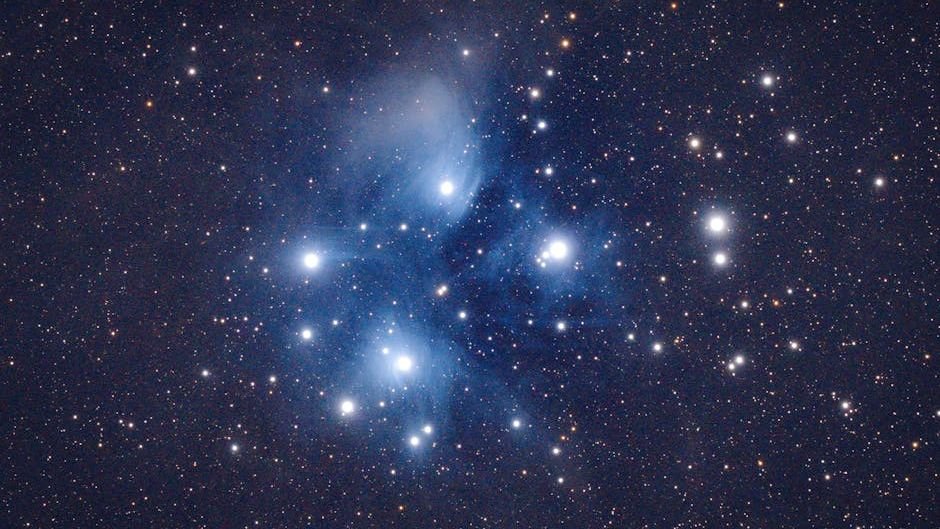
Stars Emerge from Gas Clouds in Ordered Batches (Image Credits: Pexels)
The mass of a star cluster precisely determines the heft of its most massive stars, astronomers have found, upending the idea that stellar sizes emerge purely from chance. Researchers from Nanjing University and the University of Bonn demonstrated that star formation operates via a tightly controlled self-regulating mechanism, ensuring consistent patterns across cosmic nurseries.[1][2] This discovery, detailed in a recent study, promises to streamline models of galaxy evolution by replacing random simulations with deterministic rules.
Stars Emerge from Gas Clouds in Ordered Batches
Galaxies birth their stars within dense clusters nestled in enormous gas clouds. These stellar nurseries produce a mix of diminutive red dwarfs and colossal blue giants, some reaching 10 times the Sun’s mass and shining 100,000 times brighter.[1] Yet massive stars burn hot and fast, collapsing into black holes or neutron stars after mere millions of years.
Observations revealed a striking pattern: the initial mass function, or IMF, describing stellar mass distributions, holds remarkably steady. Dwarf galaxies, limited by their scant total mass, never forge stars brighter than the Sun. In contrast, early-universe elliptical giants churned out billions of ultra-bright behemoths during furious bursts of formation.[1]
Challenging Randomness with Empirical Evidence
Two decades ago, Professor Pavel Kroupa of the University of Bonn and his doctoral student Carsten Weidner uncovered a key insight. They showed that a cluster’s total mass caps the size of its brightest star, contradicting models assuming independent random draws from the IMF.[1][2] Kroupa devised “optimal sampling” to predict stellar rosters from cluster mass alone.
This finding demanded an explanation for the underlying order. “When stars are formed from a gas cloud, their masses aren’t decided at random but follow a precise order that leaves no room for statistical fluctuations,” Kroupa stated. “This can only happen if the star-formation process is extremely self-regulating.”[1]
Shannon Entropy Unlocks the Mechanism
Dr. Eda Gjergo of Nanjing University provided the missing link by invoking Shannon entropy, a measure of information disorder from communication theory. She modeled star formation as a variational process seeking maximum entropy equilibrium – the most probable state, independent of fine-grained physics.[1][2]
“Out of all the possible mass distribution scenarios, what actually plays out is the one that’s the most natural for large scales and the least dependent on microscopic details,” Gjergo explained.[1] This framework proves the IMF arises deterministically, not stochastically, aligning theory with observations across cluster scales.
The approach recasts star birth as physics optimizing information flow, much like thermodynamics maximizes disorder. Co-author Zhiyu Zhang noted the findings will spur targeted telescope campaigns to probe this non-random process further.
Transforming Galaxy Evolution Models
Traditional simulations relied on thousands of random samplings per galaxy, devouring supercomputer resources. The new model requires just the stellar population’s total mass to forecast compositions precisely.[1]
- Dwarf galaxies skip massive stars entirely, reshaping matter cycle theories.
- Elliptical galaxies’ rapid starbursts now compute efficiently.
- Energy savings accelerate universe-scale predictions.
Kroupa highlighted the shift: “We now only need to have a number, namely the mass of the star population, in order to know what kinds of stars and how many of them will form from a gas cloud.” He added that small galaxies’ lack of giants demands revisions to cosmic chemistry models.[1]
A New Era for Stellar Astrophysics
This work, published in Research in Astronomy and Astrophysics (DOI: 10.1088/1674-4527/ae4600), builds on arXiv preprint 2601.20998.[1] It bridges microphysical chaos to macroscopic order, offering a unified view of star formation. As telescopes turn toward testing these predictions, astronomers anticipate refined maps of galactic histories and the universe’s elemental forge.
Ultimately, the self-regulating dance within star clusters underscores a profound cosmic efficiency – one where apparent randomness yields unbreakable laws.