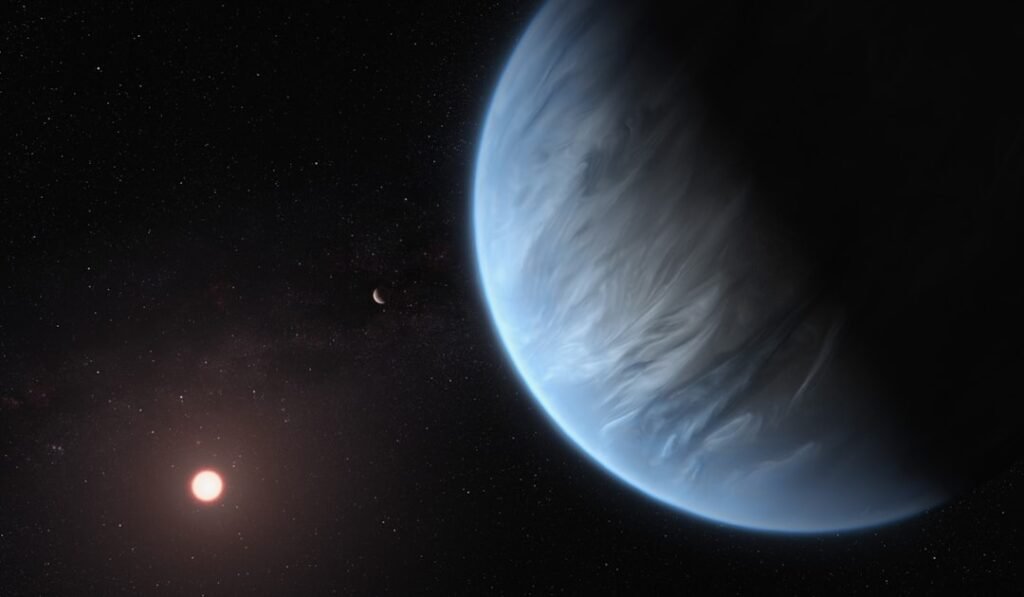
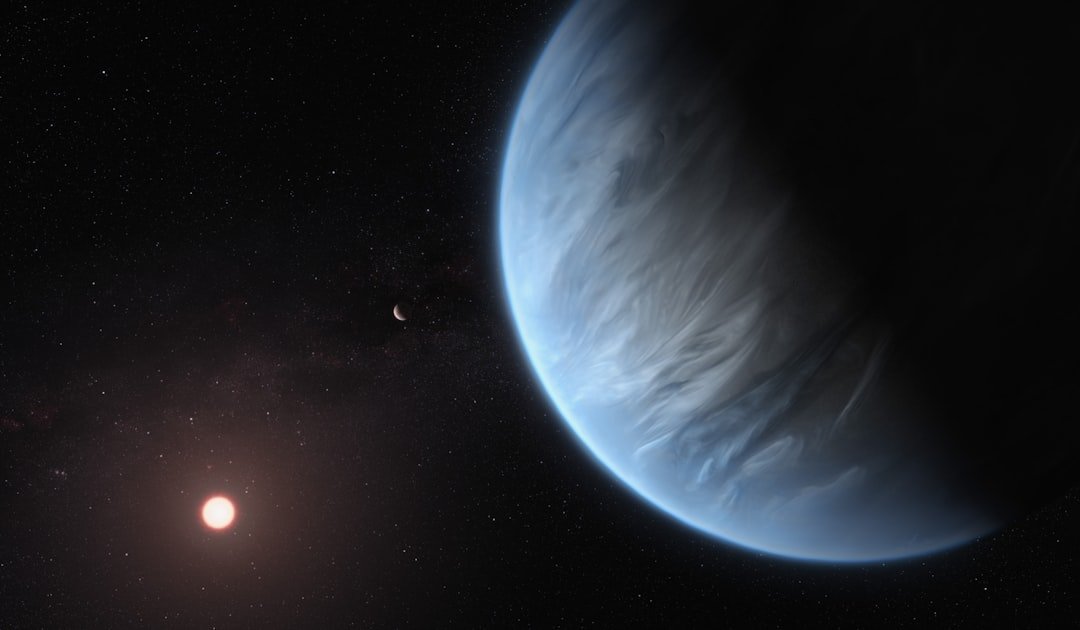
A Super-Jupiter Emerges Nearby (Image Credits: Unsplash)
Astronomers recently unveiled evidence of thick water-ice clouds enveloping Epsilon Indi Ab, a massive gas giant orbiting a star just 12 light-years from Earth. Observations from the James Webb Space Telescope marked this cold exoplanet as a prime example of a Jupiter-like world beyond our solar system.[1] The discovery highlighted the telescope’s ability to peer into the atmospheres of distant, chilly planets, offering clues about how such giants form and evolve.
A Super-Jupiter Emerges Nearby
Researchers first spotted Epsilon Indi Ab in 2024, but new James Webb data painted a clearer picture of its makeup. This super-Jupiter boasts 7.6 times Jupiter’s mass yet matches its diameter almost exactly.[1] Orbiting Epsilon Indi A – a star cooler and less massive than the Sun – at four times the distance Jupiter lies from our own star, the planet maintains a surface temperature between 200 and 300 Kelvin.
That warmth stems from residual heat left over from its formation, placing it slightly hotter than Jupiter’s 140 Kelvin for now. Over billions of years, though, Epsilon Indi Ab will cool further. Its proximity makes it the closest known cold gas giant, ideal for repeated study.[1]
James Webb’s Mid-Infrared Gaze
The James Webb Space Telescope’s MIRI instrument captured the planet through a coronagraph that blocked the host star’s glare. Scientists targeted wavelengths around 11.3 microns, revealing a bright point of light where Epsilon Indi Ab resides.[1] Earlier 2024 observations at 10.6 microns had confirmed ammonia in the atmosphere, a key marker for cold gas giants.
Follow-up photometry in 2026 showed weaker ammonia signals than models predicted. Thick, patchy clouds interfered with the light, much like Earth’s high-altitude cirrus layers. The Max Planck Institute for Astronomy team, including lead author Elisabeth Matthews, drove these efforts.[1]
Clouds Upend Atmosphere Models
Water-ice clouds topped an ammonia-rich layer, a combination that defied simpler exoplanet simulations. Current models often skipped clouds due to their complexity, but this evidence demands revisions.[1] “JWST is finally allowing us to study solar-system analog planets in detail,” Matthews noted.[1]
Collaborators from the University of Texas at Austin and the Space Telescope Science Institute contributed models and data analysis. Bhavesh Rajpoot, a Ph.D. student at MPIA, pointed out the planet’s greater mass despite its familiar size. James Mang from Texas added that such detections once seemed out of reach but now reveal atmospheric intricacies.[1]
| Feature | Epsilon Indi Ab | Jupiter |
|---|---|---|
| Mass | 7.6 Jupiter masses | 1 Jupiter mass |
| Diameter | Similar to Jupiter | Jupiter baseline |
| Orbit Distance | 4x Jupiter’s | 5.2 AU |
| Temperature | 200-300 K | 140 K |
Pathways to Earth-Like Worlds
This work builds on decades of exoplanet progress, from initial detections in the 1990s to JWST’s atmospheric deep dives since 2022. Cold Jupiters like Epsilon Indi Ab serve as benchmarks for understanding gas giant diversity.[1] The findings appeared in The Astrophysical Journal Letters, detailed in a paper led by Matthews (DOI: 10.3847/2041-8213/ae5823).[1]
Teams now seek more JWST time for similar targets. NASA’s upcoming Nancy Grace Roman Space Telescope, set for launch soon, promises sharper views of water-ice features. Such advances edge closer to spotting habitable worlds around other stars.
- Direct imaging blocked starlight for clear planet views.
- Patchy clouds mimicked Earth’s cirrus, scattering infrared light.
- Ammonia confirmation validated cold giant chemistry.
- Proximity (12 light-years) enables frequent observations.
- Models must now incorporate cloud dynamics.
Key Takeaways
- Epsilon Indi Ab hosts water-ice clouds over ammonia, reshaping exoplanet models.
- JWST’s MIRI unlocked details on cold giants previously too faint to study.
- Future telescopes will hunt Earth analogs using these refined techniques.
Epsilon Indi Ab stands as a cosmic mirror to our Jupiter, reminding scientists that alien atmospheres hold familiar yet surprising secrets. As tools like JWST push boundaries, the hunt for solar system twins intensifies. What do you think this means for finding life elsewhere? Share in the comments.